


 Francais
 Deutsch
 Italiano
Refine Your Search
F-86 stock footage and images
- Showing 2311 to 2316 of 2472 results more
more Hide
Hide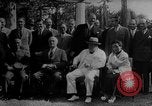
Mixture of scenes from Cairo and Teheran converences with glimpses of Soviet troops on the move and views of bombers and landing craft as well as an atomic test in the Pacific ocean.
Opening scene shows Chinese Generalissimo Chiang Kai-shek seated with U.S. President Franklin D. Roosevelt, British Prime Minister Winston Churchill, and Madam Chiang in their Cairo meeting at a residence of the American Ambassador to Egypt, Alexander Kirk, on November 25, 1943, during World War 2. Foreign ministers of the countries stand behind their leaders. Closeups of the three Country's leaders. Scene jumps to Teheran, with Soviet Leader, Joseph Stalin, President Roosevelt, and Prime Minister Winston Churchill, seated on a veranda of the Soviet Embassy. Suddenly scenes of tanks, trucks, and Soviet troops moving on the Eastern front are seen. Some of the troops move by horse-drawn sleighs through the snow. A line of U.S. Army Air Forces B-17 bombers taxiing on an airfield. View from a B-17 in flight. View f as a cluster of bombs falls from B-17 and explodes on the ground. Animated map illustrating paths of aircraft attacks against the German Atlantic Wall from England. Landing craft underway in an amphibious assault. Brief view from a ship of a post-war test atomic explosion in the Pacific ocean
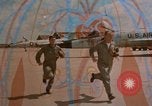
U.S. Air Force film advocating physical training and good fitness like walking, cycling, swimming and sports in the United States.
Discussion of United States Air Force (USAF) Aerobic physical fitness programs and its benefits in the United States. U.S. air force pilots scramble at air base and are seen running to their Convair F-102 Delta Dagger aircraft parked in a line. The pilots quickly enter the aircraft. Dramatization of Air Force pilot landing in jungle with parachute and evading capture due to good physical fitness condition. Off duty situations involving physical exertion: Two men pushing a stalled car. A man in front yard of house in suburban neighorhood is shoveling sand and lifting a heavy sand bag. Depiction at night of phone ringing and man wakes up and talks on phone. Cars drive on highway. An exhausted man suffering heart attack is sitting in car. Heart attack patients lying on beds in a ward of a hospital. A nurse assists a patient with recovery and therapy. Two women ride bicycles and men swim in a swimming pool for exercise. People exercise in a gym and use weight lifting equipment and exercise machines. A man running and playing tennis. Personnel doing aerobic exercises like walking, running, cycling, swimming, stationary running, playing hand ball, tennis, basketball and squash for physical fitness.
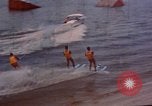
General John D Ryan requests that all Air Force personnel should participate in physical fitness programs in the U.S.
United States Air Force (USAF) Aerobic physical fitness programs and its benefits in the United States. Scenes of people doing water skiing, surfing, swimming, mountaineering and rock climbing. John F Kennedy's statement: 'Physical fitness is the most important key of helping body it is the basis of dynamic, creative and intellectual activities'. Personnel climb up and sit atop mountains. General John Dale Ryan, Chief of Staff of U.S. Air Force speaks about that USAF consists people and equipment to evaluate the performance of personnel and conducts aerobic physical fitness programs. He closes with a request that all air force personnel should participate in the program for world wide mission requirements.

Chief Justice of Supreme Court, Earl Warren and other judges pose in the United States.
U.S. Supreme Court Justices of the 1953 session. Group showing Felix Frankfurter, Hugo Black, Chief Justice Earl Warren, Stanley F. Reed, William O. Douglas, Tom C. Clark, Robert H. Jackson, Harold H. Burton and Sherman Minton, posing for the camera. Views of them as they talk.
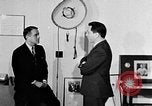
R. Sargent Shriver shows articles collected from various nations as he prepares to leave his office in Washington DC.
Director of Peace Corps Robert Sargent Shriver in Washington DC. Robert Sargent Shriver, Jr. is interviewed. He is questioned about pictures and sovereigns as he prepares to leave his office. Pictures and sovereigns in the office. Sargent Shriver removes a Mexican sombrero and a whip from a wall and tells the interviewer how he obtained it. He shows a wooden stick which was used and presented by the chief of a tribe of West Africa. An ebony cane received from northern Nigeria. He shows the Magsaysay Foundation Award for the work done by United States Peace Corps in Asia. He shows the White House pen which was used by former U.S. President John F. Kennedy to sign the Peace Corps Act on September 27, 1961 with the President's autograph. Sargent shows a framed letter by the parents of the first Peace Corps volunteer to die abroad. He reads out the letter.
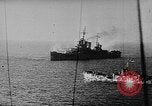
Allied Naval task forces combine efforts in Battle of Okinawa during World War II
Roles of U.S. Navy Task Force 58 and British Task Force 57 during the Battle of Okinawa in World War 2. An LCI (Landing Craft-Infantry) passes in front of the heavy cruiser USS Wichita (CA-45) as it fires its heavy guns. Explosions on Okinawa. Glimpse of Battleship USS Iowa (BB-61) in marine camouflage paint. Naval gun barrels firing and shells exploding on Okinawa. The USS LSM(R)-190, a Landing Ship Medium (Rocket) is seen firing barrages of rockets at Okinawa. Closeup of the rocket pods firing. At time 00:18-00:20 the U.S. heavy cruiser USS Minneapolis,CA-36 is seen firing her main battery. Numerous views of shells bursting on the ground. More views of rocket firing landing ships, with more closeups of the rocket pods firing. Change of scene to the south, where the battleship HMS King George V, flagship of Task Force 57, and battleship HMS Howe, are seen bombarding Japanese air installations on Formosa. British Navy Marlett fighter planes (equivalent to U.S. F4Fs) in formation flight. Anti-aircraft gunfire from British aircraft carriers and other warships. Closeup of British multiple Pom Pom gun batteries firing.