


 Francais
 Deutsch
 Italiano
Refine Your Search
F-86 stock footage and images
- Showing 2353 to 2358 of 2472 results more
more Hide
Hide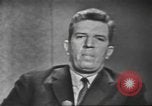
Kennedy and Nixon comment on the Indochina War, Quemoy and Matsu islands, and U-2 flights during their third debate.
Nixon and Kennedy debate questions regarding relations with Communists during the third Kennedy-Nixon Presidential Debate in the United States. Douglass Cater of Reporter magazine asks Republican candidate U.S. Vice President Richard M Nixon to comment whether there was a valid criticism of his statement of foreign policy. Nixon answers and states that the criticism is not valid. Regarding Indochina, he says that the U.S. would not have tolerated Indochina falling under Communist domination. And as a result of that the civil war there ended. He states that he supports the President's position and thinks that the President was correct in ordering the U-2 flights. Referring to Quemoy and Matsu he states that he objects to the constant reference to surrendering these islands. Democratic candidate Senator John F Kennedy disagrees with Nixon's statement on Indochina and states that reason Indochina was preserved was the Geneva Conference. On the question of the U-2 reconnaissance aircraft flights he states that he has never criticized them and never suggested stopping of espionage. On the question of keeping the Communists in doubt about the U.S. defending Quemoy and Matsu he states that the U.S. should meet its commitments to Formosa (Taiwan) and the Pescadores. He concludes by saying that he disagrees with Nixon as Nixon is extending the administration's commitment.
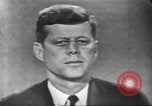
Kennedy and Nixon talk about racial prejudice in the presidential campaign during a presidential election debate in the U.S.
The third Kennedy-Nixon Presidential Debate in the United States. Roscoe Drummond of New York Herald Tribune asks Democratic candidate Senator John F Kennedy to comment on the purpose of the secret domestic militant organization Ku Klux Klan (KKK) in the presidential campaigns. Kennedy answers that the head of the Ku Klux Klan in a statement stated that he would vote for Nixon and not him. Kennedy states that he has never suggested that Nixon has slightest sympathy and involvement with the Ku Klux Klan. Republican candidate U.S. Vice President Richard M Nixon states that it is the Americans who will choose the President. He states that elections are not any test of religion, race but test of a man. He states that Communism is the enemy of all religions and he opposes the Klan organization. He concludes, early in the civil rights movement, that if civilians believe in America they cannot have religious or racial prejudice in the presidential campaign.
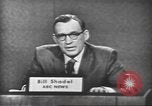
John Kennedy and Nixon talk about steps to improve U.S. economic growth during a presidential election debate in the U.S.
The third Kennedy-Nixon Presidential Debate in the United States. Roscoe Drummond of New York Herald Tribune asks Republican candidate U.S. Vice President Richard M Nixon to comment on declining economic growth and what steps he would take to improve it. Nixon answers that he is not satisfied with the economic growth of the U.S. He compares the nation's growth rate during the Truman Administration and the Eisenhower Administration. He urges for the development of private enterprise sector of the economy. He talks about his program of tax reform which would stimulate more investment in U.S. economy. He talks about the upliftment of the distressed areas and full utilization of resources of those areas. He talks about the adequate use of talents of the Americans and their civil rights. He concludes and states that there has been a continuous development of American economy in the past years. Democratic candidate Senator John F Kennedy states that Nixon has pointed a rise in food prices in his proposed agricultural program which is not true. He comments on the statement given by Nixon on aiding distressed areas and education. He says that the bills of these program have been opposed by the administration. He talks about the lowest rate of economic growth during this administration.
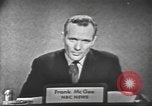
Senator Kennedy and U.S. Vice President Nixon debate on oil depletion allowance during presidential election debate in the U.S.
Presidential election debate held between Democratic nominee Senator John F. Kennedy and Republican nominee U.S. Vice President Richard Nixon in the United States. NBC correspondent Frank McGee asks Senator Kennedy if he considers twenty-seven and a half per cent oil depletion allowance inequitable. Senator Kennedy responds stating that there are many commodities and minerals that have some kind of depletion allowance including oil and no one should get a tax break on the same. He says that if he is elected the president, the whole spectrum of tax will be gone through carefully. ABC correspondent Bill Shadel asks Vice President Richard Nixon to speak on the topic. Vice President Nixon says he favors the present depletion allowance. He further says that if there is no depletion allowance oil exploration will be cut substantially in the United States.
The third presidential election debate between Senator John Kennedy and U.S. Vice President Nixon in the United States.
The third presidential election debate held between Democratic nominee Senator John F. Kennedy and Republican nominee U.S. Vice President Richard Nixon in the United States. ABC news correspondent Von Fremd questions Vice President Richard Nixon about exodus of four billion dollars of gold in past three years from the United States. Vice President Nixon responds stating that there should be balanced budget in the country and increase in exports from the United States. He further says that the U.S. must support programs abroad for economic and military assistance. Senator Kennedy speaks about oil depletion. He further talks about gold. He says that United States have to maintain balance of trade, sound monetary and fiscal policy and control over inflation.
John Kennedy and Nixon debate over the prestige of America prior to the presidential elections in the United States.
Presidential election debate held between Democratic nominee Senator John F. Kennedy and Republican nominee U.S. Vice President Richard Nixon in the United States. New York Herald Tribune newspaper correspondent Roscoe Drummond asks Senator Kennedy that how can American prestige be measured abroad. Senator Kennedy responds stating that America is identified with the cause of freedom and if other countries have to choose between America and a Communist country, they would choose America. He further speaks that there are many indications that prestige of the United States is not as high as it once was. Kennedy summarizes some of these indications and relates to it by mentioning the example of Sputnik space program by the Soviet Union in 1957 (during the Space Race). Kennedy speaks about the economic development of the Soviet Union. He says the Soviet Union will be ahead of any other country scientifically and militarily by 1970. He mentions votes by different countries in the United Nations dealing with Red China. He says that Guinea and Ghana, two independent countries now are supporting Soviet foreign policy at the UN. NBC correspondent Bill Shadel asks Richard Nixon to speak on the topic. Vice President Nixon responds by speaking about the economic development of the Soviet Union. He speaks that the Soviet Union is a very primitive economy and that the United States is well ahead economically. He says that if the United States is going to maintain its strength and its prestige, they must not only be strong militarily and economically but must be firm diplomatically also. Bill Shadel says that an entire hour was devoted to answering questions from the reporters. He says that each candidate was questioned in turn and each had the opportunity to comment on the answer of his opponent. Shadel says that the reporters were free to ask any question on any subject, neither candidate was given any advance information on any question that would be asked. He says that the fourth debate is scheduled for Friday, October twenty-first.