


 Francais
 Deutsch
 Italiano

Refine Your Search
F-86 stock footage and images
- Showing 2407 to 2412 of 2476 results more
 Hide
Mixture of arctic scenes, from the ground and the air, including some from the Byrd expedition Fokker aircraft during its flight to the North Pole
Views of arctic terrain, with waves crashing against shore and leaving frozen hills of ice and snow. Closeup of waves. Sea ice glistening in sunshine. Brief views from the cockpit of the Fokker F-VII Tri-motor airplane, the "Josephine Ford," while Richard Byrd and Floyd Bennett occupied it during their flight to the North Pole in 1926. (Neither occupant is seen.) The views include glimpse of underside of wing; engine parts in the open; and engine crankcase covered with frozen oily sludge. Views appear limited by restricted visibility from the cockpit. Clip concludes with several views downward to the frozen arctic wasteland below.
Richard Byrd and Floyd Bennett return from North Pole in Fokker Tri-motor airplane, the "Josephine Ford."
Animated map illustrates the flight course of Lieutenant Commander Richard Byrd and pilot Floyd Bennett, as they return to Kings Bay, Spitsbergen, Norway, from the North Pole, aboard their Fokker F-VII Tri-motor airplane, the "Josephine Ford." Pilot Floyd Bennett is photographed (by Byrd) in full arctic gear, at the controls of the airplane. View from the cabin of the Kings Bay encampment below. View from the ground, of Byrd and Bennett's Fokker aircraft, as it flies over the mooring mast of the Norwegian airship Norge. Next, steam issues from the ship's horn on the funnel of the SS Chantier, as she welcomes the aviators back from the Pole. Expedition team members wave and toss their hats in joy, as the aircraft approaches to land. The Fokker on final approach, with huge snow mountains behind. It touches down in front of the Norge airship hangar (between the hangar and the bay) and turns left, to taxi.
Amundsen-Ellsworth arctic polar flight, in airship Norge, gets underway from Spitsbergen, Norway
Norwegian explorer, Ronald Amundsen steps from the Byrd expedition aircraft (Fokker F-VII Tri-motor airplane, the "Josephine Ford") with navigation instruments in his hands. These are gifts from Lieutenant Commander Richard Byrd, to assist Amundsen and Ellsworth on their imminent arctic flight aboard the airship Norge. Byrd in Navy uniform, and Michael J. Brennan, U.S. Merchant Marine, Captain of the SS Chantier, follow Amundsen out of the airplane. Byrd joins Amundsen and they converse briefly. Then Captain Brennan examines some charts with Amundsen. Byrd holds a special sun compass invented by Albert H. Bumstead, chief cartographer of the National Geographic Society, and explains it to Lincoln Ellsworth, who then takes it in hand and manipulates it. Next event shown is on morning of May 11, 1926, as Byrd and Bennett take off, in the "Josephine Ford," in front of the parked airship, Norge, to provide a courtesy escort for the airship as it gets underway. Their plane is seen flying overhead as ground crews prepare the Norge for departure. Next, the Norge is seen rising vertically from the ground. Viewed from the Kings Bay dock the Norge is seen aloft in the distance. Aerial view, fairly close, of the Norge underway (presumably taken by Byrd, from his airplane).
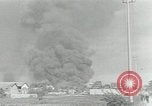
French fire fighters extinguish fires near Paris after British Royal Air Force attack on a German controlled Renault factory
Huge smoke rises from a building in Paris, France. Fire and smoke rises from the Great Palace. Damaged Renault factory destroyed by British R.A.F. shells. Vehicles and French civilians on a street. Fire fighters spray water on the burning buildings. Burnt building structure with debris on the ground. Among the ruins is a portion of an entrance way still standing with words on it "St. Pierre des Corps. Entree de Gare". (World War II period).
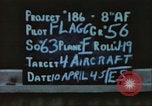
P-47 of U.S. 8th Air Force, 63rd Fighter Squadron, strafes German airfield near end of World War II.
Allied air operations near end of World War 2, in Europe. Gun camera footage from a P-47M of the U.S. Army Air Forces 8th Air Force, 56th Fighter Group, 63rd Fighter Squadron, strafing German aircraft on the ground at an airfield in Germany. The pilot is Captain Walter L Flagg, of Conimicut, Rhode Island. He is flying P-47M, Number: 44-21140, UN-F, "Shoot You're Faded". Burning German aircraft on the ground. Aerial view of bomb damaged city.
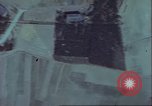
P-47, of U.S. 8th Air Force, 63rd Fighter Squadron, strafes Stendal Airfield, Germany, in final days of World War II in Europe
The Allies exercise air superiority over Germany in final days of World War 2. Gun camera footage from U.S. 8th Air Force P-47M, Number 44-21160, UN-F, "Devastatin' Deb, flown by Capt. John C Fahringer, Lima, Ohio. assigned to the 63rd Fighter Squadron of the 56th Fighter Group. He strafes German aircraft and hangars at Stendal airfield, near Berlin, Germany. Burning aircraft in front of a hangar.