


 Francais
 Deutsch
 Italiano
Refine Your Search
Florennes Belgium 1945 stock footage and images
- Showing 175 to 180 of 6929 results more
more Hide
Hide
Opening statement of the prosecution at the Nuremberg Trials; flashback scenes of Nazi crimes and starving civilians in 1945
Events related the Nuremberg Trials held at the Palace of Justice in Nuremberg, Germany. Flashbacks of a variety of Nazi crimes against humanity during World War II. Europe during 1945. War devastation: buildings and cities laid in waste, people in hunger and despair emerge from shelters searching for the causes of the war and of the immediate human suffering. Deprived children and adults weep, starve and beg on the streets. November 21, 1945, Nuremberg, Palace of Justice, seat of the International Military Tribunal. List shows the names of the convicted Nazi criminals. Chief prosecutor from the United States, Robert Houghwout Jackson, makes the opening statement of the prosecution. He presents Count 1 of the indictment a conspiracy to commit war crimes and crimes against peace and humanity. He makes the statement that criminals who have done injustice to the laws of humanity must be brought to justice. Stenographers wearing headphones take down notes. Defendants stand in their dock including Herman Goring, Rudolf Hess, Joachim von Ribbentrop, Wilhelm Keitel, Karl Donitz, Erich Raeder, Baldur von Schirach and Fritz Sauckel. Faces of the convicted criminals. Scenes from mass burial of victims from German bombing of Coventry, England. Scenes from the end of World War 2, with women weeping and civilian victims of war in Europe, including Germany, seen scavenging on streets for food. Women and hungry children scrape out trash cans and metal lids for bites of food. Desperate civilians cut down remaining tree stumps from formerly tree-lined streets to use for fuel. A group of men and women struggle in a food relief line in Italy.

French General Charles de Gaulle is feted in Chicago during his visit to the United States in 1945
Film opens showing people in an American city (possibly Chicago) celebrating the Allied victory over Japan on VJ Day, August 15th, 1945. Scene shifts abruptly to Chicago, Illinois, where French General Charles de Gaulle is seen saluting in a reviewing stand at Victory Plaza near Lasalle Street entrance to City Hall. (On August 24th, he had accepted an invitation from Mayor Edward Kelly to stop in Chicago on August 27-28, 1945, during his visit to the U.S. and Canada.) Next, general de Gaulle and Mayor Kelly are seen in an open car in a motorcade amidst crowds of well-wishers. Enthusiastic spectators run along side their car. Glimpse of a dense crowd of people, including a contingent of sailors in dress whites. Final scene shows General de Gaulle speaking with reporters and photographers near a sign reading "W-G-N." (A Chicago radio station). (World War II period).
German war criminals are executed by Allied occupying forces in 1945, in World War 2
View from above, of the surrounding walls and courtyard of a prison in Rheinbach, Germany. Ground view inside the prison yard, where German civilian Matthias Gierens is being escorted to the gallows by U.S. military police, and accompanied by a German Catholic priest, on June 29, 1945. They ascend the gallows and final charges and sentence are read to Gierens. Next scene shows bodies stacked up at the Bergen-Belsen concentration camp operated by Nazi Germany. Scene returns to the gallows, and a hood is placed over Gierens' head. View of Allied army officer witnesses, in formation, at parade rest. Noose is placed over Gierens' hood. View of a a bird flying overhead, trapdoor opens, Gierens drops, and noose tightens. Next is an unrelated scene of several German soldiers being executed. They are seen hanging from four gallows in a line in a public square while a large crowd, possibly Soviet citizens, looks on. (Notes: Regarding the execution of Gierens in the opening scene: German civilian Matthias Gierens was a 37 year old railroad worker. He was executed for the August 15, 1944, murder near Priest, Germany, of a downed American airman, who was later identified as U.S. Army Air Forces 2nd Lieutenant Lester E. Reuss. Gierens and three other German civilians, Peter Kohn, Peter Back, and Matthias Krein, were convicted on June 2, 1945 in Ahrweiler, Germany, of the murder. Their trial was the first Allied trial in Germany of civilians charged with a war crime.)
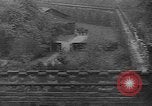
Men, women and children civilians killed by German soldiers in Stavelot, Belgium during World War II Battle of the Bulge
Civilians including men, women and children killed by Nazi soldiers in Stavelot, Belgium during World War II. Caskets with the dead bodies. Lumps of dead bodies at a place of shelter blown by Nazis (the civilians had taken refuge in basements and the Nazi soldiers had thrown grenades into the basements). Frozen dead bodies of women and small children. A woman weeps. Common grave for burial of all victims. Man brings stiffened dead body of a small child. A man checks names of the dead and priest says last prayers before burial.
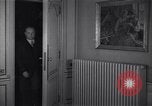
Ambassador Joseph E. Davis and Prime Minister Spaak in a meeting at American embassy in Brussels in Belgium
Belgian Prime Minister Paul-Henri Spaak arrives for a meeting with American Ambassador, Joseph E. Davis at the Ambassador's office at the American embassy in Brussels in Belgium. They look at papers and discuss. They also look at some pictures of a plane. Ambassador Davis meets representatives of assemblers of American Automobiles. They are introduced by Miss Francis E. Willis. The embassy staff is also present at the meeting.

International Inventors Exhibition at Brussels in Belgium
International Inventors Exhibition at Brussels in Belgium. The items on display include a folding desk to foil a robber, and a cord-less electronic phone. A hand sized sewing machine and a table made of several tables are also seen in the exhibition.
CRITICALPAST.COM: About Us | Contact Us | FAQs - How to Order | License Agreement | My Account | My Lightboxes | Shopping Cart | Advanced Search | Featured Collections | Website Terms & Conditions | Privacy Policy ©2026 CriticalPast LLC.
License Agreement |
Terms & Conditions |
Privacy Policy
©2026 CriticalPast LLC.