


 Francais
 Deutsch
 Italiano
Refine Your Search
Fort Oglethorpe stock footage and images
- Showing 469 to 474 of 739 results more
more Hide
Hide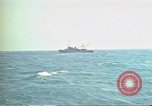
William A. Guest with others aboard a landing craft in the Mediterranean Sea during aircraft salvage operations.
Salvage operations in the Mediterranean Sea by a U.S. ARS (Salvage Ship) after 1966 Palomares B-52 crash incident. An ARS underway. A large group of civilians and USAF (United States Air Force) personnel in the hold of an LCM (Landing Craft, Mechanized). Cameramen and reporters tour the search area with U.S. Deputy-Commander Strike Force South Rear Admiral William A Guest on board LCM. Rear Admiral Guest talk to the reporters. Rear Admiral Guest in a long, leather coat points out matter to the reporters. USS Fort Snelling (LSD-30) in the background. Photographers take pictures of USS Fort Snelling.
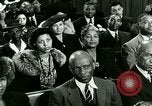
Film illustrating participation of African Americans in U.S. history from Colonial times to after the Civil War
Opening scene shows African American congregation in church, during World War 2, listening to their preacher speak about liberty. Closeup of the Minister speaking. As he refers to the seed of Liberty taking root in Boston, a plaque on the gate of the Granary Burial Ground of 1660 is shown reading: "Within this ground are buried the victims of the Boston Massacre, March 5, 1770." The gate swings open revealing the cemetery. Next, an illustration of British Redcoats shooting into a crowd on that occasion is shown. Closeup of the illustration shows an African American, named Crispus Attucks, falling as the first victim of the gunfire. A monument to him on Boston Common, is then shown. Closeup of the monument. Excerpt from a film about the Revolutionary War shows reenactment of the battle off Concord. The 221-foot granite obelisk at Bunker Hill, Boston, is seen, marking the site of the first major battle of the American Revolutionary War. A musket is seen with a sign attached reading: "Gun belonged to Peter Salem, a colored man who carried it at Lexington, Concord, and Bunker Hill, and with it shot Maj. Pitcairn." (Refers to Major John Pitcairn, a Scottish Marine officer, killed at the battle of Bunker Hill.) Illustration and painting of Peter Salem with his musket in the company of other patriots, is shown, as well as a glimpse of a mass reenactment of the battle of Bunker Hill. Next is seen the famous 1851 oil-on-canvas painting of Washington Crossing the Delaware, by the German American artist Emanuel Gottlieb Leutze. Closeup of one oarsman, identified as African American, Prince Whipple. Film Reenactment of the ragtag American army at Valley Forge in the snow, shows their suffering. Among them is an actor in the role of African American, Salem Poor, who had purchased his freedom from slavery and fought with Washington's army. A bell ringing and the American flag of 13 stars signifying the 1776 Victory. Film reenactments of pioneers including whites and African Americans working together, felling trees and building forts and barns, and the like. Scene shifts to a man of war ship under sail firing a salvo from its cannons. This is followed by illustrations of Commodore Perry in the battle of Lake Erie, during the War of 1812. In a dory with Perry is a black man named Tyler Thompson. War ships exchange gunfire. Narrator cites Perry's famous words of victory: "We have met the enemy and they are ours." Scene shifts to a painting of American general Andrew Jackson and his troops, at the Battle of New Orleans, in 1815. A battle reenactment shows a black American soldier participating. Postwar view of American ship building activity. View of a large sailing vessel. Cannon fire ushers in the Civil War in 1861 as Confederates fire on Fort Sumter. Images of combat are overlaid by the statue of Abraham Lincoln in his memorial at Washington, DC. Next, settlers are seen heading West in a wagon train. Camera focuses on a black couple who are part of the wagon train. White and African American men work side-by-side building a railroad. An early steam locomotive races along the tracks. .
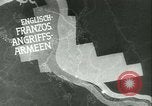
Scenes related to military readiness of Britain and France to face Nazi Germany at the onset of World War II
A montage of scenes related to British and French military readiness to face the threat of Nazi Germany at the onset of World War 2. An animated map depicts the disposition and status of belligerents on either side of the Maginot Line. Panoramic views of the Maginot Line. French troops double-time march out of the 'Caserne-Maginot' (Maginot Barracks) to take up their duty stations inside the Maginot Line forts. The soldiers are carried to their respective positions by subway cars underground. They are seen at work underground, tending one of the engines supplying electric power to the forts; stacking artillery shells; using pneumatic message devices and other communications; and preparing food. Some sing and dance Russian-stye. A slate in French reads: 'We Shall Win Because We Are The Strongest'. An animated map depicts France's and Britain's Colonial empires and their collective participation in defense of the Allies. British, French and Colonial troops parade in displays of military readiness. Some are seen parading before the Arc de Triomphe (Arch of Triumph) on the Champs Elysees in Paris, France.
U.S. 3rd Infantry Regiment pallbearers fold a U.S. flag during the funeral of General Jacob Devers in Arlington, Virginia
United States Army 3rd Infantry Regiment also known as 'Old Guard' during the military funeral of General Jacob Devers at Fort Myer in Virginia, United States. Horse drawn caisson carriage enters the gates of the Arlington National cemetery. The Old Post Chapel at Fort Myer visible behind. U.S. 3rd Infantry Regiment pallbearers fold the American flag over the casket. An officer presents the flag to the widow of General Jacob Devers. A sign on a gravestone reads 'Devers'.
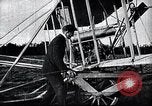
Launch of Wright plane in North Carolina on 17 December 1903 and in Virginia on 09 September 1908, United States.
Launch of Wright plane in North Carolina on 17 December 1903 and in Virginia on 09 September 1908, United States. Wibur Wright places wheels beneath wing on Kill devil hill, Kitty Hawk, North Carolina, United States. Wright plane takes its first flight after launch. Flight of plane in France. Two men pull props through on the Wright aircraft. Frenchmen stand and watch Wilbur Wright who makes adjustment on aircraft engine. Launching tower at right. Wright plane launches by catapult in France. Civilians and officers attend the air show. Wright plane passes overhead. Flight of Wright plane in United States. Orville Wright and Lieutenant Lahm sits on control section of the plane. Wright plane launches by catapult launch track at Fort Myers in Virginia on 09 September 1908. Plane in flight at Fort Myers. Spectators watch the plane. Army personnel move the Wright plane across open terrain they remove hangar doors from storage building. Army personnel grouped around the Wright aircraft. President Taft stand along the spectators. President Taft walk through spectators.
German forces plan and attack at Liege, Belgium in World War 2
Sand table animation shows plan of attack on Liege. Point of application for initial thrusts is Fort Eben Emael on border of Belgium and Netherlands. Map illustrates bombardment fron the air by the Luftwaffe (German Air Force). River Meuse and the Albert canal in the city. Bridge on the river. First line-the Ijssel position, second line-the Grebbe position, third line-the the Meuse position, fourth line- the Peel position. Fifth line-the Willem canal fortification and sixth line-the Albert canal fortification. Soldiers move in trucks on the street. German assault and shock troops use rubber boats with ladders to cross river Meuse under fire. Mechanized German infantry and bicycle contingents cross river Meuse over bridges not destroyed. Houses and buildings alongside the street. Soldiers fire guns in field. Smoke arises due to the firing. Soldiers at a boat in the waterway. Destruction of Werk 4 bunker fortification at Fort Eben-Emael. Wreckage from bombardment. Heavy smoke arises from firing and bombardment. Captured Dutch and Belgian Prisoner of War soldiers walk on the street under guard of German soldiers during German occupation. (World War II period).