


 Francais
 Deutsch
 Italiano
Refine Your Search
Fort Oglethorpe stock footage and images
- Showing 475 to 480 of 739 results more
more Hide
Hide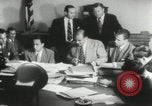
U.S. Senator Joseph McCarthy and Major General K.B.Lawton, at a press conference in New York City
Senator Joseph McCarthy, Chairman, Senate Subcommittee, investigating Army Signal Corps Subversion and Espionage at Fort Monmouth, during a press conference at the Federal Building in New York City. He is accompanied by Major General K.B Lawton, Commanding General of Fort Monmouth (in civilian clothes). Journalist asks Senator McCarthy about the outcome of the investigations into leaked information. McCarthy discusses suspensions of employees at Forth Monmouth due to communist activities and involvement with communism and espionage.
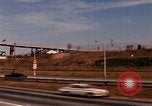
Verrazzano Bridge between Brooklyn and Staten Island, New York
View of cars driving West along the Belt Parkway, approaching the exit to the Verrazzano bridge, adjacent to Fort Hamilton, Bay Ridge, Brooklyn, New York City. Views of traffic on the bridge and across the Narrows to Fort Wadsworth, on the Staten Island (Borough of Richmond) side of the bridge. The only vehicles seen on the bridge are two trucks headed North toward Brooklyn on the upper deck (The lower deck has not yet been opened to traffic.) A ship is seen moving under the bridge as it enters the upper bay heading toward New York harbor. Work barges are seen near the bridge pier, as construction work is still in progress. (Note: The Verrazzano Bridge is the longest suspension bridge in the United States.)

Various experimental and prototype U.S. Air Force aircraft being developed and tested at Wright Field in Ohio.
Models and drawings of futuristic planes in the Air Force Laboratories at Wright Field, Ohio. Scenes of XP-67 aircraft in flight. A Northrup N9MB Experimental Flying Wing aircraft taxiing and in flight. A larger version, the XB-35 aircraft under construction. The XB-35 taking off. P-82 aircraft taxiing and taking off. Pilot in P-82. P-82 in flight. The XB-36 aircraft being assembled for its initial test flight, at the Convair factory in Fort Worth, Texas. XB-36 taking off from the Convair factory runway, at Fort Worth, Texas, and then in flight, with landing gear (of two 110-inch single tires) extended. View from above it as XB-36 lands at Eglin Air Field (one of only three airfields capable of bearing its high pressure wheel loading, which required concrete 22 inches thick). Officers standing by the tire of the XB-36 aircraft . B-50 aircraft taxiing and taking off. B-50 buzzing field. Demonstration of variable pitch propeller operation, including the blades going into full feather position. B-50 in flight on one engine, with props on engines 1,3, and 4 feathered. Testing landing gear on C-69 aircraft. C-69 landing. Testing landing gear of B-32 aircraft. Wind tunnels. Series of shots of wind tunnel.
Scenes of MSQ tracking site in Tripoli, Libya.
Scenes of radar trailer. Scenes of MSQ tracking site in Tripoli, Libya. Antenna on trucks. Scenes of an Old fort. Truck parked near fort.
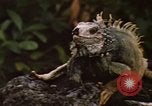
The Iguana Lizard sits on a branch at Jungle Operations Training Center in Panama.
Jungle Operations Training Center (JOTC) at Fort Sherman, Panama. The troops being briefed about animals and snakes in a survival class. An Iguana Lizard. Plants in the background. The lizard sits on a branch.
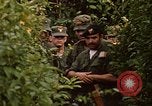
Instructor demonstrates several jungle traps during a class at Jungle Operations Training Center in Panama.
Students in a survival class at the Jungle Operations Training Center (JOTC) at Fort Sherman, Panama. A mock Vietnamese village. The instructor and the students move through a forest area. A sign reads 'Stakes'. The instructor leads students through jungle punji stakes. Instructor stands and briefs the students about punji stakes. The instructor demonstrates several jungle traps.