


 Francais
 Deutsch
 Italiano
Refine Your Search
Fort Oglethorpe stock footage and images
- Showing 511 to 516 of 739 results more
more Hide
Hide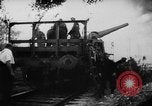
German troops fire artillery in a town, France.
German soldiers fire artillery from railroad gun during Battle of France. Horse drawn artillery moves through open ground in France. French prisoners in the foreground. Dilapidated building of Fort Brimount after fired. German Infantry advances through streets. Horse drawn artillery and Infantry goes through streets. Tank advances in the town. German soldiers get into building with hand grenade. Muzzle of machine gun firing through window. Infantry crosses river in rubber boats. (World War II period).
Beatification Ceremony of Mother Cabrini at chapel in New York.
Beatification of Italian American religious sister Frances Xavier Cabrini (Francesca Saverio Cabrini) in New York. Devout Roman Catholics file past the glass coffin bearing the relics of Mother Cabrini, at the chapel in Mother Cabrini High School (701 Fort Washington Avenue Manhattan, New York City, New York 10040 United States). A wax mask of Mother Cabrini’s face covers the saint’s skull. Priest in the chapel during Mother Cabrini's Beatification Ceremony. Nun in Black habit kneels in front of her coffin.
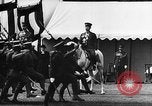
Actions of Axis and Allied powers on brink of World War II in period 1937-1939.
Japanese troops parade for Emperor Hirohito, mounted upon a white horse. Italian troops goosestep and German troops goosestep on parade. View of an Austrian town with snow-covered Alps mountains in background as German troops enter Austria on March 13, 1938 during the Anschluss. Local citizens welcome them, displaying swastika flags and giving Nazi straight arm salutes. Troops, military vehicles, tanks, motorcycles, and horse-drawn artillery comprise the German invading force. Shifts to Spain, where war torn buildings reflect effects of German and Italian intervention during the Spanish Civil War. A donkey standing near field artillery piece. Artillery being fired from an urban park in Spain. Artilleryman using a range finder. German gun crew with heavy artillery piece. Soldiers wearing Adrian steel helmets, firing a two-wheeled water-cooled machine gun. Spanish carrying wounded on stretcher. Spanish civilians inadvertently slain during civil war conflict. Starving dog walking in street. Huge poster of Francisco Franco and view of him on reviewing stand saluting marching Nationalist troops. Repeat of Hirohito reviewing troops and Italian and German troops goosestep. Adolf Hitler and Benito Mussolini stand together in open car heading to Fuhrerbau in Munich, Germany, for signing of Agreement between Germany, Italy, Britain, and France in 1938. Neville Chamberlain, and Edouard Daladier riding in car to Fuhrerbau. Views of the principals signing the accords. First is Adolf Hitler, followed by Prime Minister Neville Chamberlain, Benito Mussolini, and Edouard Daladier. After the signing, the principals, plus Hermann Goering, mingle and converse. Change of scene to nighttime in Rome, Italy, where Benito Mussolini addresses a huge throng gathered near the Victor Emmanuel Memorial to cheer him after his return from Munich. Next, German troops are seen entering Sudetenland (Czechoslovakia) greeted by joyous ethnic German inhabitants. Banners are stretched across a street. One gives thanks to the Fuhrer. Several scenes of cheering population. A woman strews flowers in a roadway. Hitler arrives, standing in an open car, and is met with cheers of adulation. A military brass band plays from the open beds of two moving army trucks. Signpost points to Prag (Prague), Eger (Cheb), Joachimstal (Jáchymov), and Komotau (Chomutov) after German annexation. Scene shifts to Prague, where German troops are seen occupying the city. High ranking German officers in a car are seen coming through the gateway from the Court d´honneur of the Prague Castle into the Hradčany Square. The next sequence shows an Italian Freccia-Class destroyer in the Albanian Port of Durrës. An Italian L3/35 Tankette is driven off a large cargo ship. Italian troops on bicycles ride in a city street. A German 88mm antiaircraft (flak) gun is shown, mounted at a fort overlooking a river and city. Final scene shows Adolf Hitler addressing a meeting of the Bundestag in the Kroll Opera House (alternate meeting place after burning of the Reichstag). He reads, contemptuously from an April 14, 1939 letter sent to him by U.S. President Roosevelt, asking him to give "assurance that your armed forces will not attack or invade the territory or possessions of the following independent nations: Finland, Estonia, Latvia, Lithuania, Sweden, Norway, Denmark, The Netherlands, Belgium, Great Britain and Ireland, France, Portugal, Spain, Switzerland, Liechtenstein, Luxembourg, Poland, Hungary, Rumania, Yugoslavia, Russia, Bulgaria, Greece, Turkey, Iraq, the Arabias, Syria, Palestine, Egypt and Iran." As Hitler reads through the litany of nations, the Bundestag erupts in laughter.
Red Army attacks and pushes Germans back in Poland. Marshal Zhukov directs the Soviet Offensive.
Red Army advances against German forces in Poland during the Vistula-Oder Offensive in World War 2. At the front Marshall Georgy Konstantinovich Zhukov and Soviet officers look at a map. (Marshal Zhukov has cotton stuffed in his ears.) German ME-110 aircraft dive bomb Soviet positions. Soviet Ilyushin II-2 aircraft bomb German positions. Smoking terrain of battlefield. Soviet troops cross river in small boats. Soviets conduct an amphibious assault. There are explosions on the opposite shore. Russian infantry advances under German fire, cutting barbed wire and marking position of land mines. Soviet tanks and artillery fire. Marshalls Georgy Zhukov and Konstantin Konstantinovich Rokossovskiy look at a map. Shells explode and Soviet infantry advances past German antitank barricades. At the command post Marshall Georgy Zhukov looks at a map. Views of German defensive fortifications, including Barbed wire entanglements; concrete forts and bunkers, one with barbed wire on top and a periscope on a steel turret. German antitank barricades along the river.
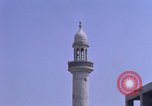
A man, a woman and two children outside the walls of a structure look at a minaret in Bahrain.
Minarets and stone structures in Bahrain. A minaret against the sky. A large open area. A tree in the foreground swaying in the breeze. Clothes are hanging on lines in the far background. The top portion of a minaret. A stone structure with two minarets. A man, a woman and two children outside the walls of the structure. The man points up to a minaret. The face of the man's wife as she looks off to the left. The man and his wife look through an iron fence into a yard. Ruins showing blocks of granite. A fort in a desert with the minaret in the background. Buildings in the background. A colorful minaret seen against the sky.
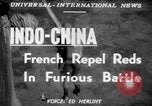
French troops advance under Vietminh fire to repel the communists from Indochina and raise the French flag.
French troops repel the communists from Indochina during the Indochina War. Paratroopers drop in the Indochina Delta. They wade through water. The paratroopers fire guns. French troops advance under Vietminh fire. Machine-guns are fired. Dead soldiers on the ground. The place where the son of French Commander in Chief, Jean Joseph Marie Gabriel de Lattre de Tassigny was killed. Vietnamese run looking scared. The French point guns at them. French troops raise the French flag. They return to a fort in trucks.