


 Francais
 Deutsch
 Italiano
Refine Your Search
Goodenough Island New Guinea 1943 stock footage and images
- Showing 6523 to 6528 of 13634 results more
more Hide
Hide
MB-1 rocket rail-launched from a U.S. Air Force F-102A Delta Dagger at Holloman Air Force Base in New Mexico.
MB-1 rocket rail-launched from a U.S. Air Force F-102A Delta Dagger at Holloman Air Force Base in New Mexico. Footage taken from GSAP (Gun Sight Aiming Point) camera mounted under right wing of F- 102 in flight. MB-1 rocket fired from rail launcher. Technicians work on F-102A parked outside a hangar. Two technicians wheel an MB-1 rocket on a dolly, underneath F- 102A parked on ramp. Three technicians check out and calibrate special instrumentation to be used during the test run. The instruments include different types of oscillographs, and photo panels. Special camera installations made on the F-102A vertical stabilizer, fuselage, and wings. Technician installs a l6mm camera inside the aircraft nose, then closes access panel. F-102A takes off. Radar vectoring station T-1 at Holloman AFB. Technician operates one of the tracking scanners installed on roof of building. Two men, inside the vectoring station, control the course of the test aircraft by radio communication from the vectoring machine plotting charts. The pilot in F-102A cockpit as he turns on the recording cameras to activate the armament system. MB-1 bomb extended below the aircraft. Engineer talks on the radio phone inside the vectoring station. Pilot's hand on the control stick as he activates the firing switch. MB-l rocket is fired from the short rail launcher. The aircraft is enveloped in a trail of white smoke. GSAP camera mounted underneath the right wing of the F-102A, shows the MB-l rocket being fired from the short rail launcher. Smoke due to the firing of the rocket.
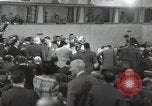
559th United Nations Security Council Meeting in Flushing Meadows, New York
59th meeting of UN Security Council at Flushing Meadows, New York. Views of the meeting chamber with council members at the table and reporters and various international observers, seated in the chamber. Several are wearing headsets to listen to simultaneous translations of proceedings.
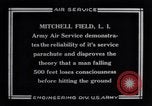
A United States Army Air Service sergeant during parachute jumps at the Mitchel Field in New York.
United States Army Air Service personnel demonstrate parachute jumps at Mitchel Field in New York. A sergeant on a plane with a parachute on his back. The sergeant jumps from the aircraft. He opens the parachute and lands without mishap. A view of the sergeant dropping from the aircraft. The second jump from the aircraft. A delay in opening of the parachute. The sergeant lands safely.
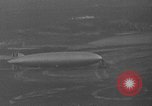
Hindenburg (LZ-129) and USS Los Angeles (ZR-3) at Lakehurst Naval Air Station, New Jersey
Aerial views of zeppelins Hindenburg (LZ-129) and USS Los Angeles ZR-3 (LZ-126), moored at Lakehurst Naval Air Station, New Jersey. Large swastikas on tail of Hindenburg airship.

German zeppelin Hindenburg lands at Lakehurst Naval Air Station, New Jersey and people flock to watch it.
German zeppelin Hindenburg lands at Lakehurst Naval Air Station, New Jersey on the morning of 9 May 1936, after the airship's maiden voyage across the North Atlantic Ocean. People gather to watch the zeppelin after a successful transatlantic flight in 60 hours. The zeppelin enters a waiting hangar as a huge crowd gathers to watch. A Nazi swastika on the airship. Dr. Hugo Eckener thanks American government for their cooperation and talks about the successful flight across the North Atlantic. (This is the only portion of the clip that includes audio). People look at the zeppelin in the hangar.

Dr. Hugo Eckener testifies before the board inquiring into the Hindenburg disaster at Lakehurst Naval Air Station, New Jersey.
Inquiry board probes into the reasons for the burning of German zeppelin Hindenburg at Lakehurst, New Jersey. Head of Luftschiffbau Zeppelin, Dr. Hugo Eckener, smokes a cigar during a meeting of the inquiry board into the airship disaster. He testifies before the board.
CRITICALPAST.COM: About Us | Contact Us | FAQs - How to Order | License Agreement | My Account | My Lightboxes | Shopping Cart | Advanced Search | Featured Collections | Website Terms & Conditions | Privacy Policy ©2026 CriticalPast LLC.
License Agreement |
Terms & Conditions |
Privacy Policy
©2026 CriticalPast LLC.