


 Francais
 Deutsch
 Italiano
Refine Your Search
Goodenough Island New Guinea 1943 stock footage and images
- Showing 7945 to 7950 of 13637 results more
more Hide
Hide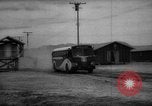
Japanese Americans at relocation center in United States during World War II.
Relocation of Nisei people in United States during World War 2. Japanese Americans arrive at the Manzanar relocation center (internment camp). Family members exit a bus. A young boy looking unsure as he observes the camp. New internees undergo medical examination. They participate in Americanization classes. They train themselves in self government. Block leaders are presented citations at a meeting. Japanese-American children internees are looked after in day care centers as men and women go to work. Young boys and girls seated at a table. Internees at Manzanar working in an experimental laboratory house for extracting rubber from guayule shrubs to increase rubber production during the war. Japanese American internees working in cultivating the guayule shrub. View of a project at the Parker camp where internees were working to irrigate desert land. View of sugar beet fields where internees could work. View of Manzanar war relocation center with mountains behind. War time propaganda narrator promotes the relocation centers as "setting a standard for the rest of the world in the treatment of people who may have loyalties to an enemy nation. We are protecting ourselves without violating the principles of Christian decency."
Production of petroleum at oil refineries and its transportation in United States, before and during World War II
Documentary titled, ' Oil Is Blood ' on production and transportation of petroleum and its by products in United States. Crude oil in a pit. Man takes samples from the pit. View of derricks at an oil drilling site. Derricks at sea. Exteriors of a building near the derricks. Service station attendants, pumping gas and cleaning the windshield, on a 1942 Lincoln Continental convertible, at a "Tydol Flying A" gas station. Scenes of busy highways and plenty of fuel give way to empty roads, closed gas stations, and restricted hours for obtaining fuel, as it is rationed during World War 2. Views of persons obtaining ration stamps and books. Various gasoline ration books including the "A" books (allowing the smallest amounts) and "B", "C", and other books allowing larger rations to more essential users. Oil rig "roughnecks" inserting new sections of pipe and proceeding to drill. Closeup of a "gusher" before it is capped. Men filling railroad tank cars with petroleum products. A long train of tank cars pulled by a steam locomotive. Animated map illustrates the ocean shipping lanes that formally served as means to transport fuel and oil, before the German U-Boat threat made them too dangerous for general use. Drums of fuel and oil being loaded aboard a ship to supply the Allies during the war. A convoy of ships heading to the war zone of North Africa.
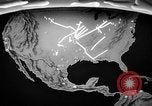
Laying of the Big Inch petroleum pipeline network between Texas and Illinois in the United States during World War 2.
A map shows pipeline network for the transportation of oil and its by-products in the United States, largely for the war effort during World War 2. Shows the laying of the Big Inch petroleum pipelines in Arkansas, Texas, and other locations. Tractors and explosives being used to clear the ground for laying the pipelines. Oil pipeline being laid across a river bed. A welder welds the joints. Pipelines being laid in trenches. Men operate valves to turn on the flow of oil in the new Big Inch pipeline. High octane aviation gas is filled in an aircraft at an airfield. Soldiers fill gas cans all lined up in a lot. An oil tanker in the background. Troops load gasoline jerrycans on trucks. B-17, B-26, and B-24 Bomber aircraft in refueling operations on various airfields. B-17 taking off and formation of aircraft in flight. Long lines of jerry cans being filled with gasoline by personnel near a railroad track. Close up view of gasoline dispensing nozzle in top of Jerry Can and a hand opening the next jerry can in line. Jerry cans loaded into trucks, transported, and unloaded by U.S. Army soldiers. Motor oil being poured into funnels for use in vehicles. Narrator declares, "Oil for freedom. American oil. The blood of the mechanized legion!" A formation of tanks and military vehicles move along a wide field. Narrator encourages sacrifice of American people giving up home comforts of goods and fuels made from oil so that they can be directed to the war effort.
America fully mobilized in World War II
Opening slate announces 11 million Americans to bear arms (in World War 2.). U.S. Army Chief of Staff, General George S. Marshall conversing with Chief of Naval Operations, Admiral Ernest King. Next, Admiral King is seen standing with Commanding General of the U.S. Army Air Forces, Lieutenant General Henry H. (Hap) Arnold, and Admiral William D. Leahy, Chief of Staff to the President of the United States. Scene shifts to a graduating class of cadets from the United States Military Academy, at West Point. They are seen receiving their diplomas. West Point cadets are also seen cheering at an athletic event and in several views of them marching in formations on different occasions. Views of cadets from the U.S. Naval Academy, at Annapolis, Maryland, on parade and at a graduation ceremony in Dahlgren Hall, where each receives a diploma and they toss their hats into the air at the end of the ceremony. Next, ordinary citizen soldiers (mostly draftees) are seen marching in formation They participate in calisthenics en masse. Heavyweight boxing champion, Gene Tunney, is seen leading an exercise session. Soldiers run over an obstacle. Next cadets are seen on parade in the U.S. Merchant Marine Academy, at Kings Point, New York. Some cadets are seen practicing escape from a burning vessel at sea. U.S. soldiers engage in field training that includes live weapons fire above their heads as they crawl under barbed wire on a training course. View of soldier firing a Browning M1917 water-cooled machine gun near the trainees. Another is firing a Browning M1919 air-cooled machine gun.
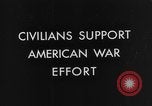
Celebrities help promote American Red Cross blood donor programs and War bond drives during World War II.
Film opens showing a huge crowd gathered in New York’s Madison Square Garden for a rally in support of the American Red Cross, during World War 2. Eleanor Roosevelt, the First Lady welcomes and introduces Princess Martha of Norway. The audience applauds. Scene then shifts for Red Cross activities on the home front. Two Red Cross women remove items from a station wagon in preparation for a local Blood drive. A panel truck parked next to them is marked: “American Red Cross Blood Donor Service.” More Red Cross volunteer women remove items from the panel truck to set up the blood donor activity. View of many persons in beds at a blood donor center. Nurses and Red Cross volunteers working at the center with donors. One of the donors is an active duty sailor in uniform. Complete change of scene to California, where Hollywood stars are seen involved in a war bond drive. Closeup of several, including Irene Dunn, Ronald Coleman, Hedy Lamarr, and Greer Garson. Glimpse of crowd at the bond drive.
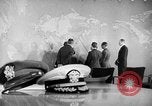
Allied officers examine map in Chateau Frontenac and reports on India; also exterior views of Roosevelt's Springwood Estate
American military officer hats on a conference table in Chateau Frontenac, around time of the Quebec Conference during World War 2. Group of allied officers gathered around wall map. One points at India. Another points at Suez. Reports labeled India, marked "Secret." British officers examining charts. Scene changes to exterior view of President Franklin Roosevelt's Springwood Estate house in Hyde Park, New York. American flag flying on house. Rolls Royce limousine parked at entrance drives away.
CRITICALPAST.COM: About Us | Contact Us | FAQs - How to Order | License Agreement | My Account | My Lightboxes | Shopping Cart | Advanced Search | Featured Collections | Website Terms & Conditions | Privacy Policy ©2026 CriticalPast LLC.
License Agreement |
Terms & Conditions |
Privacy Policy
©2026 CriticalPast LLC.