


 Francais
 Deutsch
 Italiano
Refine Your Search
Goodenough Island New Guinea 1943 stock footage and images
- Showing 7951 to 7956 of 13637 results more
more Hide
Hide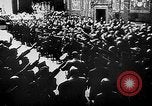
Nazi leaders honor German civilians with awards. Principal honoree reviews honor guard in Court of Honor (WW2)
Reich Marshal Hermann Göring returns salutes with his baton, as standing audience of mixed military and civilians render Nazi salutes while he leads a cadre of officers down the center aisle in a full auditorium at the new Reich Chancellery in Berlin during World War II. At the front of the assembly he greets young German officers. Next, uniformed men, holding flags of various organizations, stand before a Nazi banner backdrop. Next a woman is seen smiling and shaking hands with Albert Speer, as she receives an award from him. Change of scene shows German Field Marshal Wilhelm Keitel pinning War Merit crosses on civilians. Then, Hermann Goering is seen from behind as he shakes hands with a woman who has just been awarded the War Merit Cross. Goering speaks to an old woman who has just received an award. A middle-aged civilian man is led to the front of the auditorium, where a citation for his award is read aloud by an officer in the background. Views of the audience listening. A young officer places a ribbon with decoration around the neck of the man. Glimpse of the flag bearers at front of the auditorium. Hermann Göring steps forward to personnaly shake award recipient's hand. Drummers in a German Army band begin to play in the courtyard, as this last award recipient is led out of the hall by Goering, past a very large honor guard of Army and Navy personnel in The Honour Courtyard.(The statue by Arno Breker called "The Army" is seen near the doorway.) Goering and the awardee walk past the honor guard formations. As they draw closer to the camera in the courtyard, the award can be seen around the neck of the recipient. It resembles an eagle with wings outstretched, upward.
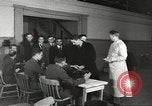
American Army recruits get their throats checked by a doctor and receive their uniforms in the United States
American Army recruits in civilian clothes get physical examination and receive uniforms during World War II. U.S. Army recruits enter a room and check-in. A doctor wearing a white gown uses a tongue depressor and checks the throat of each man. The recruits are seen receiving their new uniforms.
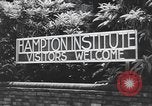
African American students gain knowledge of agriculture, chemistry and radio operation at Hampton Institute in Virginia (WW2)
African American colleges in the United States during World War II. College curricula adjusts to war needs as they prepare students for various military and civilian occupations including war factory production and war manufacturing. A sign reads ' Hampton Institute visitors welcome' at Hampton Institute, presently known as Hampton University (100 E Queen St, Hampton, VA 23669), in Hampton, Virginia. Exteriors of buildings on the campus. An educator welcomes students from other countries for taking up a course at the institute. Students in a class take lessons in radio operation and construction. Students in a chemistry laboratory learn to develop new war material. Science students train to become laboratory technicians. An African American student conducts a test on bacteria in food caused by handling. Hampton Institute provides laboratory facilities for training of nurses. Students in a ground school class. The students work on machines as they weld metal pieces. A farm management course for girls by the Agriculture Department of the Institute. Girls operate a tractor as they plant corn in a field. Dairy farming lessons being conducted as girls watch a man as he milks a cow. Students conduct research on food and the importance of soybean over meat. Students broadcast programs related to research results, improved diet and raising better crop. They take up lessons in surveying and topography. Cadets of institute regiment march. A sign reads ' U.S. motor transport shops'. The students learn to work on motor parts. U.S. Army trucks being repaired at the shop. Engineering Department of the institute trains men for the U.S. Navy. The cadets march. A clock tower in the background.
United States ships like destroyer escorts and a tanker ship being launched in the United States during World War II.
United States Navy ships being constructed and launched in the United States during World War II. A shipyard as men work on destroyer escort USS Parks. Final touches being given to the ship. The ship being launched. United States Navy destroyer escort USS Hopping being launched at a ship yard. A new tanker ship being launched. Men at the bow of the ship.
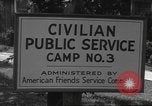
Conscientious objectors in World War 2 arrive at U.S. Civilian Public Service camp number 3 in the United States
U.S. Civilian Public Service camp number 3 (Camp Patapsco, in Elkridge, Maryland), run by the American Friends Service Committee of the Quaker Religious Society of Friends in the United States. A sign reads ‘Civilian Public Service Camp No.3’. Building at the camp. Conscientious objectors who choose public service in lieu of military service, arrive and are checked into the camp. The U.S. flag flutters from a pole. The arriving personnel talks to a man at the entrance. The new arrivals pose.
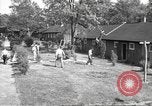
Conscientious objectors during World War 2 work in gardens and camp houses at Civilian Public Service Camp in the United States
U.S. Civilian Public Service camp number 3, for conscientious objectors, administered by Quakers of the American Friends Service Committee, in the United States. Camp number 3 is Camp Patapsco, in Elkridge, Maryland. Men use lawn mowers outside the camp buildings. Men work in a garden and over the camp houses. A man uses a mower. A man reads from a book. View of camp houses. Men making roof repairs. New recruits arrive at the camp.
CRITICALPAST.COM: About Us | Contact Us | FAQs - How to Order | License Agreement | My Account | My Lightboxes | Shopping Cart | Advanced Search | Featured Collections | Website Terms & Conditions | Privacy Policy ©2026 CriticalPast LLC.
License Agreement |
Terms & Conditions |
Privacy Policy
©2026 CriticalPast LLC.