


 Francais
 Deutsch
 Italiano
Refine Your Search
Goodenough Island New Guinea 1943 stock footage and images
- Showing 8131 to 8136 of 13637 results more
more Hide
Hide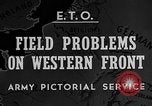
Montage of scenes during World War II on the Western front during January 1945
January, 1945, on the Western front during World War 2. Troops of the U.S. 8th Infantry Division test new white camouflage coveralls for use in snow. They patrol in snow covered forest areas on the Western Front. A sergeant makes outdoor field adjustments to the coveralls using a knife and captured German sewing machine. He helps a soldier who tries on his new coverall. The material used is from old mattress covers. Several soldiers are seen putting on the camouflage coveralls. Scene shifts to U.S. troops with a jeep towing a 20mm Italian dual purpose gun for use in Germany. On January 2, 1945, they set up and fire the gun at targets a half mile away. In Belgium, U.S. Army engineers of Company B, 238th Engineer Battalion, improvise remote controlled bazooka shells as road blocks. They set them up on fence posts and fire them by ordinary flashlight batteries. U.S. soldiers from a Signal Company of the 99th Infantry Division are seen using a Weasel vehicle (officially designated an M29C light cargo carrier) to lay communication cables through snow in the 1st Army Sector, Belgium. Views of the wire spool on back of the weasel, and soldiers pulling wire from it.

United States Army soldiers use sound deception to deceive the German in Film 'Sonic Deception'.
Film 'Sonic Deception' shows the use of sounds to deceive the enemy (sometimes described as the "Ghost Army" in World War 2). Dramatization shows United States troops crossing river in small boats and arriving on beach. They establish beachhead on river bank and defeat German troops located there, having arrived by suprise. Film recounts through actors how a German spy at a German army corps headquarters informs about the presence of United States tanks and trucks. Film demonstrates how sound recordings were used by U.S. soldiers to create false impression of troop activities including bridge building and tank and vehicle movements, in order to serve as a decoy and mislead Germany enemy forces about U.S. Army activities. Dramatization shows German officials consulting and looking at maps. German soldier looks through binoculars and informs officials through phone. Tanks cross a bridge and artillery on field. Actual scenes of front gate of Army Experimental Center station headquarters at Pine Camp in Great Bend, New York (upper New York State). U.S. Army soldiers are shown recording via microphone the sounds of actual bridge construction at the center. The microphone routes to a recording truck where a turntable for pressing recordings is running, creating a phonograph recording of the bridge building decoy sounds. Recording of other sounds is shown, including sound of a bulldozer at work, sounds of men unloading trucks, and sounds of tanks crossing a bridge. Soldier is seen selecting a phonograph record from the Army Experimental Station Library.
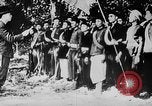
Cadres of Viet Minh holding flags. Ho Chi Minh, in declaration of independence,establishes Democratic Republic of Vietnam
Views of several cadres of Viet Minh holding flags. Image of Ho Chi Minh. Crowds gathered in celebration as Ho Chi Minh declares the independence of the new Democratic Republic of Vietnam. The Viet Minh flag with single star appears in many places as the flag of the new nation.

Franklin D. Roosevelt campaigns for Vice Presidency in 1920 and supports Smith -Davis ticket in 1924.
Franklin D. Roosevelt seen standing in courtyard of White House, with other officials. The old Executive Office Building is in the background. Democratic National Convention of July, 1920. Roosevelt is nominated as Vice Presidential candidate on ticket with James M. Cox. The two of them campaigning in San Francisco. Supporters parading. Mrs. Eleanor Roosevelt with their four children and dog, at Hyde Park in New York. Crowds gather to hear Roosevelt campaign speeches. Franklin D. Roosevelt returns to Hyde Park and is greeted by his mother. He speaks there and greets supporters. Roosevelt on chrutches (due to polio) standing with John W. Davis and Alfred Smith. Scenes of the Democratic National Convention of 1924, in New York.
United States Army recruits in World War 1 are given gas mask training in the United States.
A United States Army Signal corps training film titled 'Defense Against Chemical Warfare'. Mobilization of new U.S. Army troops arriving by railroad trains for training following recruitment. New recruits undergo training. They assemble in their uniforms and salute their officer. Recruits are given gas masks and are given training about their care and use. A U.S. Army soldier demonstrates how to strap a gas mask. The recruits don gas masks. (World War I; World War 1; WWI; WW1)
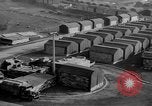
U.S. Army forces build up supplies and advance positions in preparation for invasion of Germany during World War 2
Activities of American first Army in Germany. Aerial and ground views of an Allied supply depot at Liege, Belgium. U.S. Army soldiers arrange supply boxes. Signal Corps engineers work on readying communication lines from the rear to the front and are seen stringing communication lines and preparing communication hubs. New transmission equipment of various kinds are received and installed for news. U.S. Army engineers supervise steel manufacture and sawmill operation in Luxembourg at a protected steel works facility that was taken over by the Allied Supreme Command. U.S. Army Corps of Engineers personnel walk on finished steel beams and check them before shipment front. Plank boards are cut and stacked for use in road projects. U.S. engineers repair a bridge over the Meuse in Belgium that had been damaged in the Battle of Belgium. Train crosses a repaired bridge over the Meuse, and U.S. military and civilian pedestrian traffic seen on the bridge road. Track connectors are installed to better grip in mud and allow passage of Allied tanks and tracked vehicles. Aerial view of Siegfried line and Dragons Teeth. U.S. forces seen using a tank bulldozer and mud to effectively bury Dragon's Teeth tank traps to allow passage through the Siegfried Line. Allied trucks and vehicles are repaired. A convoy of Allied supply trucks passes by through a snowy landscape bringing supplies to the front in preparation for invasion into Germany.
CRITICALPAST.COM: About Us | Contact Us | FAQs - How to Order | License Agreement | My Account | My Lightboxes | Shopping Cart | Advanced Search | Featured Collections | Website Terms & Conditions | Privacy Policy ©2026 CriticalPast LLC.
License Agreement |
Terms & Conditions |
Privacy Policy
©2026 CriticalPast LLC.