


 Francais
 Deutsch
 Italiano

Refine Your Search
Goodenough Island New Guinea 1943 stock footage and images
- Showing 8461 to 8466 of 13663 results more
 Hide
Color Sound

The Allied invasion of Sicily during Operation Husky in World War II
British Air Chief Marshal Sir Arthur Tedder, Admiral Sir Andrew Cunningham, General Dwight D. Eisenhower, and British Field Marshal Bernard Montgomery are seen looking skyward. They stand on a field in front of a large formation of troops. Scene shifts to a seaport in North Africa, with Allied troop ships preparing to depart. A barrage balloon flies over the port. (Narrator notes that the armada includes ships of Britain, The United States, the Netherlands, Poland, Greece, the Indian navies, A warship sits in the water beside a large troop ship. A tugboat tows a large troop transport ship in the harbor. Cargo ships and a three stacker transport ship are seen. Two British battleships. Sailor using signal light to send a message. Two American destroyers in trail formation. U.S. Admiral Henry Kent Hewitt, Commander of the 8th Fleet, presents Lieutenant General George S. Patton, commander of U.S. forces, with a new battle flag. Views of ships in the invasion fleet. Transport ships anchor off the coast as they shuttle troops to the beaches in their landing ships. A landing ship flying the American flag. Naval guns fire barrages at the shore. As landing craft reach the beach, troops wade ashore through the surf. An army truck drives from a landing craft through the surf. Army truck and a jeep drive ashore from a large landing craft. Brief glimpse of Wading tanks leaving a tank carrier and driving ashore through the surf. Troops landing with dry feet from a beached landing craft. View of the city of Gela. Lieutenant George S. Patton climbs over the side of a ship and descends on a rope ladder to enter a Higgins boat that takes him to assume command of the invasion operations. Closeup of Lieutenant General Patton in the boat entering the harbor at Gela. He jumps from the boat as it reaches the beach. Local civilians view activities from the beach. DUKWs (amphibious trucks) drive ashore. Artillery pieces being towed ashore. American infantry entering the town of Gela. Military vehicles enter through rubble strewn streets. An M4 Sherman tank speeds along a road. Remains of an Italian armored train destroyed by Allied gunfire. American soldiers walk through areas destroyed by German bombing. American troops search buildings. Local Italian people mingling with American troops. Surrendered Italian troops march under guard along a street. Allied forces head toward Messina. A tracked gun carrier filled with troops in the back, moves along a street. U.S. infantry marching along a roadside. Army engineers clearing mine fields in advance of troops. Closeup of a buried mine being revealed. Major General Lucian K. Truscott, Jr., Commander of the U.S 3rd Infantry Division, inspects Axis planes and hangars captured by American forces. Many undamaged aircraft are seen in revetments and simply parked on the airfield. Fuel arrives for Allied aircraft. British Fairey Firefly aircraft taking off. Dead Axis soldiers lying on the ground. Destroyed Axis military vehicles. A knocked out German Tiger tank. A DUKW drives past a damaged Axis armored vehicle. UN forces firing mortars from a field. A knocked out Axis armored vehicle. UN motorized gun carrier fires its gun. Allied infantry advancing.
Chiang Kai-shek of China receives highest U.S. Foreign award during World War II
General Joseph Warren Stilwell presents the Legion of Merit to Chinese Generalissimo Chiang Kai-shek in Chongqing (Chungking), China during World War II. Madame Chiang Kai-shek (Soong Mei-ling) is also present. Madame Chiang talks to news correspondents.
Mrs. Franklin Roosevelt visits bases in South Pacific during World War 2
First lady of United States, Eleanor Roosevelt, visits U.S. Base Hospitals in South Pacific areas including Australia and New Zealand during World War 2. Base hospital's wards are seen including some in thatched huts. Mrs. Roosevelt wearing Red Cross uniform. A soldier seen in a wheel chair. Mrs. Roosevelt waves goodbye to United States soldiers.
Manufacture of Lancaster Bomber aircraft (KB-700) in Canada by Victory Aircraft Limited
Opens with "back the attack" 5th War Loan fundraising message of World War 2. Film title "Target Berlin" seen along with sound and images of impact of bombardment. Scenes from an aircraft manufacturing plant in Canada. A man seen in office over a telephone conversation getting news to build the bombers. Canadian men and women war production workers working in the plant talk about the manufacturing of the Lancaster Bomber. Designers,engineers and officers engage in discussion about the blueprints and drawings of the aircraft for production. Workers, engineers, and technicians manufacturing and assembling various parts of the aircraft in Victory Aircraft Limited, an aircraft production company. "KB-700" painted on the fuselage of the nearly completed aircraft.
B-25 Mitchell bombers of the U.S. 9th Army Air Force in flight and bombing over Pratica di Mare airfield in Italy.
U.S. 9th Army Air Force aerial views of B-25 bombers dropping bombs over Pratica di Mare airfield. Several bomber aircraft flying over the airfield. Views of bombs dropping and impact on targets. Tail section of an aircraft visible. The airfield contained new 5-motor German bombers. (World War II period).
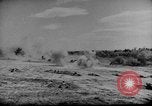
U.S. Army Quartermaster Corps prepare mortars, fire anti aircraft guns, and provide supplies during World War II.
Clip opens with brief World War I scene, circa 1917, of new American army recruits receiving army uniforms being issued by a U.S. Army Quartermaster. Clip then covers U.S. Army Quartermaster Corps' combat operations in various Theaters of Operations during World War II. Quartermaster Corps soldiers with rifles under the cover of a military truck during battle. Troops in trucks. An aircraft in low flight over a field. A U.S. Army truck. A Quartermaster fires an anti aircraft gun. Explosions occur and smoke rises. A British tank in a field. Soldiers beside a truck. Cans and barrels stacked on the ground. An enemy German tank in a field. Soldiers take cover. Quartermasters with guns in a trench. They come up the trench in prone positions. Dramatized battle scene with several Quartermaster corps casualties beside a wire fence. Soldiers prepare a mortar gun. An anti aircraft gun on an army truck. A soldier takes aim and fires a rifle during training. The Quartermaster flag hoisted on a pole. Actual footage shows aerial view of Bataan, and then ground views of groups of remaining U.S. Army soldiers around time of surrender of Bataan in April 1942. American soldier seen with their hands up and under guard of Japanese soldiers during Bataan surrender. Landing crafts arrive at a beach in North Africa. Supplies being offloaded at various battle fronts of World War 2. Soldiers and supplies off-loaded on the beach. Quartermasters seated on supplies boxes. Landing crafts arrive at a beach in the South West Pacific. Troops move across the beach. Troops disembark from landing crafts and move across a beach in Sicily, Italy. The Quartermasters unload boxes of supplies during various beach landings. They unload supplies and fire artillery on a beach head in Italy. Troops in trucks. A convoy of trucks loaded with supplies. Ammunition, ration and personnel in trucks move from Algeria to the front in Tunisia. Explosions occur and smoke rises. Trucks advance through smoke at night and in difficult conditions. Quartermaster General Major General E. B. Gregory speaks about the Quartermaster Corps. He says that the Quartermasters distribute goods to the army during training and combat. The movement of the Corps should be so regulated so as to deliver the goods at the right time in the right quantity.
CRITICALPAST.COM: About Us | Contact Us | FAQs - How to Order | License Agreement | My Account | My Lightboxes | Shopping Cart | Advanced Search | Featured Collections | Website Terms & Conditions | Privacy Policy ©2026 CriticalPast LLC.
License Agreement |
Terms & Conditions |
Privacy Policy
©2026 CriticalPast LLC.