


 Francais
 Deutsch
 Italiano
Refine Your Search
Goodenough Island New Guinea 1943 stock footage and images
- Showing 847 to 852 of 13636 results more
more Hide
Hide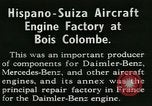
The damaged Hispano-Suiza Aircraft Engine Factory after three attacks by the U.S. Eighth Air Force during World War II.
Results of air assaults by the British Royal and U.S. Eighth Air Forces over industrial areas in and around German-occupied Paris during Wolrd War II. The damaged Hispano-Suiza Aircraft Engine Factory (producer of components for Daimler-Benz, Mercedez-Benz) at Bois Colombe, after three attacks by the U.S. Eighth Air Force in December 1943. The destroyed crankshaft plant, foundry, and tool shop. Aircraft engines overhauled, crafted and ready for shipment, left behind by the fleeing Nazis. Allied soldiers and workers under the bare roof. Damaged equipment and material. Allied officers and civilians survey the damage. Collapsed roof structures. Debris and rubble strewn all over the floor. Bent steel structures. Buildings in the surrounding area. Military jeeps parked in the factory grounds. Damaged structures left standing.
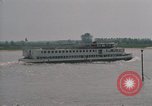
American correspondents visit cemetery in Opijnen, Gelderland, the Netherlands for Memorial Day ceremony honoring U.S. B-17 crew
American correspondents in Netherlands to mark 25th anniversary of Allied invasion of Europe in World War II. A steamer underway in a canal. Views in the village of Opijnen, in Gelderland, the Netherlands. A correspondent and his wife come out of a house. American correspondents near a bus. Houses along a road. An American flag at the walled cemetery in Opijnen, beside its 17th century Dutch Reformed Church, where the crew members of an American B-17 bomber from the 323 Squadron of the 91st Bomb Group (H) of the U.S. 8th Army Air Force are buried; shot down July 30, 1943 by the German Luftwaffe. Gravestones bearing the names of American soldiers who lost their lives when their crippled B-17 was shot down, including: Mike Anthony Perrotta, Hermon Daines Poling, Harold Royce Sparks, Robert Urquhart Duggan, Douglas Victor Blackwood, Americo Cianfichi. U.S. Color Guard marches from a town building toward the cemetery. A woman correspondent takes pictures. An American flag flies at half mast. Men, women and children at the cemetery. Dutch children carry flowers in their hands. The mayor of Opijnen speaks into a microphone. He and a woman place flowered wreaths at the graves of dead American soldiers. Two groups of four U.S. Convair F-102 Delta Dagger aircraft fly overhead followed by four F-104 Starfighters of the Royal Netherlands Airforce. Children walk past the graves. Additional propeller aircraft pass overhead honoring the airmen.
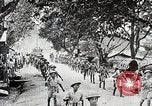
Chinese and American troops battle Japanese forces as they proceed along the Ledo road in the China-Burma-India theater of operations in World War II
On Christmas Eve, 1943,during World War 2, the Chinese 38th and 22nd Divisions are seen marching along a road toward North Burma. A regiment of Merrill's Marauders is seen joining the march from India through Burma. (Narrator says they will engage the Japanese 18th Division.) Along the line of march a road sign reads,"Shinbwiyang, Mile 110." Numerous views of troops struggling through jungles and natural obstacles. They employ pack animals that sometimes had difficulty in rough terrain. Animated map shows the route from Ledo, Assam, India, to the places of Chinese and American engagement with Japanese forces, in the Hukawng Valley. U.S. troops are seen moving under fire from Japanese enemy during active combat and returning fire with rifles, Browning M 1917, and M 1919 machine guns. Some of Merrill's Marauders wear standard M1 steel combat helmets, while others wear older M1917A1 "Kelly" helmets. One is seen firing a Bren gun with top-mounted curved box magazine. Others fire mortars. Chinese troops seen firing small artillery pieces. M3A3 Stuart light tanks of the joint Chinese-American 1st Provisional Tank Group (1st PTG) are seen with infantry walking behind them. Next, Allied casualties on litters are seen being placed in an ambulance. Numerous wounded are seen on the ground. Chinese troops carry a wounded on a litter. Views of Japanese soldiers being burned out of their hiding places by Chinese troops. Numerous views of dead Japanese soldiers. Scene shifts to air support by U.S. Army Air transport command providing aerial resupply from C-47 transport aircraft. C-47 aircraft seen flying over jungles. Monitors at a headquarters location are seen charting the changing positions of the Allied troops on the ground. View in a warehouse where air drop ready supplies are stored. Numerous views of supplies of all kinds being readied for air drop, including mail for the troops. Shipments being loaded aboard a transport airplane. C-47 airplane taxiing out after loading. Troops on the ground in radio contact with a transport plane. A long sequence ensues showing aerial resupply air drops from C-47 transport planes. After that, medical personnel are seen on the ground providing care to seriously wounded under difficult circumstances. Closeup of a surgeon tending to a patient. Many wounded seen on the ground awaiting attention and others in tents. A wounded on litters are transferred from an ambulance to an airplane. A woman nurse with other medics transferring patients. View inside an airplane set up for air evacuation. A nurse gives a wounded patient some water to drink. At a location unreachable by larger transport airplanes, a wounded soldier is placed aboard a single engine Stinson L-5 Sentinel liaison airplane which is then seen taking off and flying away. Animated map shows progress of Chinese troops on the Ledo road.
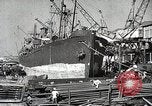
Construction of India-Burma-China Pipeline during World War II
Opening scene shows a large transport ship at a dock in Calcutta, India, during World War 2. It is surrounded by cranes unloading it. In the foreground, numerous sections of pipe are piled up on the dock. Closeup of group of pipe sections being lifted by crane from the ship's hold. Some individual pipes are seen moved by groups of Indian workers carrying them over their heads. Other Indian workers roll pipe sections onto barges that are seen clustered together near a steel bridge. A convoy of trucks is seen carrying the pipe sections along the Ledo road. Some bundles of pipe sections are carried on jeeps. View of an Army Air Forces C-47 transport plane taking off. Sections of pipe being offloaded from a C-47 plane. Numerous pipe sections in organized stacks near the airfield. Sections of pipe being fastened together. Engineers re-condition the road bed using construction equipment. Long connected pipe lines being pulled through water. Caterpillar tractors working on a muddy section of the road. Workers installing pipe near graves of workers who died from disease and other causes. Workers sending a bundle of pipe segments across a river by means of a Zip line. A worker's camp of tents in the background. Workers dressed in rain gear and boots carrying a pipe section through water during the Monsoon. Workers using machetes to chop their way through jungles. An open utility train moving Chinese troops along a single-track rail line, passes pipeline workers standing aside. Engineers and other pipeline workers distributing pipe sections along the rail line from railroad flatcars. Trucks driving the road, in Burma. Various views of the pipeline in including one showing lines of pipe forming a suspension bridge across a river. Other scenes show the pipeline crossing ravines, submerged under rivers, climbing vertical cliffs. Aerial views of the pipeline from low flying aircraft. A vehicle marshaling yard filled with army vehicles. M3A3 Stuart light tank moving past a yard filled with them. Army trucks moving out of their parking yard. Aerial view of large airfield with many parked Air Transport Command C-47 airplanes. B-29 bombers being refueled at an airfield. One is seen taking off. Lieutenant General Daniel Isom Sultan, Commander India-Burma theater, comments that the pipeline is a lifeline to our beleaguered ally and that the Chinese are in on this. Views of Chinese soldiers engaged against Japanese forces. They fire artillery pieces and heavy machine guns. British soldiers carrying Bren guns and struggling to move artillery pieces in the mud. They are seen firing artillery from under camouflage canopies and firing Vickers machine guns. Aerial view of the British controlled port in Calcutta, India, where war materiel is seen being unloaded. Tanks being transported on an Indian railroad. War supplies moving on a barge line and on roads. View of a British airfield in India. North Burma Chinese troops with their weapons and army vehicles. U.S. troops advancing on roads in the jungles. Chinese Marshal Chiang Kai-shek with U.S. President Franklin D. Roosevelt and British Prime Minister Winston Churchill, at the Cairo Conference of November 22–26, 1943. General Sultan concludes the film by reassuring American soldiers that they are in the China-Burma-India theater in the common allied effort to fight against Japan.
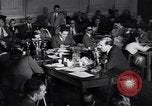
Journalist Howard Rushmore testifies before the House Committee on Un-American Activities in Washington DC.
The House Committee on Un-American Activities (HUAC or HCUA) an Investigating Committee of the United States House of Representatives, questions Hollywood personalities about communist influence. Journalist Howard Rushmore is asked questions. He is asked about Gerhart Eisler and whether he was "Jerome's "boss, and whether Eisler was a Communist. Witness answers that he is one of the major ones and that he is a representative of communist international in the United States. He mentions giving certain communists favorable press. Member of committee calls such communists 'Sacred Cows', witness call them 'Sacred Red Cows'. He takes name of Edward G Robinson and states that Jerome had instructed him to always defend Robinson, even if he gave a poor performance in a bad picture. . He talks to the committee about meeting of American committee, for the protection of foreign born, in Cleveland. Attorney General Biddle labeled it as a communist front in 1943. The committee asks him about League of American Writers and whether it is a Communist organization. Journalist also takes names of Earl Browder and Mike Gold, a writer for the Daily Worker newspaper.
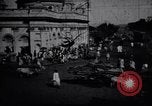
Old Howrah bridge, Calcutta, India.
View of traffic on approach to the Old Howrah floating pontoon bridge, across the Hoogly River, on the Calcutta side. Men work and carry luggage on bullock-carts. Building on the East bank of river Hoogly, used by the public for changing when they come to bathe. Men walk. Houses along the sides of a street. People walk on the street. Man buys articles from a street vendor. (Note: The Old Howrah pontoon floating bridge was used until the cantilever bridge, begun in 1937, was opened for traffic in 1943.)
CRITICALPAST.COM: About Us | Contact Us | FAQs - How to Order | License Agreement | My Account | My Lightboxes | Shopping Cart | Advanced Search | Featured Collections | Website Terms & Conditions | Privacy Policy ©2026 CriticalPast LLC.
License Agreement |
Terms & Conditions |
Privacy Policy
©2026 CriticalPast LLC.