


 Francais
 Deutsch
 Italiano
Refine Your Search
Goodenough Island New Guinea 1943 stock footage and images
- Showing 859 to 864 of 13636 results more
more Hide
Hide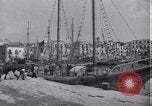
Allied Military Government working to provide medical care and food to Italians in liberated parts of Italy during World War II
Relief activities of the Allies in Italy during World War 2. Opening scene shows a sailing Schooner under Allied Navy control, docked at a port in Italy following the Allied invasion of Italy in 1943. This schooner is being loaded with Allied Military Government (AMG) medical supplies. Closeup of wooden crates containing the supplies. American medical corpsmen checking a stream of water for mosquitoes, and then spraying the area from a DUKW. A hospital building and interior with Italian women holding their infants as they await checkups and vaccinations against disease. Italian citizens in a street anxiously seeking food from the AMG. Local Italian police work to control the crowd in which some persons become unruly and have to be removed. American troops of the U.S. 5th Army marching along Italian roads. Troops riding on a Sherman tank and on a truck pulling an artillery field piece. Supply yard stacked high with food supplies for U.S. troops. (Narrator states it required 750 tons a day to feed the 5th Army.) Views of Naples harbor cluttered with 30 large ships and 300 smaller ones blown up or scuttled by retreating German forces. Firemen manning hoses to fight fires at the waterfront. Smoldering ruins in the port. Three months later, U.S. forces are seen operating supply missions through the port. View from a hill of the port with barrage balloon overhead. Closeup of flour being offloaded from holds of ships by derricks. Italian soldiers unloading the flour bags and placing them aboard trucks for transport to Italian commercial food companies. A U.S. Army Captain at a table with Italian businessmen who purchase the flour from AMG at a fair market price. Italian purchasers examining the flour. Flour being transported to bakers who bake it into bread. Young men busy making and baking loaves of bread. Loaves stacked up at the bakery. A big tray of fresh loaves being sampled by Italian officials and distributed to local Italian civilians who enjoy it.
WW2 German defensive preparations on French coast; Allied invasion scenes; Allied bombing over Germany
Slave laborers digging during the construction of the Atlantic Wall in World War II. German engineers oversee the construction. Men working around a large gun turret. Nazi German fortifications, bunkers, and artillery posts along coasts facing the Atlantic Ocean in Europe. The 380 mm gun at the Todt Battery near Cape Gris-Nez, Pas de Calais, France. 40.6 cm SK C/34 gun “Battery Lindemann” (German unit MKB 6 / MAA 244) as part of the Dover Strait coastal guns. German emplacements and troops marching along Normandy in France. A German soldier uses binoculars to watch the English Channel. Adolf Hitler and a Nazi German general. Adolf Hitler greets Benito Mussolini as the latter exits a plane in Vichy France. Allied leaders Winston Churchill, Franklin Roosevelt, Joseph Stalin, and General George C. Marshall at the Tehran Conference in 1943 during World War 2. Armies from various European countries march and prepare themselves for war against Germany. Supreme Commander General Eisenhower and other Allied generals during a meeting. Fleet of ships in sea ready to land in Normandy on D-Day. Navy and coastal command aircraft drop bombs on Nazi German submarines. Anti-aircraft guns fire at Nazi bombers. Docks damaged by German bombing receive aid from Allied countries. Cranes and hooks lower relief supplies, medicines and warfare material at dock. Warships loaded with artillery and warplanes lowered in ships by hoists. A locomotive train is being lowered from a ship. A military band plays music in a dock. Soldiers move towards the ships. British and Royal Canadian and Australian bombers at their base take off for bombing on Nazi bases at night. A soldier directs a bomber taxiing in runway. Aerial views of British bomber aircraft bombing targets in Germany at night, with immense explosions.
Test flights of German missile A-4 V2 rocket in Peenemunde. First fully successful flight on Oct. 3, 1942.
Opening slate mentions speed and pressures generated in the test launch of A4 V2 rocket. The rocket launches and appears to be successful, moving up and out of sight. However, some white smoke descends and lingers in the atmosphere afterwards. The next slate states that the causes of the malfunctions have been identified and corrected. It is followed by a slate showing date of 3 October, 1942, and another about last instructions before the 3rd launch. German rocket scientist, Konrad Dannenberg, is seen discussing matters with several German officers at the test site. (Dannenberg is in the center of the group. Second from left is possibly Wernher von Braun. Second from right is possibly General Walter Dornberger.) The next slate reads: 1558 hours (3:58 PM) followed by one reading: Fire free. A German officer is seen speaking those words into a microphone. Camera shows a technicians hand as he sets firing switches on a control panel. ;Closeup of V2 rocket engine firing up. The rocket ascends successfully and disappears from sight. (Note: The footage at the end of clip showing the successful Oct 3 flight of A-4 V2 rocket was reportedly part of a film shown to Hitler at his Wolfe's Lair in 1943.) (World War II period).
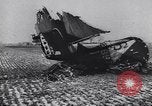
Remains of U.S. 8th Air Force aircraft shot down by German fighter aircraft and flak. U.S.flier POWs during World War II.
Tail and crushed wings of American B-17 bomber, one of several shot down over the Germany-Holland border, during World War 2. Bodies of two U.S. airmen lying on the ground next to the debris. Remains of crashed B-17, Serial number 42-39822, of the U.S. 333rd Bomb Squadron, 94th Bombardment Group, which was shot down by German FW-190s while returning from a mission to Brunswick (Braunschweig), Germany, on January 11, 1944. A fuselage from downed allied warplane being hauled away on a truck. A junkyard filled with American warplane parts, stacked by type, engines in one pile, tails in another, etc. One vertical fin, marked with the 'triangle A' of the 91st Bomb Group, is from B-17G, tail number 42-37737, named "Tennessee Toddy" of the 401st Bomb Squadron. It crash landed after losing two engines, on 10 October 1943, at Brocklanderweg, near Apeldoorn, Holland. Two U.S. Army Air Corps prisoners being interrogated by a German officer. Group of United States airmen prisoners of war, apparently showing personal identifications (dog tags) to a German interrogator.
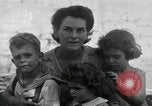
Margaret Moule, wife of William Moule, describes their life in Manila,Philippines during World War 2
Margaret Moule, the wife of William Moule, is seen along with her three children, Billy, Eileen, and Linda, late in World War 2. She describes how they hid from the Japanese in 1942, but were captured by the Japanese in 1943 and lived in a concentration camp in Manila, Philippines.
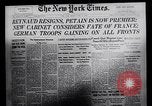
France surrenders to Germany during World War 2
French Marshal Petain, now Premier, following Battle of France, walks to a car and seen later at conference table with Pierre Laval and other national leaders. View of Adolf Hitler, with close associates, expressing delight after signing of the second armistice at Compiegne,ending resistance by France, on June 22, 1940. German honor guard marching near Marshal Foch's railroad car where the 1918 armistice was signed. Monument of Marshal Foch. Hitler, Hermann Goering, and Admiral Raeder, head of the Kriegsmarine, review the honor guard. German stand at steps of the rail car. Raeder, and Goering, both carrying Marshal's batons, flank Hitler. French Army General Charles Huntziger, accompanied by General Jean Bergeret,Air Minister, Vice Admiral Le Luc, Commander of Maritime Forces, and Ambassador Leon Noel, are escorted by two German officers. They enter the railroad carriage. View inside, as Hitler, Goering and German representatives stand when they enter. Newspaper headline describes tax on France for German occupation. French prisoners of war in an outdoor yard and being moved to Germany. French prisoners in bucket brigade and carrying construction materials. French workers engaged in labor to support German war effort. Unhappy French children. Public funerals for persons executed by the Germans. German flag draped over the Foch statue. Hitler's touring motorcade passes Arc de Triomphe in Paris in early morning when streets are empty. Parisians gather on streets to hear German orders broadcast. Many express distress. In Southern France, Military units carry their colors as they depart for North Africa. General Charles de Gaulle is among the marchers. De Gaulle seen reviewing contingents of French military. Free French soldiers parading in London, England. Military officers salute as the ship carrying Regimental colors departs. French colors carried beside unit with American flag. General Charles de Gaulle and General Henri Giraud at 1943 Casablanca Conference (Roosevelt and Churchill seated).
CRITICALPAST.COM: About Us | Contact Us | FAQs - How to Order | License Agreement | My Account | My Lightboxes | Shopping Cart | Advanced Search | Featured Collections | Website Terms & Conditions | Privacy Policy ©2026 CriticalPast LLC.
License Agreement |
Terms & Conditions |
Privacy Policy
©2026 CriticalPast LLC.