


 Francais
 Deutsch
 Italiano
Refine Your Search
Goodenough Island New Guinea 1943 stock footage and images
- Showing 7 to 12 of 13635 results more
more Hide
Hide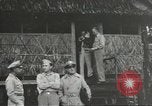
U.S. Army Chief of Staff, George C. Marshall, visits 6th Army Headquarters during World War II
George C. Marshall, U.S. Army Chief of Staff, stands on the top step of a wood and woven palm building, headquarters of the U.S. 6th Army, on Goodenough Island, New Guinea, during World War 2. Lieutenant General George C. Kenney, Commander of Allied Air Forces and the U.S. Fifth Air Force, stands with two other officers on the ground in front of the hut. General Douglas MacArthur Supreme Commander of Allied Forces in the Southwest Pacific Area (SWPA) joins Marshall and poses, standing to his left. General Marshall leaves the building to enter a car. Next, he is seen standing on the ramp of an airfield. MacArthur is also seen briefly, standing next to Marshall. General Marshall converses with Lieutenant General Walter Kreuger, Commander of the Sixth United States Army in the South West Pacific Area, and with General Kenney. General MacArthur and General Kenney, followed by other officers, walk back from a B-17 bomber (General Marshall's airplane) after saying goodbye to General Marshall. General Kreuger remains at the door of Marshall's B-17, bidding Marshall farewell. The B-17 is next seen taking off from the runway.
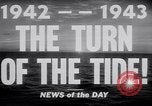
A 1942-1943 film report to the American public about the progress of World War II in Europe and the Pacific.
Opening slate at start of film reads: "1942--1943 The Turn of the Tide." A column of British armor enters Bengazi, Libya, led by several troops in tankettes. Next seen are a Lee Medium Tank, M3 followed by an infantry tank, a jeep, another infantry tank and another Lee M3 Medium tank. Closeup of local people greeting the troops with upraised hands giving the "V" for victory sign. Another Lee M3 tank passes close by the camera. Black smoke is rising in the background. Scene changes to a half sunken ship near another burning in the harbor. Another view of this from further away above port buildings. Closeup of three smiling British soldiers leaning over a cartoon on a tank, of Winston Churchill (As a bulldog smoking a cigar and wearing a cap with the word "Victory" written on it). A crumpled captured flag with swastika on it. British Field Marshal Bernard Montgomery stands atop a vehicle (unseen) and looks through binoculars. Below, a column of British supply vehicles is making its way along a path in the desert. Two tanks coming toward the camera through sand. Animated map shows Nazi territory being threatened by the Allies from the Mediterranean, the USSR, and the English Channel. Views of Soviet infantry advancing against German forces in the snow of winter on the eastern front. Soviet troops firing updated 76-mm divisional gun model 1902 hidden in woods. Shells exploding in snow-covered field as Soviet BT series tanks advance. Various Soviet artillery firing from fixed gun batteries and from woods. A shell striking in distance. Fallen German soldiers lying on snowy field. Makeshift battlefield crosses marking graves of fallen German soldiers. German steel helmets lined up in the snow. A sign, posted on a birch tree, lists the names and birth dates of 16 German soldiers from the 3rd Panzer Division (3Pz-Pi-BH.39) buried at this site on November 28, 1941. Scene shifts to Joseph Stalin addressing Soviet troops in Red Square, Moscow, Russia. All the soldiers in formation seem to be singing (unheard). Film switches to animated map again. This time delineating the Eastern front being pressed by the USSR, and showing area of the 2nd Soviet winter offensive in 1943. Change of scene from Europe to the War in Asia, against Japan, shows General Douglas MacArthur after arriving by a B-17 bomber at a Pacific island American base. He ascends a steep hill in a jungle area, accompanied by other officers. Closeup of MacArthur. American infantry moving in single file in New Guinea, as a field piece fires a round in the direction they are headed. U.S. artillerymen load shells into a 105mm howitzer gun. A fire burns as mop-up operations begin on New Guinea. An Australian soldier is seen firing a Bren gun in jungles. Other Australian soldiers fire a mortar that explodes, raising earth and dust. More views of shells exploding near Allied soldier advancing. A soldier with fixed bayonet makes a fake charge toward the camera. Views of Japanese prisoners of war guarded in an outdoor compound. Japanese dead soldiers on Guadalcanal. An animated map shows new battle lines in the Pacific, closing in on Japan, with pressure from China, the USSR, and the Pacific islands being captured by the U.S. Arrows are added showing new pressure from American naval fleets and from British and American bombers out of Australia and captured islands.
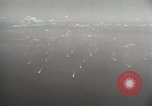
American campaign against Japanese-held islands in the Pacific during World War II
U.S. sea power in the Pacific Theater during World War II. Aerial view of landing craft speeding through the water below. Animated map of Pacific Islands including the Solomons, New Britain, and New Guinea. Shows arrows depicting American amphibious assaults on Russell Islands in February, 1943; on New Guinea, and Rendova in June, on New Georgia in July, on Eastern New Georgia in August, on Choiseul, in October, and Bouganvillle in November, 1943. Aerial view of a Pacific Island airfield. Grumman F4F aircraft with engine running on an aircraft carrier. Bow view of an American Essex class Aircraft Carrier making way in heavy seas. A Douglas Dauntless airplane heading away from a carrier (in background). Map showing locations of American North and South Pacific naval forces and arrows pointing to Tarawa Atoll in the Gilbert Islands, and then to the Marshall Islands (Kwajalein Atoll and Enewetak Atoll). American infantry marching with full field packs, at a port, where they board transport ships. An artillery field piece being loaded on the ship, along with landing vehicles tracked, and army trucks. A convoy of troop ships and supply ships at sea.
Japanese forces capture Corregidor, Philippines; Bataan Death March; Pacific supply lines to allies in Australia in World War II
Japanese forces fire artillery at Corregidor Island, during Japanese occupation of Philippines during World War II. Smoke rising from Corregidor under bombardment. Japanese troops land on Corregidor, the Philippines, on May 5 1942. A soldier watches enemies' action through binoculars. Soldiers fire artillery in the field. General Wainwright surrenders. He sits with other officers and Japanese officers and discusses. Japanese soldiers lower the American flag. Japanese troops Banzai cheer and celebrate their victory. They raise the Japanese flag. Captured Americans and Filipino prisoners of war departing Mariveles during the Bataan Death March, under Japanese guard. Map shows Japanese targets for invasion in other areas like Malay, Borneo, and New Guinea. Close up view of Japanese soldier's face. Briefing documents labeled Secret are opened and reviewed. Airplanes on the ground. U.S. And Australian troops march in Australia. Animated globe shows different countries. View of armament and artillery production factory operation in the United States supplying war materiel. Close up views of faces of war production workers. Animation and models show a supply line through which supplies are transferred to Australia. Lockheed P-38 Lightning wrapped in camouflage is lowered onto a transport ship deck. U.S. Army tank loaded onto ship and American troops go ashore in Australia. United States planes bomb and sink Japanese ships in the Bismarck Sea on March 2, 1943. View of American machine gunner firing machine gun from aircraft in flight toward enemy Japanese ships. Cockpit point of view shot out of American aircraft as it bombs and strafes Japanese ship. Bombs away view as U.S. aircraft release bombs. Smoke rises from the burning Japanese ships. General Douglas MacArthur and Admiral Chester W. Nimitz meet and discuss strategy and review maps. Animation shows different potential routes for American forces to return to the Philippines.
Role of the Jeep in U.S. military operations during World War II.
A U.S. Army Air Forces (USAAF) Waco CG-4A-WO glider is seen descending and landing in a grass field. Upon touchdown, its front pops open and and an army jeep drives out. USAAF C-47 aircraft are seen next, offloading jeeps pulling small artillery pieces, and infantry who move rapidly from the parked aircraft. Jeeps traversing a high hump in a dirt road. A jeep towing an M-3 Antitank Gun 37mm, and others driving through underbrush and bouncing over rough road while towing 37mm guns and trailers. Soldiers stepping from jeeps to set up machine guns. American soldiers playing a game of horse and rider, during a break in duties. Soldiers setting up mortars. Jeeps driving through bodies of water. Two M4A1 (76)W Sherman tanks, with cast steel hulls, drive into a stream. Troops setting up several 37mm guns on a river bank. Two soldiers in a communications jeep. Army officers perusing a map laid out on the hood of a jeep. U.S. field artillerymen using periscopic binoculars on tripods, to spot and direct gunfire. Military vehicles, including jeeps, moving across desert terrain. Artillery crews firing M59 (M2 Long Tom) 155mm guns. A Douglas A-26 Invader aircraft flying overhead. Jeeps in various roles, bouncing along in the desert and laying smoke screens. Jeeps equipped with M3 anti-aircraft guns and others with stretchers for wounded affixed to their sides. U.S. Army Ford GPA "Seep" amphibious jeeps plunging into water and continuing on as boats. A jeep production and assembly line in a U.S. factory showing stages of assembly and finished jeeps driving out of the plant into yards containing hundreds of them. A convoy of jeeps driving over a bridge, and others carrying a U.S. military brass band in a parade in England. A Hollywood actress (Gloria Swanson?) being lifted into a jeep by several men. Glimpse of an unidentified actress with an American soldier, in a jeep. Hollywood stars, Stan Laurel and Oliver Hardy clowning in the front seat of a jeep with Desi Arnaz and two women riding in the back. Several jeeps carrying these and other Hollywood personalities during a war bond parade in Washington DC. The Capitol looming in the background as the jeeps move away from it toward the camera. Jeeps being prepared for transport to overseas destinations. Jeeps being partially disassembled and loaded into wooden crates and placed on rail cars for transport. Jeeps being hauled by cranes and placed aboard ships. Landing crafts mechanized (LCMs) transporting infantry and vehicles, including jeeps. An M4A1 Sherman tank driving out of a landing craft into surf. A jeep being driven onto beach at Adak,in the Aleutians,from a landing craft of the USS J.Franklin Bell (AP-34), in 1942. In 1943, this transport ship was reclassified as APA-16.) American troops with jeep on a South Pacific island in World War 2. A soldier on motorcycle, skids in mud on road in North Africa, and jeeps drive past him. American soldiers ride camels and some drive in a jeep near the Great pyramid and Sphinx in Egypt. Jeeps seen in China, with Generals Joseph Stilwell and Claire Chennault. One parked next to a Flying Tiger P-40 airplane. Soldiers in a jeep in Alaska, next to a tent and sign pointing to "Tokyo." Local tribesmen literally carrying a jeep, on long poles, across a river in Timor. General Douglas MacArthur, accompanied by staff officers, being driven in a jeep along a jungle road in New Guinea, past a line of local tribesmen. Wendell Wilkie, serving as Ambassador-at-large, during the war, speaks to U.S. officers in a jeep. Britain's King George VI in a jeep followed by another carrying Queen Elizabeth. President Franklin D. Roosevelt riding in a jeep to review troops. He removes his hat as they pass the American flag. Sign on a building in North Africa reads "Bizerte." General George S. Patton, standing in a jeep during a victory parade in North Africa. Soldiers at an outdoor religious service during the war with the hood of a jeep serving as a make shift altar.Various views of jeeps driving with soldiers in them.
Montage of scenes related to the China-India-Burma theater during World War II
Two U.S. Pennsylvania class battleships underway at sea, with other warships in background, during World War 2. One fires to starboard with her 14-inch guns from the forward triple turrets. U.S. Army Air Forces B-24 Liberator bombers flying in formation over mountains. Glimpse of General Douglas MacArthur with General Joseph (Vinegar Joe) Stilwell in gunner's station of a bomber. Montage of brief glimpses showing U.S. forces engaging Japanese forces in: amphibious assaults; firing weapons in New Guinea and other Pacific islands. U.S. warship firing naval guns. U.S. ship firing at attacking Japanese aircraft, with sky full of black flak clouds. Admiral William (Bull) Halsey. Mitsubishi A6M Zero kamikaze aircraft blown up close to flight deck of U.S. aircraft carrier. It misses the ship and crashes in flames, exploding in the water, astern. U.S. General Joseph Stilwell, Madame Chiang Kai-Shek, British Allied commander Lord Louis Mountbatten, and Chinese Generalissimo Chiang Kai-Shek, photographed together in India. Chinese Generalissimo Chiang Kai-Shek seated for a picture with U.S. President Franklin D. Roosevelt. Camera moves back revealing British Prime Minister Winston Churchill, and Madame Chiang Kai-Shek, also seated. Behind them stand key allied military leaders, including (from the right) Field Marshal Archibald Percival Wavell, Commander-in-chief in India; Admiral Louis Mountbatten, Supreme Allied Commander of South-East Asia forces; George Giffard — commander of Eleventh Army Group; U.S. General Daniel Isom Sultan, deputy to General Stilwell; General Joseph Stilwell, Commander China-Burma-India (CBI) Command; and General Albert Coady Wedemeyer, Chiang Kai-Shek's Chief of Staff. General Joseph Stillwell is seen stepping from a military cargo plane, and being greeted by another officer. Stilwell is wearing a campaign hat. He has the CBI patch on his jacket shouder. A B-24 Liberator bomber takes off from a Chinese base at Liuchow, or possibly, Luiliang, China. (ostensibly carrying Chinese soldiers to India for training). U.S. marked P-40 aircraft are parked beside the runway. They display the shark teeth nose art of the Flying Tiger All volunteer Group of Claire Chennault. But this is 1944 and the aircraft are from the U.S. 23rd Fighter Group. Chinese soldiers are seen being armed and trained in India, with modern small arms. They are also seen fording a river with military supplies and moving in jeeps through jungle-like settings. Various views of Ledo Road construction in Burma. bulldozers, trucks, caterpillar tractors, explosives and men are shown in construction work. A jeep rides along a muddy section of the new road while U.S. and Chinese soldiers patrol on either side to protect it. Allied soldiers firing a small field piece. A C-47 aircraft airdrops supplies to the road builders. General Stilwell, standing with a Chinese officer, looks skyward at the aircraft. A C-46 Commando plane taking off from a field in India carrying supplies. Men loading a jeep aboard a C-46, plus ammunition and other supplies. Rare sight of supplies being loaded into nose cargo compartment of the one-of-a-kind XC-108A transport plane (modified B-17 bomber, tail number 41-2593). A formation of USAAF C-45 transport aircraft flying "over the Hump." Chinese P-36 Hawk aircraft in formation demonstrate firepower. Newly trained Chinese pilots marching and walking on flightline where solid-nose B-25s and P-40s are parked. Chinese and American pilots wave to each other from their P-40 aircraft. A B-25 takes off flanked by two P-40s. Bombs being dropped by Chinese B-25s. Japanese ship being strafed by Chinese fighter plane. Chinese laborers at work building an airfield without machinery. A large group pull a paving roller by hand. Chinese troops in combat with Japanese forces. One firing a Czech ZB vz. 26 light machine gun. Madame Chiang Kai-Shek addressing the U.S. Congress, 18 February, 1943.
CRITICALPAST.COM: About Us | Contact Us | FAQs - How to Order | License Agreement | My Account | My Lightboxes | Shopping Cart | Advanced Search | Featured Collections | Website Terms & Conditions | Privacy Policy ©2026 CriticalPast LLC.
License Agreement |
Terms & Conditions |
Privacy Policy
©2026 CriticalPast LLC.