


 Francais
 Deutsch
 Italiano
Refine Your Search
Goodenough Island New Guinea 1943 stock footage and images
- Showing 13 to 18 of 13635 results more
more Hide
Hide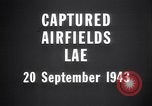
Destruction from Allied bombing at Lae airfield, New Guinea. B-25s fly bombing missions against Japanese targets in Wewak area.
Opening slate gives date as September 20, 1943. Scenes show devastation wrought by Allied bombing of the Japanese airfield at Lae, New Guinea. Most views are from the ground, as Allies occupy the field. Numerous Japanese aircraft are destroyed along with all the buildings and facilities. Next, is shown the view from inside a B-25 bomber, on September 27, 1943, as it flies in a 100 aircraft bombing mission to attack coastal facilities, ships, and airfields in the Wewak area, including the main air base at Wewak and its satellite fields at Boram, Dagua and But. Several B-25s are seen ahead in formation. View of the coastal area below as the camera plane (B-25) comes under fire by Japanese anti-aircraft guns. A pall of smoke hangs over the Wewak area from bombing by B-24s earlier. view from cockpit as the B-25 makes very low strafing and bombing attack against the Japanese satellite airbase at Boram. Another B-25 seen as it flies close to the ground. View to the rear shows small parachutes being released by the B-25, carrying single 100-lb fragmentation bombs and 23-pounders in clusters of three. The fragmentation bombs explode amongst palm trees sheltering Japanese aircraft. view out the back of the camera B-25 shows it continuing to fly, just over the tree tops, at very low altitude. Next, several B-25s are seen rejoined up in formation, ahead. Scene shifts to view from high altitude of bombs striking in the Wewak waterfront area. View from below of three B-25s in formation. Then view from cockpit of a B-25 flying low over the water strafing a ship. (Narrator says they dive low to skip-bomb a ship trying to escape.) Various views of the high hills at the waterfront. View from B-25 strafing Japanese aircraft on the ground at Dagua and Boram airfields. several B-25s in formation headed home. (World War II period).
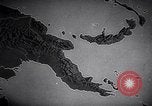
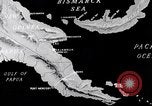
United States B-25 bombers, B-24 bombers, and P-38 fighters attack Japanese positions in Papua New Guinea.
August 1943: Animated map depicts Allied ground advances, 5th AAF air fleet stations, Japanese opposition base at Rabaul as well as Japanese positions and network in Papua New Guinea. Map depicting strategic Japanese positions of Wewak and Boram. 5th AAF soldiers decide to raid the two posts. 17 August 1943: USAAF B-25 Mitchell bombers and P-38 Lightning fighters attack the Japanese post of Wewak. Heavy bombardment by the American bombers. Smoke and explosion from the bombardment. Aerial view of the Japanese airplanes parked on the airstrip. 20 August 1943: USAAF B-24 Liberatoor bombers and P-38 Lightning fighters attack the Japanese position at Boram. Imperial Japanese Navy Air Service Mitsubishi Zeros attack the B-24s, P-38s intervene. Bombs dropped on the target. Smoke and explosion from the bombardment. (World War II period).

Allied troops advance as B-24 Liberators bomb target areas in Papua New Guinea.
1943: Animated map depicts Japanese advancement and footholds of Allied troops in Papua New Guinea. Australian 6th Division troops advance through thick jungles towards Salamaua. Soldiers route for enemies in the jungle and fire guns and artillery. Machine gun nests in the jungle. An injured soldier waits to be evacuated. The natives carry soldiers on stretchers. An Australian soldier help a wounded comrade across a river. The Australian troops are relieved by U.S. troops. USAAF B-26 Marauder at a supply depot in Kela village. Native carriers wait for supplies to be dropped from airplanes. 14 August 1943: 5th AAF bombs and strafes targets in the Wewak and Salamaua areas. USAAF B-24 Liberator drops bombs over target areas. Smoke and explosions due to the bombardment. (World War II period).
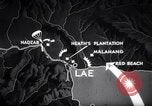
Australian 7th and 9th Division troops capture Lae in Papua New Guinea, during World War II.
September 1943, in World War 2. Animated map shows advance of the Allied troops to Nadzab and Lae in papua New Guinea. The Australian 7th Division advance towards Lae. Soldiers in jeeps, on motorcycles and on foot advance through the jungle amidst air and artillery barrage. Soldiers fire machine guns and other artillery. Animated map shows the advance of General Thomas Blamey's troops towards Salamaua. Soldiers cross the Francisco River with natives. The Australian 9th Division advances along the east coast. Soldiers in puddles and streams. A military truck stuck in the mud. Soldiers prepare for jungle fighting. Soldiers take cover among bushes as Japanese troops fire. Machine gun nests in the jungle. USAAF B-25 Mitchell bombers drop bombs over enemy territory. Fire and smoke from the explosions. AN-M40 (Para-Frag) fragmentation bombs are dropped from USAAF A -29 Havoc aircraft. Australian 7th Division troops amidst artillery and anti-aircraft fire. USAAF B-17 Flying Fortress and B-26 Marauder bombers in the sky. On 16 September 1943, the Australian 7th Division captures Lae. Bombed ruins, damaged Japanese planes, destroyed airstrips, enemy ships and boats in the harbor. Destroyed Japanese ammunition dump 'Chinatown'. Australian 9th Division crosses the Bamboo River bridge to enter Lae. Animated map shows advance of amphibious forces, paratroopers and airborne operations of the 5th AAF. U.S. General Douglas MacArthur and his men at the 90th Strategic Reconnaissance Wing quarters.
Soldiers pack supplies and parachutes at an Australian Parachute Packing Depot in Papua New Guinea.
March 1943: A map shows Salamaua in Papua New Guinea. An aircraft drops supplies with parachutes over hills. An Australian parachute packing depot. Soldiers pack parachutes on tables in rows. Stacked Australian parachutes to deliver rations, American parachutes used for Ammunition, and 24 foot parachutes for regulation. White parachutes used for medical supplies, blue ones used for rations and red used for ammunition supplies. Aerial view of Goodview, an area of conflict. A soldier radios the requirements to base. Another soldier delivers the plan to the depot. Soldiers pack mortar ammunition. The fuses and sheets are packed together in boxes. Soldiers put boxes into sacks, tie the sacks and attach parachutes. Soldiers pack canned meat: lay straw in big cans, put small cans into those, seal the big cans, secure them with a wiring machine, and attach parachutes. Sacks of rice are put into copper sacks, their mouths tied. Soldiers pack rations including onions, bacon and potatoes for delivery. Supplies are loaded onto trucks and transferred to the aerodrome. (World War II period).
C-47 Skytrains and P-38 Lightning fighters drop supplies with parachutes over Greenview in Papua New Guinea.
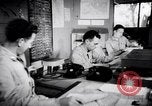
March 1943: Australian and American soldiers in Salamaua in Papua New Guinea. Trucks loaded with supplies move to the aerodrome. The Depot officers radio A3 of the 5th Air Force Headquarters, who in turn contact the 54th Troop Carrier Wing for airplanes. Brigadier General Prentiss monitors the mission with Colonel Hampton. Board shows duties of the Troop Carrier Wing. The pilots and crew are briefed for the mission. Soldiers leave in jeeps at dawn for the aerodrome. The pilots are given the time for take off. Supplies are loaded. Planes are ordered off ground. Douglas C-47 Skytrains and P-38 Lightning fighters taxi and take off. Pilot scouts the skies for change in weather and danger. Planes over drop area in Greenview, marked by parachutes from earlier drops on the ground. Soldiers put supplies onto ramps and prepare for the drop. Pilot gives the signal and supplies are dropped. (World War II period).
CRITICALPAST.COM: About Us | Contact Us | FAQs - How to Order | License Agreement | My Account | My Lightboxes | Shopping Cart | Advanced Search | Featured Collections | Website Terms & Conditions | Privacy Policy ©2026 CriticalPast LLC.
License Agreement |
Terms & Conditions |
Privacy Policy
©2026 CriticalPast LLC.