


 Francais
 Deutsch
 Italiano
Refine Your Search
Goodenough Island New Guinea 1943 stock footage and images
- Showing 211 to 216 of 13635 results more
more Hide
Hide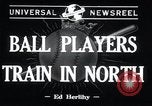
Baseball players train in northern U.S. states during World War II, 1943
Newsreel clip entitled "Ball Players Train in North" shows major league baseball teams holding spring training in 1943. Teams were not allowed to travel south to Florida because of World War 2 travel restrictions. First part of clip shows men (presumably baseball players) riding in a horse and buggy along a tree-lined road. Giants seen running on field and meeting with manager and Hall of Fame outfielder Mel Ott. Players pose for camera, all wearing long sleeves. Closeup of Giants Hall of Fame pitcher Carl Hubbell. Giants players seen throwing at posters of Benito Mussolini, Adolf Hitler and Hideki Tojo -- Leaders of the Axis powers during the war. Players look at the posters after throwing; note patriotic war patch on Giant player's sleeve. Clip shifts to Washington Senators training camp the same year. Coach and renowned baseball clown Nick Altrock leads players in warmup drills. Players warm up in outfield, near what looks like a heating plant. Closeup of Senators pitcher Dutch Leonard throwing. Closeup of Senators owner Clark Griffith (in overcoat) talking with manager Ossie Bluege. Closeup of Bluege. Players marvel over of 7-foot player Richard Ahrens, who was signed by the Senators that spring as a possible publicity stunt; he never appeared in a minor or major league game. Washington players pretend to warm themselves up by small campfire on the field. Another shot of Altrock. (Note: There is no indication where these clips were taken but the Giants trained in Lakewood, New Jersey that spring and the Senators trained in College Park, Maryland. )
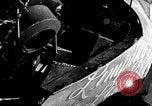
A USAAF P-38 Lightning aircraft takes off after being loaded with film magazines in Australia, during World War II
The 8th Photographic Reconnaissance Squadron in Australia during World War II. A United States Army Air Force P-38 Lightning aircraft in flight. P-38 photo recon aircraft being loaded with film magazines and then buttoned up. The P-38 Lightning aircraft takes off on a mission to photograph Japanese positions in Rabaul, New Britain, Papua New Guinea, during World War 2. The aircraft lands after returning from the mission.

Four British working men and four American counterparts visit officials concerned with war production, in New York City and Washington DC (WW2)
A British film entitled, "People to People." Four British working men, visiting America, are seen in overcoats on the deck of a ship passing the Statue of Liberty in New York Harbor during World War II. They are accompanied by four American workers who were returning on the same ship, from a similar visit to England. Closeup of the eight men, named by the narrator, who calls them trade unionists on an exchange visit. Brief view of Chiang Kai-Shek, Franklin D. Roosevelt, and Winston Churchill at the Cairo Conference in 1943.Camera pans closeup over Roosevelt and Chiang Kai-Shek. Brief views of Roosevelt, Churchill, and Joseph Stalin at the Tehran Conference in 1943. Closeup of Roosevelt and Churchill, with Anthony Eden standing immediately behind them. Closeup of Stalin and Roosevelt, with U.S. Army Air Force Chief, General Henry H.(Hap) Arnold and British General Alan Brooke, Chief of the Imperial General Staff, conversing behind them. Scene shifts back to the men aboard the ship in New York harbor, with the New York City Manhattan skyline of buildings in the background. Next, the eight men are seen climbing steps to New York City Hall. Inside they are welcomed by New York City Mayor Fiorello LaGuardia. The group is then seen entering a building in Washington, DC, where they sit down at a table with Donald Nelson, Head of the U.S. War Production Board. In the Department of Labor building they meet William Hammatt Davis, Head of the War Labor Board, and also the Secretary of Labor, Frances Perkins. After that they are seen heading into the White House, where they are met by Mrs. Eleanor Roosevelt, who comes out of the White House to greet them on the porch. (Narrator says she later invited them inside for tea.) The men are next seen climbing the Capitol steps. Vice President Henry A. Wallace comes out to greet them and comments about industrial production not only during the war, but in the time of peace to follow.
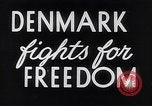
German occupation, martial law, and Danish resistance in Denmark during World War II
Film about Denmark after the Nazi German occupying force declared martial law and state of war with Denmark, in 1943-44 during World War 2. It was made by Danes and smuggled out of Denmark during that period. Opens with view of a church building and flocks of birds. Views of German army troops marching into Copenhagen, Denmark on April 9, 1940. SS troops dressed in black, marching. German soldiers carrying rifles with fixed bayonets, goosestepping. A fire burning at site sabotaged by Danish resistance elements in 1943. Derailed trains carrying goods to Germany. Fire at a German factory. Danish workers with bicycles staging a strike in protest German measures in response to resistance actions. Danes gathered in outdoor observance memorializing those killed by the Germans. A shop owned by German sympathizers (Quislings) destroyed by other Danes. People gathered on street on 29 August 1943, when the occupying German forces attacked the remaining Danish garrison and declared martial law. Announcement posted in Danish on a wall. View of Danish Naval vessels ordered scuttled by the Danish Admiralty, including the coastal defense ship,Peder-Skram, seen in front of a large building, the submarine, Havfruen (not seen) and others seen sunk at docks in Copenhagen harbor. Bullet hole through a glass window. A week later, on Sunday, 5 September, 1943, a German Panzer light tank is seen moving on a street, as pedestrians go about their business in Copenhagen. German soldiers patrolling on a motorcycle with sidecar. A man holding his hands up as he is hustled through a crowd under arrest by a German in black uniform (possibly Gestapo or SS). Motorcycle driving through pedestrians on the sidewalk. Spectators line a fence by an open field near a building labeled "Badstue Badminton." One, a woman, speaks through the fence to a Danish soldier interned there. View of the quarters of the Royal Guard at Rosenborg, occupied by German soldiers and with Nazi flag flying above it. Civilian relatives of interned men wait outside army headquarters for news about them. A courtyard, during a mass funeral, is filled with memorial flower wreaths covering the coffins of Danish soldiers and civilians killed by the Germans. Camera focuses on a wreath from King Christian of Denmark, among the many others. Two German soldiers march up a path at the Royal Residence Amalienborg, where King Christian is arrested. Views from moving camera as Danish flags are seen flying all over the city of Copenhagen, on 26 September, 1943, to celebrate the King's 73rd Birthday. The major exception is the Nazi Gestapo headquarters in the "Shellhus" (the prewar Shell Oil offices) shown in isolation. Views of people moving their belongings on hand carts after their homes were taken over by Germans. The slogan in English, "Do it well and do it now,"is seen left by Danish resistance fighters where they sabotaged a German military installation.
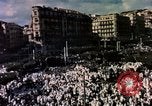
Independence celebrations in Algeria and unfurling of the Algerian flag at the UN Headquarters in New York City.
A documentary titled 'America salutes Algerian Independence' depicts independence celebrations in Algeria and its admission into the United Nations. A huge crowd of people in the streets of Algeria in north Africa to celebrate their independence. The Algerian flag is waved. Algerian soldiers march on parade. People with the Algerian flags. The Algerian flag is raised in a ceremony. Soldiers stand at attention. The United Nations Headquarters in New York City in the United States. Flags of the member nations flutter. Algerian Prime Minister Mohamed Ahmed Ben Bella is greeted by UN Secretary General U Thant, President Ahmed Sekou Toure of Guinea and President of the UN General Assembly Muhammad Zafrulla Khan. The Algerian flag is unfurled and it flutters among the flags of other member nations. Algerian war victims present at the ceremony. In the UNO, the full body of the General Assembly gives a standing ovation to Algeria as it joins the UNO. Algerian delegates seated. A map of Africa with the focus on Algeria. The capital city of Algiers. Ships at the harbor in Algiers. People in a market place. Minarets of Jeema Kebir Mosque . The National Museum houses things of art and craft such as brocade garments, rugs, specimens of metal work and jewelry.
The bombing of Rekata bay, near Munda in the South Pacific,on August 24th 1943.
Bombing of Rekata bay (near Munda and Guadalcanal in the South Pacific) during August 24th 1943. U.S. B-24 Liberator bombers of the 13th Army Air Forces in flight at a high altitude over the bay. Bombers drop bombs on Japanese targets at Rekata bay. (World War II period).
CRITICALPAST.COM: About Us | Contact Us | FAQs - How to Order | License Agreement | My Account | My Lightboxes | Shopping Cart | Advanced Search | Featured Collections | Website Terms & Conditions | Privacy Policy ©2026 CriticalPast LLC.
License Agreement |
Terms & Conditions |
Privacy Policy
©2026 CriticalPast LLC.