


 Francais
 Deutsch
 Italiano
Refine Your Search
Goodenough Island New Guinea 1943 stock footage and images
- Showing 283 to 288 of 13635 results more
more Hide
Hide
Destroyer Escort USS Frament, DE 677, is built and launched. Destroyer Escorts fitted out, readied for shakedown cruise
U.S. Destroyer Escort USS Brennan, DE-13,underway. U.S. navy crew aboard the ship. View at shipbuilding area of Bethlehem Steel in Quincy, Massachusetts. Keel is laid and shipbuilders busy on day 60 of construction of DE-677, the USS Frament. Scenes of construction. Welding steel plate. DE-677 is christened USS Frament and launched on June 28, 1943. Destroyer Escorts at pier, being fitted out. New ship's crew assembled on pier and boards for shakedown cruise. Supplies and munitions loaded on board the ship, including ammunition, depth charges, and torpedoes ("tin fish").
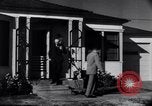
British worker and his American counterpart in labor exchange program visit the Lockheed aircraft plant in Los Angeles, Calfornia
A British guest on labor exchange program visit to the U.S. during World War 2. He leaves the home of his counterpart American host in Los Angeles, California. They leave in the American's car and drive a considerable distance to the Lockheed Aircraft Company facility. View of Honor Roll listing 15, 174 Lockheed affiliated members of the U.S. Armed Forces. The British-American pair walk past a Lockheed Ventura airplane under construction. View of a room filled with P-38 Lightning fighter planes completing final construction, outside the plant. A film clip of the maiden flight of the Lockheed Constellation aircraft (Later designated C-121 by the Army Air Corps) is inserted at this point. It shows the Constellation taking off from the factory airstrip in 1943, and climbing without raising its landing gear. View of aircraft fuselage under construction, where the British worker is inquiring about the manner of its assembly. Next he is seen observing a turntable press operation being run by men and women workers. View of workers using pneumatic hand tools to remove wrinkles from edges of pressed products. A woman punch operator is seen with safety straps on her hands that pull them away each time the punch comes down. Another woman worker demonstrates an electric spot welder. (The observing visitors are required to wear safety goggles in case sparks are created by the process.) Closeup of the aircraft part being spot welded. More workers operating similar machines in the plant, including an African American man and woman. Workers placing a large sheet of aluminum into a machine that fabricates wings for the P-38 fighter plane. Closeup of the British worker and his American counterpart on a balcony overlooking the production line for the Lightning aircraft. View across the production line floor. The two look into the factory first aid station available to workers and also see the transportation section where worker carpools can be formed. Employees are seen obtaining ration books and driver licenses from government clerks working in the plant itself. Employees are seen eating outdoors under foliage camouflage and others gather at an indoor eating site. Next, a section of a B-17 flying fortress wing, is seen moving out of a manufacturing jig. New components are immediately placed into the empty jig for construction. View of final installation area for B-17s, An overhead crane moves a finished wing, including engines, to be mated with its fuselage. Glimpse of numerous B-17s being assembled. A finished B-17 bomber being towed out of the factory.

Airfield is being constructed at Marston Strip in North Carolina. First use of "Marston Mats."
Views of diesel powered bulldozer leveling off sandy field and pierced steel planking (PSP) laid down by U.S. Army workers to quickly build landing strip at Marston Strip, North Carolina, supporting Camp Hoffman airfield (later renamed Camp Mackall in 1943). A C-47D aircraft landing on the new landing strip. This was the first use of the perforated steel planking, nicknamed "Marston Mats" (or sometimes misspelled "Marsden Mats"), which were widely employed by the U.S. Army in World War 2.
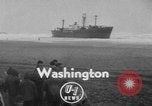
The freighter SS Yorkmar aground, awaits re-floating, on a beach near Grays Harbor, Washington State, United States
The freighter SS Yorkmar, owned by the Bethlehem Steel Company, and operated by the Calmar Line, is aground on an open beach north of Grays Harbor, Washington State, United States. A ship's officer and some members of the crew are seen briefly,on the shore. A Coast Guard helicopter hovers over her stern while carrying a line out to the ship from the shore. Crew members are seen standing in the water near the Yorkmar,and pulling on a line from the ship to the shore. Others climb a rope ladder up the side of the Yorkmar. The crew remains with the ship awaiting tide to refloat her. (Note: The SS Yorkmar, seen here, should not be confused with a ship of the same name that was torpedoed in 1943. This ship was originally a Liberty Ship, launched in 1944, and named the "Walter Kidde." After the war, she was operated by Calmar SS Corporation of New York and renamed the "Yorkmar," in 1947.)
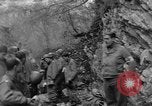
U.S. Army forces assault the German Winter Line of Defense during the Italian campaign of World War II
American troops of the 45th Infantry Division, are seen in mountains after breaking through the first segment of the German Winter Line, near San Pietro Infine, Italy, in World War 2. It is Christmas Day, 1943 and they occupy Mount Lungo. They receive Christmas dinner in their individual mass kits and sit down on the ground to eat it. On December 28th, they employ pack mules and also use stretchers to retrieve remains of fallen 3rd Division defenders down the steep mountain trails of Mount Lungo. They place the carefully wrapped remains at the base of a bullet pock-marked stone structure. Scene shifts to Mount Sammucro where American troops take advantage of a brief lull in fighting. On 1 January, 1944, Second Corp reinforcements have arrived and Americans commence a new assault on the German Winter Line defenses, with an artillery barrage on German positions guarding San Vittore del Lazio. View of smoke rising from that town. Shelling of Mountaintop flanking Highway 6held by Germans. Groups of American troops firing mortars from valley below. Shells exploding on German positions. Closeup of American gun crew loading and firing a 155mm long tom field gun. Soldiers holding their ears when gun fires. Bombs dropped from American warplane aircraft explode near roads in the valley. Glimpse from U.S. warplane flying overhead, of smoke rising from German positions in the Winter Line. Soldiers of the 168th Infantry Regiment firing a recoiless rifle from wooded area. Shells striking at base of mountain. Troops of the U.S. 137 Infantry Regiment advancing on San Vittore. view in the Italian town on 7 January, 1944, when street fighting has ended. American soldiers are seen mingling with the civilian inhabitants. German military equipment destroyed and burning during the American Winter Line offensive. Captured German soldiers being taken into custody, searched, and processed as prisoners of war.
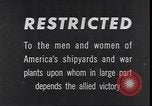
1940 launching of USS Hornet (CV-8); accomplishments of USS Hornet, famous for the 1942 Doolittle Raid during World War II.
A film titled 'The Life and Death of The USS Hornet' dedicated to the workers of America's shipyards and war plants during World War II. The Capitol building in Washington DC. U.S. President Franklin Roosevelt gathered at press conference to announce the bombing of Tokyo Japan by Doolittle Raid forces in April 1942. Reporters run out to phones and typewriters. A man at NBC microphone in 1943. The headlines of newspapers read 'Japs Murder Doolittle's Fliers'. American people in groups and families listen to radio broadcasts, gathered at work and in living rooms around radios to hear the radio news. They buy newspapers at newsstands. Headline of newspaper reads "Carrier Hornet was Shangri-La". Workers at shipyard, factories, machine shops. Men and women war workers of varying ages and races, including white, Japanese-American, and African-American seen welding, machining, and working to buld the ship and its parts. Scenes from the launching of USS Hornet CV-8 in December 14, 1940, with sponsor Annie Reid Knox at the launching.
CRITICALPAST.COM: About Us | Contact Us | FAQs - How to Order | License Agreement | My Account | My Lightboxes | Shopping Cart | Advanced Search | Featured Collections | Website Terms & Conditions | Privacy Policy ©2026 CriticalPast LLC.
License Agreement |
Terms & Conditions |
Privacy Policy
©2026 CriticalPast LLC.