


 Francais
 Deutsch
 Italiano
Refine Your Search
Goodenough Island New Guinea 1943 stock footage and images
- Showing 277 to 282 of 13635 results more
more Hide
Hide
A 1943 film promoting the U.S. Army Service Forces and the importance of Logistics in World War II
A stream of U.S. Army trucks heads along a highway as opening slate rolls, emphasizing the importance of logistics to wartime operations. Two U.S. Army small hatch M4 Sherman tanks (Possibly Ford built moels M4A3) rush down a hillside toward the camera. View from atop a tank with Browning M2 .50 caliber heavy machine gun installed. It heads uphill, firing rounds from its gun, raising explosion of earth ahead of it. Barrel of a 240 mm howitzer gun swings up in front of the camera. A U.S. coastal defense gun firing from a fort. Rear view of 240 mm Howitzer being fired. Towed field artillery pieces being fired. Troops near water, firining a Bofars 40 mm anti aircraft gun. A U.S. soldier firing a Browning 1917 water cooled machine gun. A B-17 bomber in flight overhead. View of a bombardier at a Norden bomb sight inside the B-17 with his finger on the bomb controls. The bomb bays open and bombs fall, seen striking in a line on the ground. Ground level views of large explosions on the ground. A tank camouflaged in underbrush, firing its gun. A small hatch Sherman tank charging the camera. Several German Messerschmitt Bf 109 aircraft flying fast and low on strafing runs. A soldier firing an antiaircraft machine gun. Closeups of three Messerschmitt Bf 109 aircraft attacking at high speed, only several feet above ground. Bombs bursting in a field where a soldier in lying next fo barbed wire. A tank knocking trees over as it emerges from woods. Infantry following tanks across a field. A series of scenes showing armor and infantry charging. In one, troops are wearing gas masks. A huge explosion in a field. Paratroopers inside an airplane connect to a static line and jump from the plane. Lines of parachutes fill the sky as paratroopers jump from C-47 aircraft. Closeup of paratrooper as he descends and hits the ground. View of Polish cavalry riding in a loose formation. German gun crew fires at Polish city. Smoke rising from burning buildings. Norwegian flag flying over a fort in Norway. Views of German Ju-52 aircraft in flight over Athens, Greece. It flies over the Parthenon and other ancient buildings. German tanks and troops entering Belgium. Troops marching in Yugoslavia. The American flag flying over Bataan. Civilians grieving over dead in Poland. Dead victims of war in Norway, Greece, Belgium, Yugoslavia, Malaya, Singapore, Shanghai, and Mandalay. A group of civilians grieving over two dead children. The German (Nazi) flag flying from a flagpole. (World War II; WW II; World War 2; World War Two)

German soldiers raffle chances on geese during 1943 Christmas celebration in Germany.
Christmas celebration in Germany. World War 2 German soldiers raffle chances on geese. Two men seated at a table. Geese picks up numbers from a bowl. One soldier matches the picked numbers with the ones in his ticket.
828th Engineer Aviation Battalion rebuilds airfield at Munda Point, New georgia, solomon islands, in World War II
American Army's 828th Engineer Aviation Battalion (African American) reconstructs airfield, at Munda Point, New Georgia, Solomon Islands, in World War 2. Originally constructed by the Japanese and captured by U.S. Forces, the airfield is unusable and requires rebuilding. African American bugler blows reveille and the Battalion begins a day of work reconstructing the field. Battalion engineers pile into trucks, as their names are called, and head from their bivouac area to the airfield work area. They climb aboard and begin to operate heavy construction equipment, such as graders, tractors, steam shovels, and dump trucks. Surveyers seen using a level in the midst of the field. A machinist steps into a shop contained in a truck, and begins turning a part on a lathe. One engineer steps into a shed containing heavy equipment. Team of men in an excavation pouring concrete. Grading equipment seen smoothing the field surface, and steam rollers packing down the surface. A plane takes off in background. View from above, of Douglas Dauntless SBD aircraft all over the field. A C-47 transport plane in foreground. A B-24 Liberator bomber taking off. Engineers climb aboard a truck at end of work shift. Back at their encampment, the men gather around as mail call is in progress. They enter a mess tent, go through a chow line and eat together at tables. Another tent is seen with sign outside reading: "Munda Cotton Club." Inside, the men relax, playing cards, smoking, playing checkers, and writing letters. Change of scene shows Chaplain leading singing during church service. As a day ends, the bugler blows taps. A sentry stands at ease with rifle. (Note: Sound is very poor and undiscernible in much of the clip.)
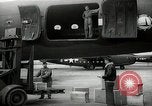
The United States Air Transport command crew loads V-discs on plane at LaGuardia Field, Long Island, New York.
Transportation of V-Discs by the United States Air Transport command, Army Air Forces at LaGuardia Field, Long Island, New York. Crew members load cartons of V-discs on transport plane, ground crewman notes. Elevator rises to plane with cartons of V-discs. Crewman stands on door of the plane, he carries the carton. 'Destination Australia', 'PSX02' and 'V- disc' written on the carton. Crew loads carton onto plane. V-disc record.

A new amphibious sports car known as the Amphicar being tested at Long Island in New York.
A new amphibious sports car 'Amphicar' being tested at Long Island in New York. The car is navigated through a river. The Amphicar successfully crosses the river and reaches the shore.
View from Ellis Island of Statue of Liberty on Liberty Island and the World Trade Center in New York, United States.
Shot from Ellis Island looking out to Lower Manhattan and over to Liberty Island and its vicinity in New York City, United States. The recently completed World Trade Center Twin Towers. View of broken piers and debris in water near Ellis Island complex. The Statue of Liberty on Liberty Island.
CRITICALPAST.COM: About Us | Contact Us | FAQs - How to Order | License Agreement | My Account | My Lightboxes | Shopping Cart | Advanced Search | Featured Collections | Website Terms & Conditions | Privacy Policy ©2026 CriticalPast LLC.
License Agreement |
Terms & Conditions |
Privacy Policy
©2026 CriticalPast LLC.