


 Francais
 Deutsch
 Italiano
Refine Your Search
Goodenough Island New Guinea 1943 stock footage and images
- Showing 523 to 528 of 13636 results more
more Hide
Hide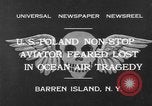
Aviator Stanislaus Hausner poses with her wife Martha at Barren Island in the United States before an air tragedy.
Aviator Stanislaus Hausner and his aircraft disappear over the Atlantic Ocean during a trip to Poland from Floyd Bennett Field in New York, United States. Past events show men towing a Bellanca CH Pacemaker aircraft out of a hangar on Barren Island. Aviator Stanislaus Hausner stands beside the aircraft with his wife Martha. They kiss and pose for the camera. The aircraft taxis and takes off from an airstrip. The aircraft gains altitude.
USS Nautilus (SSN-571) submarine on a cruise from Groton to New York.
USS Nautilus (SSN-571) plays host to civilian newsreel cameramen for the first time in Groton. Nautilus submarine departs for New York from Groton. Navy personnel at controls aboard USS Nautilus. Men eat at tables aboard the Nautilus. The Nautilus enters New York Harbor. View of boats spraying water with Manhattan Island skyscrapers of New York City in background. Also view of the USS Nautilus surfaced in the harbor, with the skyline of Manhattan behind.

Scenes of various atomic bomb tests conducted by America during a course of time.
Scenes of various atomic bomb tests conducted by America during a course of time. Shows the atomic bomb test in Alamogordo, New Mexico(1945). Nuclear weapons tests for shot Able and shot Baker, tested at Bikini Atoll in the Marshall Islands as part of Operation Crossroads(1946). Close -up view of massive nuclear explosion at sea seen from shore with blast wave approaching unmanned ships near harbor and a palm tree on shore seen waving dramatically. Atomic bomb tests at the Enewetak Atoll (sometimes spelled Eniwetok or Eniewetok) In the Marshall Island as part of Operation Sandstone (1948). (World War II period).
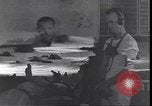
U.S. Navy USS Hornet (CV-8) sinks after battling Japanese bombers during Battle of the Santa Cruz in World War II.
Battle of the Santa Cruz Islands, Solomon Islands on 26th of October, 1942 during World War II. U.S. aircraft take off from U.S. Navy USS Hornet (CV-8) carrier at dawn. Members of crew on U.S. carrier look through binoculars. Japanese bombers formation overhead. Gun crews of USS Hornet (CV-8) attack the Japanese aircraft. Japanese aircraft in flames crash. Flak bursts in sky. USS Hornet gets torpedoed and bombed heavily. USS Hornet burns. The crew abandons the USS Hornet. Members of the crew board rescue boats. USS Hornet being sunk by torpedo attacks at night. Wounded men transferred to other U.S. ships and taken ashore. New ships being launched from shipyards in United States.
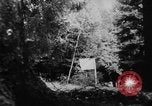
Cold War commences in Europe and UN takes military action against North Korean aggression
Opening scenes show people of East Germany escaping from the Soviet-controlled zone, to the West, through forests. Whole families are seen carrying whatever they could in back packs and suitcases. Early in Korean War period: An animated map is inserted showing a map centered on Korea, with the 38th Parallel dividing Communist North Korea from South Korea. View of a line scratched in a dirt road, designating the 38th Parallel, leading to a temporary border with guard post, established for administrative purposes. View of Ducksoo Palace, in Seoul, Korea, headquarters of the United Nations (UN) Commission on Korea. Diplomats inside its chambers, trying (in vain) to negotiate the withdrawal of Soviet forces from North Korea. United States troops are seen evacuating from South Korea, after the establishment of the Republic of Korea. Carrying duffel bags and all their gear, they board trains to evacuation ports. General scenes of landscape and South Korean people going about their normal activities, under the new government. Smoke rising from surprise attacks by North Korea against the South. Republic of Korea (ROK) troops march to defend against the North's aggression. ROK troops in trucks and trenches fire small arms against the invaders. Huge numbers of refugees are shown fleeing the North. Soldiers raise international flags at the headquarters of the United Nations, in Lake Success, Long Island, New York. Inside, diplomats meet to deal with the crisis. View of empty place at the table labeled "Union of Soviet Socialist Republics." Warren Robinson Austin, U.S. Ambassador to the UN is seen as well as other UN representatives. (Narrator states that after its cease fire order had been ignored by the Communists, the Security Council voted for united military action against the aggressor, and provided for a unified command of United Nations forces.) View of the delegates voting with raised hands. U.S. General Douglas MacArthur is seen receiving the first UN battle flag. Aerial views of the Port of Pusan, Korea. The U.S. Navy transport ship, USS Pickaway (APA-222) is seen being moved by tug boats in the port. View of the troop ship loaded with American troops headed to the port of Pusan, Korea. Color guards waving flags of the UN, the U.S. and the Republic of Korea, as they lead a military brass band marching along the pier. Change of scene to American troops marching along opposite sides of a road in Korea, as jeeps drive in the middle. Troops, including ROK soldiers, engage North Koreans with small arms, mortars, machine guns and artillery field pieces. Back in America, troops parade along Constitution Avenue in Washington DC, with capitol building seen in background. American soldiers boarding a train. Camera focuses on shoulder emblem of a Canadian officer boarding a train and then shows Canadians marching to a port of embarkation. Turkish troops pass in review on their way to Korea. Troops of the Netherlands on the march. Australian troops assembled before sailing to Korea. Swedish doctors and nurses boarding a ship to Korea, where they will set up hospitals to treat the wounded. British sailors boarding ships for action in Korean waters. Glimpse of a British Colossus class aircraft carrier, underway in Korean waters. Views of other UN forces headed to Korea. The UN General Assembly building in Lake Success, Long Island, New York. View of delegates inside the building. Film ends showing a rotating globe of the world, with flags of Nations participating in UN actions in Korea, being shown as the globe passes their respective countries.
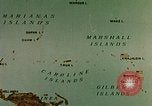
U.S. Naval Task Force 58, including USS Yorktown attacked by a Japanese Kawanishi H8K flying boat in the Pacific.
USS Yorktown CV-10 in the Pacific Theater during World War II. Early 1944: Animated map shows the Caroline Islands, Mariana Islands, Gilbert Islands and the Marshall Islands in the Pacific. The U.S. Naval fleet advances from Truk Islands towards an advanced naval base in the Marshall Islands, taken from the Japanese. U.S. ships underway around the fleet anchorage. U.S. Navy Aircraft Carriers, battleships, cruisers, fleet auxiliaries and support ships. Crew and aircraft on the flight deck of the 'Fighting Lady' CV-10. The crew members relax and enjoy themselves in the water. They dive and jump off a makeshift platforms and diving boards into the ocean, and then swim and play around large floating rafts. Sailors sort letters in the ship's post office. Some write letters back home. The crew assembled on the ship deck. Commander of the ship Rear Admiral Joseph James 'Jacko' Clark briefs the crew about their mission, designation to Task Force 58, and advance towards Tokyo. The USS Yorktown and other carriers of the Task Force underway. Sign boards for various Ready Rooms on the ship. Air Group Commanders and pilots ready on call. Rear seat gunners and radio men on call in another Ready Room nearby. They talk, relax, drink Coca-Cola and have ice cream. Flags on board. Commander of the TF 58 Admiral Marc Andrew 'Pete' Mitscher and Skipper Clark on the flight deck. A poster for the ship board movie 'Home in Indiana'. Sailors watch the movie. Planes in flight through clouds, the Task Force underway seeking the Imperial Japanese Naval fleet. New cruisers, Coast Guard cutters and Navy Transports in the Task Force. The patrol spots a Imperial Japanese Navy search plane, a Kawanishi H8K flying boat called 'Emily' by the Allies. The plane fires at the Task Force ships before being hit and sinking in the water. U.S. officers and sailors in a discussion. An animated map depicts the objective to move towards and free the Mariana Islands.
CRITICALPAST.COM: About Us | Contact Us | FAQs - How to Order | License Agreement | My Account | My Lightboxes | Shopping Cart | Advanced Search | Featured Collections | Website Terms & Conditions | Privacy Policy ©2026 CriticalPast LLC.
License Agreement |
Terms & Conditions |
Privacy Policy
©2026 CriticalPast LLC.