


 Francais
 Deutsch
 Italiano
Refine Your Search
Greek-Civil-War stock footage and images
- Showing 9115 to 9120 of 27484 results more
more Hide
Hide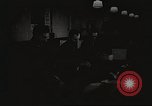
U.S. Army movies are loaded on and transported by ships, airplanes, dog sleds and camels to remote areas during World War II
Distribution of motion pictures to U.S. Military units during World War II. Men work in an office of overseas motion picture service in New York. Men tying a document related to shipment of films. Men discuss amongst themselves. The films are placed in wooden cases for shipment. Animated map shows various locations. An airplane in flight. Men unload the wooden cases from the airplane. A ship docked in a harbor. Men gather near the ship. A man enters a building in New Delhi, India. A sign outside the building reads: 'India Film Exchange Film Library'. A sign outside other building reads: 'Special Service Section'. Men stand outside the building. A car arrives near the building. The films are transported to remote areas with the help of dog sleds and camels.
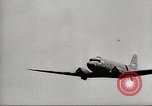
U.S. troops and their improvised movie theaters in combat zones during World War II
A U.S. Army Air Forces C-47 airplane carrying movies among its cargo bound from New Caledonia to troops stationed at Bougainville, Solomon Islands, during World War 2. Views inside the airplane cabin, where troops sit alongside the cargo. Glimpse from cockpit of aircraft on final approach to land on the airfield. Troops unloading canisters of movie films from the C-47. (Handing the movie reels out of the C-47 is Russ Laming of the 13th Troop Carrier Squadron, a.k.a the Thirsty 13th.) Army truck carrying mail bags and movie films driving away from the airfield. U.S. soldiers walk to their makeshift movie tent from foxholes and fortified positions. Sign on the tent reads: "Bougainville Roxy, Tonights feature." Movie projector seen inside the tent, as soldiers enter. Views of movie theaters made out of logs and other available materials at various locations in the Pacific theater of operations. They range from simple and rugged to more elaborate, at rear locations, away from the front lines. U.S. servicemen racing to get the best seats in a theater, as the doors open for a movie. Servicemen walking into an open air theater. They are called to attention as the unit commander arrives and takes his seat. View of wounded soldiers recuperating in a hospital,where a movie camera is being set up in the ward. They are tended by a French nurse wearing a "flying nun" hat (possibly North Africa). Servicemen and women being seated in an outdoor theater, and other places, waiting to watch movies. Allied troops join Americans to watch U.S. movies. A theater sign announcing the week's movie program at a Royal New Zealand Air Force post in the jungles. Courier carrying film canister from a jeep into a jungle theater. Soldier mounting the film on projector. U.S. troops watching a movie outdoors, during rain storm.
U.S. service personnel watch movies in various parts of the world during World War II
Audiences of U.S. servicemen and women watching Hollywood movies in a regular base theaters and outdoors in jungle combat settings, during World War 2. Views of the faces of audience members and their reactions as they watch movies on screen. Soldiers leaving a large elaborate movie theater after seeing a movie. Lieutenant General Brehon Burke Somervell, U.S. Army Chief of Logistics, expressing the Army's appreciation to the motion picture industry as he accepts the 10 thousandth Hollywood movie for exhibition to troops overseas. General Somervell mentions visiting troops in Australia, India, China, and Africa and comments on the way movies boost their morale.

U.S. 16th Armored Dividion in Pilsen, Czechoslovakia, at end of World War II. Firing at snipers
Czech civilians pose with some U.S. soldiers of the 16th Armored Division, in Pilsen, Czechoslovakia, at end of World War 2, in Europe. They are standing on top and in front of an abandoned German tank. They completely cover the tank, and wave enthusiastically for the camera. Scene shifts to the rear of an M24 Chaffee light tank, with some civilians gathered around it, as it prepares to move out, behind an M3A1 halftrack pulling an M10 ammunition trailer. Views of other halftracks loaded with U.S. troops and equipment. Several American infantrymen gathered at a fence, one pointing out sniper location, while another takes aim with his rifle. American soldier in a 105 mm Howitzer Motor Carriage M7 (aka, 105 mm Self Propelled Gun, Priest, by the British Army). He is firing its M2 .50 caliber air-cooled machine gun in its raised cupola. Brief glimpse of a Czech soldier aiming his rifle behind a tracked vehicle.

Soldiers march during a meeting of Allied Generals in Ludwigslust, Germany at end of World War II.
Allied Generals meet in Ludwigslust, Germany at end of World War 2, in Europe. Formations of British and U.S. troops pass in review. Russian, U.S. and British Generals review the troops. U.S. Army Major General James M. Gavin, Commanding General ( CG ) of the 82nd Airborne Division, U.S. Major General Matthew B. Ridgway CG 82nd ABN, Lieutenant General Miles Dempsey Commanding General British 2nd Army and Soviet Colonel-General Ivan Tikhonovich Grishin, Commanding General 49th Soviet Army, at the reviewing stand.
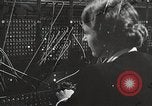
A Port of Embarkation switchboard operator continues working after receiving news of the death of her son in World War II.
Contribution of Signal Corps and army messengers during World War II. A map locates target areas. Telephone operators seated at a switchboard in the United States, at a Port of Embarkation. Men and women work in a room and pass messages to soldiers at a battlefield. The switchboard operator goes on break and places a call to her 10 year old boy at home using a pay phone booth. The woman picks up the phone and dials a number. She talks to her son and gets the information of the death of her eldest son, a Signal Corps soldier in combat. She puts the phone down and sits in her chair. Other women talk to her and suggest that she go home. She continues with her work.
CRITICALPAST.COM: About Us | Contact Us | FAQs - How to Order | License Agreement | My Account | My Lightboxes | Shopping Cart | Advanced Search | Featured Collections | Website Terms & Conditions | Privacy Policy ©2026 CriticalPast LLC.
License Agreement |
Terms & Conditions |
Privacy Policy
©2026 CriticalPast LLC.