


 Francais
 Deutsch
 Italiano
Refine Your Search
Greek-Civil-War stock footage and images
- Showing 919 to 924 of 27579 results more
more Hide
Hide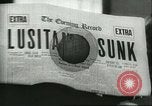
Men aboard U.S. merchant ships underway at sea in the United States after the declaration of war in World War I.
The legislative and maritime history of the U.S. Merchant Marines. Newspaper headlines in the United States read: 'SS Vigilancia', 'Torpedoed', 'US declares war' during World War 1. Women march in a parade with a banner "Wake Up America". President Woodrow Wilson with military and other officials marching on a New York City street decked out for a parade. U.S. infantry and cavalry pass led by General Pershing on streets of Paris France. Buildings along the sides of an American city street decorate with bunting for a parade. U.S. Army soldiers pass in parade review. Soldiers aboard a ship. The U.S. troop carrier ship underway at sea bound for Europe. Women and families on shore dock wave hands and scarves to the departing U.S. forces heading for the war front. Supplies being loaded onto a ship. Shipbuilders quickly working to build both steel and wooden ships to carry forces in the war, due to a lack of transport ships. A newly completed ship slides down the ways and takes float. Men standing on the deck of the ship. A newspaper headlines reads: 'War Ends'. A busy American shipbuilding and port area crammed with ships of all sizes. Ships sitting idle after World War I and some in disrepair including one with name "America" on the bow.
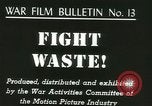
U.S. Government tells citizenry how they can help the war effort by living conservatively and avoiding waste, early in World War II
A public service informational campaign during World War 2 in the United States. A uniformed nurse tends to a U.S. Army Sergeant, Vincent Booth, who lost a leg during the African campaign of World War 2. He is in a wheel chair. The Sergeant speaks about the things that can be done on the home front to ration and help the war effort. As he narrates, a typical American family of three, father, mother, and youth in Boy Scout uniform, are seen sitting down at their dining room table. Missing is their daughter, serving as a WAC overseas (shown briefly in uniform) and their son, in the Navy (also shown briefly, in uniform). Scene shifts to the father at his work place. Narrator says he uses 10 percent of his weekly income to buy war bonds. The mother is seen at home with her Boy Scout son. She is writing letters to her son and daughter in the service. Change of scene shows her in a hospital, volunteering as a Red Cross Nurses aid. Next, the family members are seen in their home, characterized by the narrator as "an arsenal for victory," where they are being careful not to waste resources like electricity, home heating fuel, and cooking oils. They contribute their old metal objects to the war drive collections, and their son in the Boy Scouts participates in the local paper salvage drives. He is seen in Boy Scout uniform tying up a bundle of newspapers (with pictures of Hitler and Tojo on top which he dramatically stands on when tying the papers). They repair and use their old clothes, or contribute them to charities. The propaganda film ends summarizing ways that ordinary civilians can help the war effort, by rationing and avoiding waste at home, with on screen instructions: "Fight Waste! 1. Don't waste anything; 2. Buy only what is necessary; 3. Salvage what you don't need; 4. Share what you have."
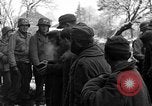
Prisoners of war being moved and searched by U.S. Army Military Police in WW2 and in Korean War
First scenes of clip show United States Military Police (MP) processing German prisoners of war (POW) during World War 2. German prisoners load into a U.S. Army truck under supervision of several MP, in cold winter weather conditions with snow on the ground. Next scene shows German prisoners of war enter a holding area in a large field under MP supervision. Scene changes to Korean War and activities of U.S. 8th Army Military Police. U.S. Army Military Police (MPs) and Korean or Chinese prisoners of war (POW) standing. The POWs board a truck. They are led by MPs. The POWs enter a camp area in a line. An MP frisks a prisoner. Prisoner of War documents being completed by an MP. Prisoner being fingerprinted. Elevated views of mass of prisoners running quickly into large column formation with Military Police watching at the head of the column. Prisoners standing on a road in groups. The MPs stand beside them. They check the identities of the prisoners. The prisoners are being searched by the MPs. Korean civilian refugee families fleeing an area. A young Korean child on a bicycle that is also laden with many belongings as a family evacuates. Families pulling open carts with Korean children laying on the carts bundled in blankets.
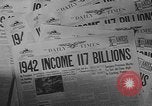
Men and women working in different war production factories for the production of raw materials and armament for World War 2 effort
The production of war materiel and supplies for soldiers and sailors in the United States during World War II. Newspaper headlines read: '1942 income 117 billions'. Men working in war production factories. Manufacture of aluminum and steel for the war effort. Sheet of aluminum rolling down conveyor in factory. View of assembly floor in a production plant building bomber aircraft. Brass being processed in factories, and hands of a worker sifting through new bullet casings in an ammunition factory. Use of copper exemplified in engine wiring and telephone communications applications. Steel being forged in factory. War ship being launched and a new Liberty ship SS Richard Bassett being launched from ship building slips on May 22, 1942. Tanks being built in a factory. Elevated view of many wood army barracks being built at an army base or camp. Then a view of homes being built as housing for war production workers. Lumber operations underway and coal miner in coal mines. A chart depicts the last year's production goals and then animated chart showing the production goals for the coming year shooting sky high. A sign on a door reads: 'Lt. Gen Brehon Somervell, Commanding General, ASF'. Lt. General Somervell seated at a desk in his office. He talks about engineers and technicians working for the U.S. Army and making materials go further to do more jobs than ever before.
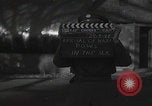
German Nazi prisoners of war disembark from bus, eating at mess hall in the United Kingdom during World War II
Arrival of German Nazi prisoners of war in the United Kingdom during World War 2. A bus arrives. A military policeman disembarks. German prisoners of war disembark from the bus one by one under guard. German prisoners of war, including captured German generals, enter the Transient Personnel Entrance of a mess hall. Sign with “Messing Hours” hang on the right side of the building. Nazi prisoners of war eating at a mess hall under guard. A German prisoner of war is seen with his hands clasped. Some prisoners drink from mugs. A man pour coffee for German generals.
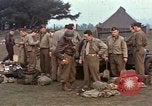
War correspondents gather in South England preparing to head to France, immediately before D-Day invasion in World War II.
War correspondents gathered in England, awaiting D-Day and preparing to enter France after the upcoming D-Day invasion in World War 2. War correspondents and soldiers at a camp on the South Coast of England. Jeeps, tents and men near baggage. Various correspondents meet up with each other. A correspondent walks amidst rows of tents with an officer. An officer gives a correspondent a shovel to defend himself. Correspondent Larry LeSueur smokes a cigarette. Various correspondents including Jack Thompson of the Chicago Tribune, Scripps-Howard Newspapers' Ernie Pyle, Associated Press' Larry O'Riley and Wharton Becker. They bid farewell to each other. A correspondent wearing a leather jacket with "War Correpondent" labeled epaulets on the shoulders. Clark Lee of INS and Chicago Daily News' William Stoneman next to a trailer attached to a military jeep. The war correspondents climb into a military truck. The truck passes through small British towns. People shop for vegetables in a crowded market place or a British town. Destroyed buildings in the town of Plymouth seen as the correspondents exit the rear of the Army vehicles.
CRITICALPAST.COM: About Us | Contact Us | FAQs - How to Order | License Agreement | My Account | My Lightboxes | Shopping Cart | Advanced Search | Featured Collections | Website Terms & Conditions | Privacy Policy ©2026 CriticalPast LLC.
License Agreement |
Terms & Conditions |
Privacy Policy
©2026 CriticalPast LLC.