


 Francais
 Deutsch
 Italiano
Refine Your Search
Greek-Civil-War stock footage and images
- Showing 1363 to 1368 of 27579 results more
more Hide
Hide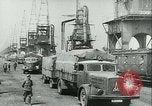
German troops transport war material, build bridges, prepare for battle and sort mail during the Battle of France.
The German assault on France during the Battle of France in World War II. German war material hauled into France. Trucks are loaded at docks. Soldiers load material. German trucks haul the war material into France. A road sign gives directions for 'Mecheln, Brussel, Antwerp, Mons, Bayern'. The convoy advances. Soldiers and horses in trucks. German soldiers sort and load cans, ammunition and other war equipment into trucks. German engineers and technicians build and repair war material. Engineers repair a bridge. Huge equipment used for the repair. Smoke emitted from a locomotive engine as it crosses the bridge. Soldiers seated cleaning ammunition. German civilians manufacture war material. Workers manufacture ammunition, rifles, guns, shells and artillery pieces. German officers confer over a map on a table. Soldiers ready artillery. Trucks transport German war supplies. German soldiers eat, drink and rest. Some wash clothes, bathe, get hair cuts, get dresses, and read. A soldier bathes a dog in a tub, another washes clothes in a tub. A soldier uses a hand pump, another dries clothes on a line. The men clean ammunition, clean and shoe horses. Soldiers lined up before an officer in a field. German officers and soldiers sated at tables. Officers confer over a map. Soldiers sort mail while others write letters. A sign reads 'Deutsche Feldpost' (German Army Postal Service). A soldier with a mail bag at the entrance. He gets into a mail van and leaves. Soldiers sort mails and parcels.
A World War II Ford Motor Company film entitled: "Women on the Warpath."
Film begins showing the Ford bomber aircraft factory at Willow Run, near Detroit, Michigan, during World War 2. Views of the heavy industrial plant with smoke rising from smoke stacks. Cranes loading ships at various docks. Modern looking administrative buildings at the Willow Run plant. A wheeled tractor pulls a train of flat cars filled with parts for the assembly line, next seen, where B-24 Liberator bombers are being assembled. Partially constructed bomber bodies and wings are seen on a production floor. In another section of the plant, war production workers assemble aircraft engines. View of and engine, enclosed in a nacelle, being lowered by a crane. A gunner's compartment being lowered by a crane. Women's Army Corps (WAC) members at work replacing men called to serve in the armed forces. A contingent of WAC practice donning gas masks. Women in uniforms of United States Women's Naval Reserve (WAVES). Two women attendants service a car at a gas station. Women not engaged in war effort are seen shopping and on a golf course and swimming. A woman hanging clothes to dry on a backyard line. A flight of three B-24 bombers flies overhead, causing women in various pursuits, to look up to the sky. Cars arrive at the Ford bomber plant in Willow Run, carrying women volunteers. One middle aged woman punches a time clock in the factory. More views of the B-24 production line, and parts being stamped by a man operating a press. Scene transitions showing the man gone, and a women replacing him at the press. Women war production workers working on aircraft frameworks. A woman, walking on a sidewalk, pauses to look at advertisements encouraging women to work in the war effort. One read: "Women at war, We can't win without them." A sign outside an office reading: "War Manpower Commission." The woman enters that office.
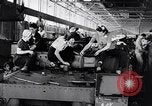
War materiel production by American women at factories in the United States (WW2)
American women at work in war production factories during World War II. A woman working on a lathe answer why she is contributing to the war effort. They produce various war materials. They are asked about their engagement in producing the war materials. They cite their reasons for producing these materials. “My husband is a prisoner of the Japs in the Philippines. If he’d have a few more of these shells out in the pan, maybe he’d still be fighting. Whenever I get a bit tired, I think of him on that death march.” a woman answers, clenching a handful of shells from a container. They produce equipment useful in war and other products. A woman working on the plexiglass nose turret of a bomber aircraft in an airplane manufacturing plant. They wear uniforms and work on machines to produce for the war effort.

Planning and training for invasion of North Africa (Operation Torch) in World War II
'Tunisian Victory' shows preparations during World War 2. Film opens showing a sailor in the crow's nest of a ship in a convoy of American warships. Aerial glimpse of the convoy. Sailors working on teletype machines in s communications center aboard an American warship. Ships exchanging light signals at night. Scene shifts to a British naval convoy moving across the sea. View from bridge of forward guns on British King George V-class battleship. A single stack Navy destroyer ship. HMS Rodney with 3 over 3 forward gun turrets leads another warship protecting the convoy. The aircraft carrier, HMS Illustrious in camouflage paint. An American Navy Douglas Dauntless dive bomber seen from a ship. A U.S. Navy Consolidated PBY Catalina aircraft over the convoy. Brief view of a four-engine bomber flying over the convoy. Scene shifts to sailors on ship's deck in the American convoy. The British flag on one of its convoy ships. Scene shifts to the White House on June 18, 1942. President Franklin D. Roosevelt arriving with British Prime Minister Winston Churchill in a car. Lights burning at night in the White House. Closeup of hats of the British and American staff officers on a rack. World Globe showing German army thrusts to the North by Field Marshal Fedor von Bock into Ukraine and the Caucasus, and another by Field Marshal Erwin Rommel South toward Egypt. In Asia, the conquests of Japan are shown. President Roosevelt and Prime Minister Churchill are seated at a desk. Behind them are Roosevelt's assistant, Harry Hopkins and two uniformed officers. View of relief map showing planned joint offensive. British and American staff officers seated at a planning table. Pertinent maps being printed for the offensive. Closeup views of woman's hands typing on typewriter. Tight closeup view of a teletype tape coming across a machine that reads "ANFO GAZE ACROBAT RE NO K" A typist at a teletype machine with tape being made. A busy military communications center. A plan marked "secret" moving across a sliding document mechanism or slide. American and British war production workers arriving at military equipment production factories for work; large groups of war production workers. Workers at military equipment plants and factories in the the U.S. and the U.K., including many women workers involved in war production. A document labeled "SECRET OCSigO" Staff officers in planning session. U.S. Army Chief of Staff, George C. Marshall, seated with British Field Marshal Sir John Dill. More views of the Combined Chiefs of Staff at work viewing wall maps and table maps and plans. Steel mills in operation. American army troops training and preparing in battle drills, firing machine guns, battlefield advance training, swimming under water below flamethrower flames and below oil slicks on fire, leaping into water, practicing paratrooper jumps into water. New ships including Liberty Ships and warships being launched at American shipyards. War production workers inside a plant building B-17 bomber aircraft. An early version of Sherman tank (external bolts showing) and Sherman tanks being built in factory. Shipboard twin anti aircraft guns being test fired. Giant yards filled with newly manufactured weapons, armor, trucks, tanks jeeps, searchlights. U.S. Army generals walk in a group inspecting equipment. War materiel and troops and tanks being transported on railroad trains in America and Britain. Covered Lockheed P-38 Lightning aircraft being towed by trucks past a watching British police (Bobby) at night. Ships being loaded at docks. Troops and war materiel being loaded aboard ships in the U.S. and Britain. Crowd on dock (mostly women) waving goodbye to soldiers on a ship. Soldiers look out portholes and from deck as troop transport ships get underway. Hand sets ship engine control to slow. Soldiers entertain themselves. Soldier playing piano on deck of ship as fellow soldiers listen and tap feet on top of console piano. Closeup view of hands on piano and a soldiers boot nearby on the piano case. Soldiers smile and enjoy the music.
Depicts Korean suffering under Japanese occupation from 1910 through end of World War II
Korean propaganda film depicting suffering of the Korean people under Japanese occupation prior to and through World War 2. Korean citizens answering questions of Japanese civilian officials during period of Japanese occupation before World War 2. Japanese warship carrying Nakajima E4N bi-wing scout plane. Steel truss bridge being bombed. Koreans being forcibly recruited to fight for Japan. Koreans being tortured and imprisoned at hands of Japanese. Aircraft dropping bombs on ground targets. Slate announces August 9, 1945, marking the Soviet invasion of Japanese occupied areas, including North Korea, in World War II. Destroyers dropping depth charges. Battleships firing heavy guns. Soviet infantry rushing from a ship to engage Japanese forces. Soviet soldier offloading an M1910 Maxim Sokolov Machine gun onto a pier. Amphibious assault by Soviet forces. Artillery barrages. Explosions and smoke. Soviet infantry attacking industrial facilities and planting the Red flag on a hilltop in a rural area. Japanese troops surrendering to Soviet soldiers. Fallen Japanese gunner in gun position with shell in his hands. Numerous other fallen Japanese soldiers. Captured Japanese weapons and war materiel, including many swords. Japanese prisoners of war seated in an open area. Various destroyed Korean buildings and temples. Denuded trees in war zone. August 15th, 1945, shows Japanese citizens listening to a loudspeaker broadcast by Emperor Hirohito, announcing the surrender of Japan, and end of World War II. Shackles are removed from Korean prisoners. Koreans celebrate in the streets. The Korean flag flies from houses in a village. Korean people march, sing, and cheer everywhere in the country. A seated band of musicians plays. Scene shifts to the deck of the battleship USS Missouri, where Japanese Foreign Minister Mamoru Shigemitsu in formal attire sits to sign documents of surrender. General Douglas MacArthur, and other senior allied officers, stand nearby as Soviet Lieutenant General Kuzma Nikolaevish Derevyanko sits to sign for the USSR. Japanese civilians living in Korea, during the Japanese occupation, are seen moving with their belongings, to be relocated back in Japan.
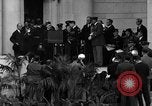
In an Armistice Day speech in 1935, President Roosevelt reflects upon World War I and the perils still threatening world peace
President Roosevelt delivers a speech reflecting the failure of World War 1 to be the "war to end war." He addresses a crowd at the Arlington National Cemetery Amphitheater in Arlington, Virginia, gathered for Armistice Day, commemorating the 1918 armistice ending World War I. Roosevelt reflects upon the role of United States in the world (as seeds of World War 2 are being sown). He upholds the ideals of peace and importance of being a good neighbor. He declares that the aim must be to avoid war and to remove the causes of war.
CRITICALPAST.COM: About Us | Contact Us | FAQs - How to Order | License Agreement | My Account | My Lightboxes | Shopping Cart | Advanced Search | Featured Collections | Website Terms & Conditions | Privacy Policy ©2026 CriticalPast LLC.
License Agreement |
Terms & Conditions |
Privacy Policy
©2026 CriticalPast LLC.