


 Francais
 Deutsch
 Italiano

Refine Your Search
Greek-Civil-War stock footage and images
- Showing 13921 to 13926 of 27563 results more
 Hide
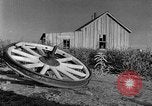
Conditions leading to the dust bowl on the American Great Plains
A homestead on a farm in the U.S. Great Plains. Horse carts break the plains. A woman sweeps stairs. A man and a child stand on the plains near the plow. An explosion on the land. World War 1 news headlines: 'England declares war on Germany, Belgium invaded, French win at sea' and 'War news tumbles securities, Stock Exchange Closed, Wheat Prices Soar'. A man drives a tractor with a plow on a plain land and dust cloud rises. The plow breaks the plains. News headlines: 'Wilson proclaims war, Spy ring arrested, German ships seized' and 'War sends wheat soaring, Grain up 13 points, Pit in Pandemonium'. The postwar decline of the wheat market results in overproduction: Farm machinery is used to sow the land. Wheat grains are poured into a thresher. A steamer at a sea. Tractors are driven and plows break the plains. A dust storm in the foreground during dust bowl era. Overproduction of wheat. Notice of 'Farms for Sale' in lower prices. Farm machinery is used. The sun rises in the background. A notice of 'Own a farm away from home'. Overproduction of wheat is shown. Over-exuberance in roaring 20s market is shown by a stock market or commodities market ticker running large amounts of ticker tape and a scene of a 1920s African American jazz musician drummer playing the drums enthusiastically and smiles while another band musician in the background plays bass.
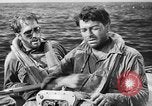
Different communication equipment used by units of the United States Army Signal Corps.
Communication means and equipment maintained and used by the U.S. Army Signal Corps during World War 2. Soldiers in a life boat use a hand cranked radio and an aircraft comes to rescue them. They wave at the aircraft. View of machines used for processing and printing V-Mail letters that are typed by machines and then delivered to soldiers. View of a soldier opening a small V-mail envelope and reading the note inside. Men and women work at various jobs in America in support of war production and war materiel. Men and women war production workers assembling various pieces of electronic equipment and radio devices. Men and women in large, busy clerical and administrative offices supporting typing and communications for the U.S. Army and military. Engineers work in a laboratory. A man loads a tube into a pneumatic message delivery system. Close up views of woman's hands on typewriter typing telegrams, letters, and messages. Women file clerks sort files. Technicians work on a telegraph machine. U.S. Army soldiers on a pole stringing communication wires. A soldier ties a wire on a tree. (World War II period).
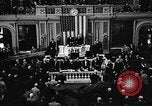
President Roosevelt asks the Congress to reexamine the Law of Neutrality during an address in Washington DC, United States.
President Franklin D Roosevelt addresses the Congress before entering World War II. President Roosevelt during his address urges the Congress to amend the Law of Neutrality to avert the danger of war looming large on America. He says that the primary function of American foreign policy has been to avert war and the government will try to keep out of the war. He states that America has always believed in neutrality and peace but with the outbreak of war in Europe there is a threat to peace and security of United States.
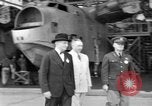
Aviation business and military leaders meet at Consolidated Aircraft; views of aircraft assembly plant operations
A meeting of business and U.S. military leaders at a Consolidated Aircraft assembly plant during World War II. View of General Henry "Hap" Arnold, Consolidated Aircraft founder Reuben H. Fleet, and William S. Knudsen (President of General Motors, and appointed by President Roosevelt as Director General, Office of Production Management. He developed the "Knudsen Plan" for rapid U.S. war materiel production expansion in World War 2). The three men are walking in front of an aircraft hangar with partially finished PB2Y Coronado flying boat aircraft at the Consolidated Aircraft factory in San Diego, California. Group of American military and industrial leaders gathered talking at the site, including Henry Ford of Ford Motor Company, and James H. "Dutch" Kindelberger, President of North American Aviation. (Consolidated, North American, Douglas, and Ford all produced B-24 bombers during the war.) Change of scene: Men at unidentified location view blueprints for expanded aircraft manufacturing and assembly facilities. View of war production factory workers as they stream out of a factory at end of shift. Views of PB2Y Coronado flying boat patrol bomber, and B-24 Liberator bombers under construction. Views of factory operations with metal forging and tempering work. Views of wing and engine assembly operations.
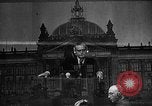
Footage after Reichstag fire, and of rearmament of Germany presented during the Nuremberg Trials in Nuremberg, Germany.
Nazi rise to power, rearmament and remilitarization of Germany leading up to World War 2, and actions related the Nuremberg Trials held at the Palace of Justice in Nuremberg, Germany, following World War II. Exterior view of the Reichstag in Berlin. Joseph Goebbels at desk during the Nuremberg Trials. Hans Bernd Gisevius, former official of the Berlin police administration, testifies concerning his investigation of the Reichstag fire. Hans Gisevius relates how Goebbels recruited reliable Nazis to intentionally burn down the Reichstag as a propaganda stunt to help the Nazi movement. Nuremberg War Trial defendants stand in their dock including Herman Goering, Rudolf Hess, Joachim von Ribbentrop, Wilhelm Keitel, Karl Donitz, Erich Raeder, Baldur von Schirach and Fritz Sauckel. Close up of Herman Goring. Footage showing firefighters spraying water on smoking ruins of Reichstag following Reichstag fire in 1933. A German police officer stands guard at the smoking ruins of the Reichstag. View from a high ridge of League of Nations Palace of Nations in Geneva, and then inside the League of Nations meeting chamber during the disarmament conference of 1933. View of a German Kriegsmarine submarine launching in 1934. Steel mill operations and Industrial war materiel operations in Germany in the early 1930's as Germany rearmed and restarted war production. A Nazi party meeting in Germany where General Werner von Blomberg announces compulsory military service. View of legal document describing new military service law. View of newly recruited (conscripted) civilian German men with suitcases marching forward report for mandatory military training. Nazi forces in training march goosestep at training camp; Junkers 52 aircraft in background. Soldiers goosestep while walking bicycles in a line. Nazi troops trained. Scenes of remilitarization of Rhineland, violating terms of the Treaty of Versailles, as Nazi troops in 1936 march over the Hohenzollern Bridge crossing the River Rhine, with Cologne Cathedral rising in the background.
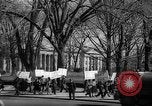
American Peace Mobilization delegates march outside the White House gates carrying placards in Washington DC.
American Peach Mobilization delegates march outside gates of the White House, Washington DC, early in World War 2. People carry signs and march on the street . Traffic passes on the street in foreground. Signs held by anti-war marchers on street read 'No Police Terrors Against Strikes', 'Strike Is Only Protection To Labor', 'All Out Aid To Britain Means Total War For America', 'Defend The Rights Of Labor', 'Fight Every Step To War', and 'There Is A Way Out War - Join APM'. People pass by the White House gate.
CRITICALPAST.COM: About Us | Contact Us | FAQs - How to Order | License Agreement | My Account | My Lightboxes | Shopping Cart | Advanced Search | Featured Collections | Website Terms & Conditions | Privacy Policy ©2026 CriticalPast LLC.
License Agreement |
Terms & Conditions |
Privacy Policy
©2026 CriticalPast LLC.