


 Francais
 Deutsch
 Italiano

Refine Your Search
Greek-Civil-War stock footage and images
- Showing 13927 to 13932 of 27563 results more
 Hide
Visual saga of the American Soldier from 1945 to 1970: WWII; Korea; Berlin Crisis;Cuban Missile Crisis; Red China
Review of conflicts involving U.S. from World War 2 to 1970. A U.S. soldier with rifle and binoculars, on guard. German Chancellor Adolf Hitler speaks in Germany to mass audience. German mobilization and blitzkrieg. U.S. troops firing small arms on island in Pacific, battling Japanese. U.S. soldiers on half-track firing artillery. Explosive destruction of Nazi swastika and Eagle symbol on top of building in Zeppelin Field, Nuremberg, Germany. General Douglas MacArthur stands as Japanese General signs surrender documents aboard USS Missouri, ending World War II. Times Square in New York City on Victory over Japan Day (VJ Day) marking end of World War 2. American troops firing artillery and small arms in Korean War. Soviet leader Nikita Khrushchev speaking at the United Nations. Newspaper headlines about postwar Berlin Crisis. Soviet missiles on display in military parade in Red Square in Moscow, Russia, Soviet Union. Soviet General Georgy Zhukov and Nikita Khrushchev, at Kremlin, reviewing the parade. Cuban President Fidel Castro giving a speech. A newspaper headline reading: "Khrushchev orders removal of missiles" ending the Cuban Missile Crisis. Soviet cargo ship with covered missiles on its deck. Red flag with image of Lenin and message: 'Partido Communista Dominicano' and a crowd chanting support for the Communist party in the Dominican Republic. Communist Chinese people marching with massed flags in the People’s Republic of China. Chairman Mao Zedong waving to a crowd of young supporters and Red Guards in China as they chant. A United States soldier in South Vietnam during Vietnam War looks through binoculars and then walks carrying his M-16 rifle. A map of Vietnam.

The victims of the German atrocities and Adolf Hitler during a speech in Germany.
Jefferson Memorial in Washington DC. Adolf Hitler during a speech in Germany. In the speech Hitler proclaims his right to rid the world of inferior races. He addresses a large crowd of officers. The Nazi sense of justice as exemplified in aggressive wars and atrocities is compared with that of the war crime tribunals at Nuremberg. Scenes of victims of the German atrocities, including men, women, and children, and including executed American soldiers in uniform, shot in the back. Scenes from German concentration camps of atrocity victims. Dead bodies lie all over. Women weep seeing the dead bodies. Dead bodies loaded on a horse cart led by a man wearing a gas mask. A Nazi book burning rally during the night time, before the war. People hold flags. Concentration camp victims on litters being transported for medical care away from liberated concentration camps. Torture devices used at the Buchenwald Concentration Camp. Dead bodies covered with snow after exposure deaths.German Doctor Adolf Wahlmann, head physician at the Hadamar Euthanasia Centre, shows medicine bottles containing drugs used to kill the patients. View of a gas chamber. Foreign Ministries of three major powers sign the Moscow Declaration in London. German Nazi, Doctor Hans Frank speaking at a podium to a group of gathered German Nazi officials during World War 2. American soldiers on foot passing through rubble of a city in Europe during World War 2. View of a military tribunal hall as proceedings are about to begin. Civilian German men viewing a pile of bodies in a room in a German concentration camp, as they are shown the camp by American forces.
Scenes of Germany during period from 1919 to 1938 showing military resurgence and territorial expansion
Germany's military resurgence from the end of World War I through its reoccupation of the Rhineland in 1936 and union with Austria in 1938. German war materiel piled up in scrap yards and aircraft engines being destroyed in accordance with the Treaty of Versailles after World War 1. Smoke stacks of war plants being toppled, aircraft hangars being destroyed, and warships being scuttled. German postwar armored cars for training. A soldier flexes the rubber gun barrel on one of them. French forces, including Colonials, occupying Coblenz (Koblenz) in accordance with the Treaty of Versailles, after World War I. French soldiers on guard at the railroad station as a train pulls in. French colonial troops tending to their horses. A British soldier standing guard in front of a building displaying a placard with the Union Jack and word:"General Headquarters, British Army of the Rhine, No.1 Building." French troops stationed in front of their headquarters and patrolling fences across railroad tracks at their occupational boundary. A large film slate announcing that the Rheinland is again free, followed by scenes of German troops re-occupying the Rhineland in 1936. Local citizens cheer the troops, who parade through a city and along the banks of the Rhein River. German sentries posted at The "Deutsche Eck" in Koblenz beside the monument of Kaiser Wilhelm I. Sign demarking boundary of Austria. Border guards opening the gates and German troops entering as crowds cheer. Adolf Hitler speaking before a huge crowd,immediately following the Anschluss (union of Germany with Austria) on 12 March 1938.

U.S. Army Training film emphasizing Army Air Forces safety rules of the air for pilots training in PT-17 "Kaydet" aircraft.
Opening scene shows a fuel gauge reading half empty in a U.S. Army Air Forces Stearman Boeing PT-17 “Kaydet” bi-plane trainer aircraft. Closeup of pilot with helmet and goggles in open cockpit of the airplane. Narrator says rules require pilot to return to base immediately. View of the aircraft descending toward the field. Animated diagram showing proper entry into left traffic for the active runway. View of PT-17 on final approach to the runway. Closeup of pilot in the cockpit. He makes a three-point landing on the first third of the runway and rolls without braking. Next, assisted by a wing walker, the pilot taxis to an open slot on a line of aircraft and stops on a parking line. The pilot steps from the cockpit, wearing a seat pack parachute, and begins walking to the field office, when he stops to converse with the narrator. He complains, somewhat about the restrictive rules for pilots in training and expresses desire to fight the Germans and Japanese in World War 2. Narrator defends the rules of safety, first, saying "You can't fight until you can fly." Scene shifts to four pilot trainees who "washed out" of the program for various infractions of the trainin safety rules. They are carrying their belongings in duffle bags and wait at a bus stop for transportation away from the base. Camera focuses on each of the men in turn, as narrator describes their failures to follow rules. Scene shifts to the airdrome where successful student pilots are seen walking toward the camera. Series of scenes showing student pilots performing various preparatory actions before flying their planes. One standing on a wing, checks the "Form One" that contains aircraft maintenance record. Another sitting in his cockpit notes that his gas, oil,cockpit switches, and flight controls all check OK. Another pilot is fastening leg straps of his seat pack parachute and comments about need to keep checking when taxiing down the line for takeoff. Closeups of pilots addressing the camera with admonitions about rules to follow. View of massed parked PT-17 training planes. Views of current war planes in flight, including Bell P-39 Aircobra, Lockheed P-38 Lightning, Republic P-47 Thunderbolt, and Martin B-26 Marauder bombers. Many good views of such airplanes in takeoffs, formations and aerobatic maneuvers. (World War II; WW II; World War 2; World War Two)
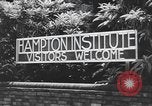
African American students gain knowledge of agriculture, chemistry and radio operation at Hampton Institute in Virginia (WW2)
African American colleges in the United States during World War II. College curricula adjusts to war needs as they prepare students for various military and civilian occupations including war factory production and war manufacturing. A sign reads ' Hampton Institute visitors welcome' at Hampton Institute, presently known as Hampton University (100 E Queen St, Hampton, VA 23669), in Hampton, Virginia. Exteriors of buildings on the campus. An educator welcomes students from other countries for taking up a course at the institute. Students in a class take lessons in radio operation and construction. Students in a chemistry laboratory learn to develop new war material. Science students train to become laboratory technicians. An African American student conducts a test on bacteria in food caused by handling. Hampton Institute provides laboratory facilities for training of nurses. Students in a ground school class. The students work on machines as they weld metal pieces. A farm management course for girls by the Agriculture Department of the Institute. Girls operate a tractor as they plant corn in a field. Dairy farming lessons being conducted as girls watch a man as he milks a cow. Students conduct research on food and the importance of soybean over meat. Students broadcast programs related to research results, improved diet and raising better crop. They take up lessons in surveying and topography. Cadets of institute regiment march. A sign reads ' U.S. motor transport shops'. The students learn to work on motor parts. U.S. Army trucks being repaired at the shop. Engineering Department of the institute trains men for the U.S. Navy. The cadets march. A clock tower in the background.

Examples of parachute use in first half of 20th Century
Brief history of the use of parachutes early in the 20th Century. Allied Spad aircraft taxi from flightline in World War 1. One pilot pursuing another in their respective World War 1 airplanes. Numerous World War I airplanes in dogfights. Post-war "barnstormer" being pulled by parachute from wing of a Curtiss JN-4 (Jenny) airplane. Soviet soldier jumping from a parachute training tower in 1930s. Infantry, cargo and weapons being airdropped from Soviet Tupolev R-6 bombers in flight. A Soviet manned vehicle being airdropped from a few feet by airplane. (The soldier jumps up unhurt after landing.) German paratroopers jumping from Junkers Ju-52 trimotor aircraft early in World War 2.
CRITICALPAST.COM: About Us | Contact Us | FAQs - How to Order | License Agreement | My Account | My Lightboxes | Shopping Cart | Advanced Search | Featured Collections | Website Terms & Conditions | Privacy Policy ©2026 CriticalPast LLC.
License Agreement |
Terms & Conditions |
Privacy Policy
©2026 CriticalPast LLC.