


 Francais
 Deutsch
 Italiano

Refine Your Search
Greek-Civil-War stock footage and images
- Showing 13945 to 13950 of 27563 results more
 Hide

Scenes from 1929 Geneva Convention; surrender of 20,000 Germans to U.S. General Macon by German Major General Elster near Loire
A U.S. Army Signal Corps training film on Rules for controlling German prisoners of war in World War 2. International conference 1929 in Geneva, Switzerland. Various officers and dignitaries in the conference where the Geneva Convention was agreed-upon by many nations. Image of Field Manual 27-10 states the Rules of Land Warfare based on the Geneva Conventions and describes standard procedures for handling Prisoners of War. Scene of 20,000 Prisoners of War who surrender under Nazi Major General Eric Elster at Loire, France September 16, 1944 to the United States 3rd Army, 83rd Division, under General Macon. General Elster salutes General Macon, then approaches the microphones in the middle of a roadway and delivers a surrender speech. General Macon then replies accepting the surrender on behalf of General Simpson. General Macon states that the men will be treated according to the rules made during the conference in Geneva.
Prisoners reach a surrender junction in different vehicles, all supplies confiscated and taken to Britain.
German Prisoners of war in France in World War 2. They come to surrender to American forces at a junction set up tor the purpose. They arrive on all kind of vehicles, including supply trucks, command cars, fuel trucks, horse wagons and bicycles. Enemy war materiel and assets, including livestock and other supplies, are confiscated. Some prisoners are marched to locations. At one outdoor enclosure, a sign reads 'German Enlisted Men.' Documents and weapons are confiscated. A stack of rifles. German POWs stand disarmed. Prisoner discusses map of American and German positions with a U.S. Army Sergeant. Prisoners are questioned and searched. Some wounded German prisoners are carried by other German soldiers. Others are transported by Americans. A wounded prisoner lies on a stretcher. A jeep with Red Cross flag carries wounded. Group of German prisoners of war eating a hot meal. Others eating regular U.S. rations.
British Expeditionary Force troops mobilize in England while Adolf Hitler is greeted by thousands as he rides through Vienna.
The first phase of German assault on France and the Low Countries during World War II. Vehicles move on an autobahn (freeway). In England: British troops parade and drill. British recruits in civilian clothing are seen with baggage as they join military during recruitment for war effort. German Fuhrer Adolf Hitler reviews German troops. War materiel rolls from German factories, including views of artillery, tanks, and aircraft for German war effort rolling off of production lines. Hitler rides through Vienna Austria and across the Czechoslovakian border. Large group of people gathered on the streets greet him and give the Nazi salute. Hitler in his car as it makes its way across the border. Soldiers give the Nazi salute.
Soviet forces encircle German Army outside Stalingrad in November 1942; Soviet civilians celebrate Christmas 1942
Bombed out Soviet city seen in snow during World War 2. Map depicting U.S. and British forces landing and advancing in North Africa, and far North, the Soviet Army launching counteroffensive to push back the German Army advances in the Soviet Union. Animated map depicting Soviet forces pushing back on German forces and recapturing Schlusselburg, breaking the Axis ring around Leningrad. Map showing Russian forces bypassing German forces at Rzhev and recapturing Velikie Luki. Another Soviet advance was in the Voronezh area, pushing back German forces there and back over the Don River. Map shows Germans falling back from Grozny. Fresh reserve Soviet cavalry soldiers arriving on horseback from Siberia, riding horses on snow covered terrain. Views of reserve Soviet tanks and soldiers on foot arriving to assist at Stalingrad. Closeup views of reserve Soviet soldiers entering destroyed city of Stalingrad. Soviet Russian military officers Marshal Voronoff, Col. General Kosakoff, Lt. General Rakossovskvy, meeting to plan Operation Uranus strategy. Map depicts the result of their plans as two simultaneous attacks were launched; one encircling from the north of Stalingrad, counterclockwise, and the other from the South of Stalingrad, to perform a larger encircling around the encircled German forces. Footage (reenactment) shows Soviet soldiers from the north and south groups meeting on a snow covered field (in Kalach) as they complete the operation encircling the Germans in November 1942. The Soviet soldiers embrace and celebrate. Scenes of Soviet civilians celebrating Christmas in 1942. Civilians choosing a evergreen tree to serve as a Christmas tree. Soviet civilians riding in a truck on snow covered road. A Soviet child carrying a Christmas tree over his shoulder. Soviet children at an indoor Christmas celebration with dancing around a giant Christmas tree, an indoor slide, and a carousel. A small dog in a costume dances and twirls on its hind legs entertaining a group of smiling Russian children. Two Russian boys playing a game where each has to guess which hand is holding an item. The losing boy receives a finger flick against his nose by the winner. Carousel filled with children rotates around the Christmas tree. Scenes in Soviet ballistic and munitions factory as war production workers, both men and women, manufacture shells for the war effort. Young workers exchange greetings of Happy New Year as they work past midnight. Soviet soldier viewing war front through binoculars. Closeup view of wrist watch showing 12 o'clock midnight. A fellow Soviet soldier yells a new year greeting, followed by "Fire" as Soviet artillery open fire against German positions during night battle. Daytime views of snow covered battlefield show Soviet soldiers operating a long line of artillery as they blast German positions.
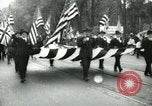
Men parade with banners and British and American flags during a patriotic rally by Ford employees in Dearborn, Michigan
Ford Motor Company employees move along roadway during a parade with sign 'Ford Patriotic rally' during World War 1. They carry banners along with British and American flags, as they move. '5000' formed of small stars appear. The text on signs reads: "This war is our business", "Put the Iron Cross on the man who 'double cross' ", "Hang the Spy", "Hell is too good for the Hun" and "There is no bridge over the Atlantic but there are thousands of Ford's boys". (World War i; World War 1; WWI; WW1)
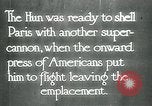
German supergun artillery piece (Paris Gun) abandoned outside Paris.
German supergun or super cannon artillery emplacement (without barrel) abandoned on rail tracks outside Paris during World War I. United States soldiers and French soldiers stand on and beside the abandoned German siege gun substructure. United States and French soldiers walk beside the railroad track. United States soldiers walk on the tracks. A United States soldier holds a shell casing from the World War 1 Supergun or Supercannon. (World War I; World War 1; WWI; WW1)
CRITICALPAST.COM: About Us | Contact Us | FAQs - How to Order | License Agreement | My Account | My Lightboxes | Shopping Cart | Advanced Search | Featured Collections | Website Terms & Conditions | Privacy Policy ©2026 CriticalPast LLC.
License Agreement |
Terms & Conditions |
Privacy Policy
©2026 CriticalPast LLC.