


 Francais
 Deutsch
 Italiano

Refine Your Search
Greek-Civil-War stock footage and images
- Showing 13957 to 13962 of 27563 results more
 Hide
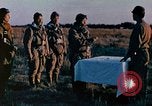
Four Kamikaze pilots drink a final toast of Sake on an airfield in Chofu, Japan (WW2)
A World War II reenactment shows four Japanese Kamikaze pilots on an airfield in Chofu, Japan. They stand near a table on the field. Sake or Japanese rice wine placed on the table. Commander stands on the other end of the table. He talks to the pilots. Kamikaze pilots dressed in the flying gear. They salute the commander. They each step forward and the commander fills their glasses with Sake. They return to face the commander and they all drink their Sake together, and then walk away. (World War II; WW II; World War 2; World War Two)

4 Kamikaze pilots drink a farewell toast of Saki on an airfield in Chofu, Japan (WW2)
A World War II reenactment depicts four Kamikaze pilots on their farewell toast. The four pilots in flight gear stand holding glasses of sake, or Japanese rice wine, on an airfield in Chofu, Japan. They and their commander drinking sake during their farewell toast. (World War II; WWII; World War 2; World War Two)
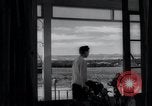
Places in New Mexico, familiar to Ernie Pyle
Views of Ernie Pyle’s familiar places in New Mexico. Opening shot shows a man stepping from the porch of Ernie Pyle’s house, with great expanse of desert landscape in the background. A car driving along a quiet mountain road. People picnicking at a roadside table. Views of mountains and sky and a man leading a horse walking slowly up a sandy hillside. Horse-drawn wagon in the Pueblo of Isleta. A farmer plowing a field with a team of horses. Pueblo women placing rugs on a line and baking bread in an ancient clay outdoor oven. Pueblo residents celebrating Corpus Christi Day. They walk slowly carrying banners and flags. The local Priest says prayers for American soldiers away in World War 2. Inside the church, a Pueblo mother lights candles for her son, overseas, against a backdrop of stars representing each local man away in the war. Car is seen driving across a low bridge over the Rio Grande River. It drives slowly into the town of Sandoval, where a man leads a cow across the road in front of the car. Farmers cultivating rows of crops by hand. A woman sings accompanied by a guitar. A sheep ranch where shepherds on horseback move a flock. Sheep being herded into pens. View of sheep being sheared by team of men. Wool being piled into a truck. Mailman delivering mail to a country mailbox on a street in Albuquerque, New Mexico. Two girls in jeans walking in town. A girl comes out of a building and embraces a young soldier in uniform, who was waiting for her. Pedestrians on the sidewalks in the commercial district. Women with cut roses; playing cards; baking a cake; and cutting a lawn with a manual reel mower. A wedding party walking along the sidewalk. Two girls reading. People in various settings reading the Albuquerque Tribune (or the Journal) newspaper. Movie houses that show films in Spanish and English. Students walking on the grounds of the New Mexico State University in Las Cruces. More views of ordinary people in towns including people of Hispanic descent or Mexican Americans. Sheriff Harold Hubbell of Bernalillo County, who served with the 200 Coast Artillery on Bataan, in 1942, is seen mailing a letter. Former Governor, Clyde Tingley, now Mayor of Albuquerque, comes down steps of a building. A Navajo indian reading a newspaper. A rancher rolling his own cigarette. A young Spanish American boy (Muchacho). Girl (Muchacha) rides a bicycle. A Navajo man followed by his family. Sign reading “Bataan Relief” announcing a talk by a Bataan veteran of World War 2. View of the speaker, in uniform, speaking to a group of mostly women. (Narrator states they lost a whole National Guard Regiment to the Japanese after the Pearl Harbor attack in 1941.) Another glimpse of students at the State University. Another repeat glimpse of Pueblo women baking bread in outdoor oven. Views of girls and women. Various Views of Ernie Pyle with American troops overseas during the war.
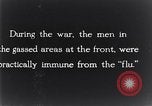
Chemists experiment with chlorine gas for influenza immunizations at Chemical Warfare Service in the United States.
Experiments with chlorine gas for influenza immunizations in United States. A World War I tank sprays gas in a field. View of American soldiers during 1917 to 1918 period of World War I, in a trench, wearing gas masks, and firing rifles at enemy positions. Post war tests on use of Chlorine gas to control the flu (emerging from 1918 Spanish Flu epidemic), inspired by low rate of influenza among United States soldiers exposed to chlorine gas during the war. Man enters a chlorine chamber at the Chemical Warfare Service. A chart on the wall showing results on symptoms after exposure in chlorine chamber. A woman in 1920s hat carrying a tissue is treated with chlorine gas. A testing apparatus on a table. Group of patients sit together in a chlorine chamber being exposed to the chlorine gas. A business man in a suit receives a portable chlorine gas treatment in his office as he is too busy to visit the chlorine chamber.
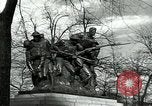
History and contributions of the U.S. Army infantryman to development of the United States of America
Memorial statue in Central Park, New York, to the 7th U.S. Army Regiment of World War I (World War 1, WWI, First World War). American infantrymen run with rifles from C-47 transport planes. U.S. soldiers in battlefield in Europe, and parading in tanks and marching,along the Champs Elysee,in Paris, France, with the Arc de Triomphe behind them. Soldiers march with flags. People watch. Korean War era U.S. soldiers march with rifles. West Point cadets march in New York City. Houses and buildings along the sides of the street. U.S. Army soldiers in various modes of operation: riflemen, artillerymen, paratroopers,ski troops, and Army engineers building bridges. One scene shows a woman soldier working as a mechanic. Soldiers training on an obstacle course, traversing a polar region with dog sleds. A gun emplacement in Hawaii and U.S.troops parading in the Philippines. A ship traversing the Panama Canal. View of U.S. Army tent Camp in Puerto Rico. A U.S. soldier sentry standing guard beside the ocean, in summer, in Iceland. An American soldier poses on a hill in New Jersey, silhouetted against backdrop of the Manhattan skyline with tall skyscrapers of New York City seen behind him. Sergeant James Mansfield talks about Colonel William Wilson Quinn. Colonel William Wilson Quinn on the show discusses the blue badge of the combat infantryman. The badge framed on a wall. He says that the badge has a blue background which is the color of the infantry. Copy of a rifle on the badge is surrounded by a circle with a star.
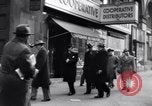
British and American working men on exchange visit meet with labor representatives in the United States (WW2)
Four British working men and their four American counterparts on an exchange visit to the United States enter a building in World War II. They are seen inside, seated at a table opposite representatives of American labor organizations including the American federation of Labor (AFL), the Congress of industrial Organizations (CIO) and the Railroad Brotherhood. During the meeting, one of the American workers states that they had just returned from England. One of the American labor representatives asks the English workers what they think about these exchange visits. They respond in support of them, and note they had an similar exchange with Russians as well. They also discuss international labor unity and its importance in winning the war. The British contingent note that they need more time to meet rank and file American workers to make any assessments. The subject of women filling jobs in war industry was viewed as affecting the lives of all women during the war and afterwards.
CRITICALPAST.COM: About Us | Contact Us | FAQs - How to Order | License Agreement | My Account | My Lightboxes | Shopping Cart | Advanced Search | Featured Collections | Website Terms & Conditions | Privacy Policy ©2026 CriticalPast LLC.
License Agreement |
Terms & Conditions |
Privacy Policy
©2026 CriticalPast LLC.