


 Francais
 Deutsch
 Italiano

Refine Your Search
Greek-Civil-War stock footage and images
- Showing 14023 to 14028 of 27563 results more
 Hide
U.S. Regular Army, National Guard, and Army Reserve units operating together in combat, in Korea, and returning home after the truce
Soviet military forces in massed formations at Red Square, in Moscow, Russia. Joseph Stalin stands on balcony above. Scenes of rebellion in Europe and Asia. A map of Korea. June 25, 1950, as Korean War war broke out between North and South Korea. Buildings burning. Refugees fleeing. View of United Nations building on East River in New York City, where American ambassador Warren Austin is speaking. View of the Capitol in Washington, DC. President Truman, speaking, committed U.S. forces to action. U.S. Reservists are recalled to active duty to fight in Korea. Some are seen getting off a bus at a military base reception center. Recalled reservists with full field gear, starting their journey overseas, and later seen in Korea. U.S. tanks moving over the road manned by soldiers with World War Two experience. Numerous scenes of heavy artillery firing, mostly at night. U.S. regular Army, National Guard, and Army reserve soldiers engaged in fire fights in Korean War using tanks, artillery, mortars, and rifles. Soldiers administer first air and assist wounded comrades. American troops slogging through rain and snow in Korea. Soldiers eating from mess kits, and reading the Stars and Stripes newspaper, during a lull in combat. North Korean officers arriving, in snow, for armistice talks. Following the truce, American soldiers are seen packed up and heading home from Korea.
Republican nominee Richard Nixon express his views about the presidential race before U.S. Presidential Election of 1968.
Self-portrait of Richard Nixon aired during his 1968 presidential run against Hubert Humphrey and George Wallace in the United States. An interviewer asks Richard Nixon what did he think when he made a decision to run for the President of the United States in 1968. A picture showing Richard Nixon and his wife Pat Nixon. The interviewer asks if he felt any strain on the family. Nixon says he thought of his family first. A picture showing his wife Pat Nixon and daughters Julie Nixon and Tricia Nixon. Nixon calls this presidency more of a challenge in terms of America being involved in the Vietnam War and in the Cold War with the Soviet Union. A photograph shows Richard Nixon with his wife Pat Nixon, daughters Julie and Tricia and Julie's husband David Eisenhower at a beach. He says that present time is different from World Wars I and II because now America is a great power and there should be a best possible leader to lead the nation. Nixon states that America needs a kind of leadership that would obtain peace and avoid war and surrender. A picture of Mr. and Mrs. Richard Nixon.

Crowd listens to loudspeaker broadcast of PM Winston Churchill in Parliament Square, London on Victory in Europe Day.
Victory in Europe Day being celebrated in London, England with the end of World War II. Crowd in Parliament Square and views of buildings and some statues of Parliament Square, including the War Office building (now Old War Office) and people sitting on pedestal of statue of Earl of Derby. Railing of House of Commons with people climbing up. Whitehall Old War Office as seen from Parliament Square. Crowd listen to loudspeaker broadcast of Prime Minister Winston Churchill's speech. House of Commons in the background. Gateway of House of Commons with members arriving. Crowd in Parliament Square listening to Churchill's speech.
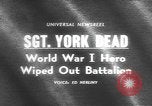
Past events show the life of U.S. Army Sergeant Alvin Cullum York after he passes away in the United States.
U.S. Army Sergeant York passes away in the United States on September 2, 1964. Scenes from the life of Sergeant York. Alvin York seen flashing the 'V' for victory sign. York in the front yard of his home. Newspaper headline reads, 'War with Germany.' World War I newly drafted men in civilian clothing marching along with tags pinned to their civilian clothes. World War 1 new recruits undergoing physical examination as they enter the U.S. Army. Soldiers standing in formation learning to drill. Closeup of front of artillery piece as it fires. Trench fighting against the enemy on a World War I battlefield. A soldier hurls an explosive toward no man's land. Soldiers rushing out of trenches going "over the top" to charge the enemy. Sergeant York in uniform during WWI. Later in life, Sergeant York is seen seated in a car with his wife as photographers scramble to take photos. Sergeant York at the White House with his family. York receives a citation from the Gold Star Mothers Club and then gives a short speech.
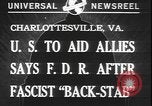
President Roosevelt addresses graduates of University of Virginia and talks about U.S. decision to aid the Allies.
U.S. President Franklin Delano Roosevelt addresses graduates of the class of 1940 at the University of Virginia, before the U.S. entrance into World War II. Speaking in Memorial Gymnasium, the President speaks into a microphone and addresses the University community and graduates, including his son Franklin Roosevelt Jr., who was graduating with a law degree. He speaks about the United States' decision to aid the Allies by extending to them the material resources of the United States in the war. He says that the U.S. took the decision after Italian Government's back-stab decision to engage in the war, after having earlier worked for the preservation of peace in the Mediterranean area. (Roosevelt had learned that morning of Italy's declaration of war on France.)
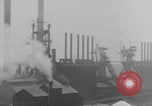
President of Lukens Steel Company, Robert W. Wolcott, speaks about the importance of scrap metal in the wartime steel industry (WW2)
Smokestacks in a steel factory in the United States during World War 2. Robert W. Wolcott, the President of the Lukens Steel Company in Coatesville, Pennsylvania (the oldest steel mill in commission within the United States), and also chairman of the American Industry Salvage Committee, speaks about the importance of scrap metal in steel production for the war efforts in World War 2. Robert W. Wolcott speaks to two men inside his office. Wolcott’s office is decorated with patriotic posters on the use of scrap for war production (“Half the Metal in every ship, every tank, every gun is SCRAP!”). Behind Robert W. Wolcott is a sign saying “American Industries Salvage Committee”. “This decline in scrap must be checked. Steel, scrap must flow to the mill. This is becoming a serious situation. And it is a definite challenge to industry” concludes Robert W. Wolcott.
CRITICALPAST.COM: About Us | Contact Us | FAQs - How to Order | License Agreement | My Account | My Lightboxes | Shopping Cart | Advanced Search | Featured Collections | Website Terms & Conditions | Privacy Policy ©2026 CriticalPast LLC.
License Agreement |
Terms & Conditions |
Privacy Policy
©2026 CriticalPast LLC.