


 Francais
 Deutsch
 Italiano

Refine Your Search
Greek-Civil-War stock footage and images
- Showing 14029 to 14034 of 27563 results more
 Hide
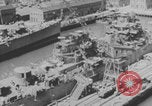
Naval guns and torpedoes manufactured, USS Wisconsin launched (WW2)
Steel used for ship building and war materiel manufacture in the United States during World War 2. Shipbuilding at a dock. Sign says “U.S. Naval Advance Base Depot”. A steam locomotive pulls a 16 inch naval gun from a war production factory. Men move newly made Navy torpedo via overhead conveyor. Men building torpedoes in a factory. A huge engine is being lifted by an overhead crane. War production workers on factory floor building items for U.S. Navy. A United States Naval officer speaks with a factory executive. Narrator mentions importance of scrap metal for use in ship building. The launching of the Iowa-class battleship, USS Wisconsin (BB-64), in the Philadelphia Navy Yard on December 7, 1943. Assisted by Rear Admiral Melo F. Draemel, Mrs. Margaret Roche-Goodland, wife of Wisconsin Governor Walter S. Goodland, successfully breaks a bottle of champagne over the ship's bow. The USS Wisconsin starts down the dry dock during launch.
Free French vehicles moving, damaged buildings, a WW1 Memorial in La Haye Du Puits (WW2)
French troops passing through La Haye Du Puits, Normandy during World War 2. M3 half-tracks pass by ruins of buildings. Army trucks park near a World War 1 memorial used as a motor pool. Two tricolor Free France flags in the World War 1 memorial. An M3 half-track driving, with the Église Saint-Jean showing its damage (Place Patton, 50250 La Haye, France) in the background. French soldiers in trucks pass by a street with shops with signs “CITROEN”, “E. DE SAINT-GERMAIN” and “X GRANDES MARQUES”. Storefronts are damaged from bombing. Tricolor French flags in the street. A close view of a World War 1 Memorial with inscriptions “LA-HAYE-DU-PUITS A SES GLOREAUX MORTS 1914-1918” (“LA-HAYE-DU-PUITS TO ITS GLORIOUS DEAD 1914-1918” in English).
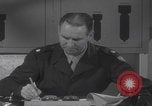
Incendiary bombs moved from United States to England during WW2.
Chemical Warfare Service (CWS) handles the distribution of incendiary bombs in Europe during World War II. Lieutenant Colonel R. N. Isbell of the Chemical Warfare Service (CWS) makes calculations from his desk. An incendiary order addressed to the Commanding General is typed on a typewriter. Buses arrive at the motor pool of the United States War Department, now known as the Pentagon. Women disembark from the buses and head to the War Department. Employees working in the office inside the War Department. Men prepare bombs at an arsenal. Men hauling carts with large incendiary bombs in warehouse. A man stencils labels onto bomb that read, "PT-1 Incendiary," and "Bomb Burster." The United States flag waving on a ship. Ships carry a shipment of incendiary bombs to the United Kingdom. Incendiary bombs inside wooden crates are unloaded from ships. Steam locomotive train running on track as railroad signal activates. Incendiary bombs are removed from train cars. Two munitions are suspended on a crane. Trucks loaded with bombs drive out of the depot, passing past village cemetery. An Air Division Chemical Officer receives new shipment information. The Air Division Chemical Officer reads the document and updates bomb listings on chalkboard.

Soldiers dig up bodies of Malmedy Massacre victims and capture German POWs during WW2.
United States 30th Infantry Division troops marching on both sides of a snowy road during World War II. A soldier walks in deep snow outside Malmedy, Belgium. United States troops dig up bodies of Malmedy Massacre victims (also known as Baugnez Massacre) at the crossroads of Baugnez. Bodies of the 84 American prisoners of war (POWs) killed by Kampfgruppe Peiper soldiers are lying in the snow after being dug up. Captured German prisoners of war raise their hands. The prisoners of war are led away from the gravesite. German prisoners watch as bodies of Americans are dug up from frozen grave. A dead body of a Malmedy massacre victim. A soldier uses a camera to record the exhumation. Faces of captured German troops as they raise their hands. Contrails of a bomber squadron in sky.

United States Infantry troops question captured German soldiers (WW2)
United States 88th Infantry Division soldiers question a group of German prisoners of war (POWs) in Zerf, Germany in World War II. The POWs belong to a mountain division recently brought into battle area from Finland. A prisoner of war comes out of a building. United States soldiers question the prisoner. Another soldier holds a clipboard. A prisoner of war talks to the Americans. A soldier wearing glasses speaks to a captured prisoner.
Filipino citizens after United States occupation of Philippines
Dramatization of the Second Continental Congress during the American Revolutionary War. The United States Declaration of Independence. The Thomas Jefferson Memorial (16 E Basin Dr SW, Washington, DC 20242, United States) in Washington DC. Bronze statue of Thomas Jefferson. The statue of United States President Abraham Lincoln at the Lincoln Memorial (2 Lincoln Memorial Cir NW, Washington, DC 20002). President Woodrow Wilson meets European leaders in France after World War I. Artistic depiction of United States soldiers fighting in the Spanish-American War. Map showing the Philippines, one of the two territories acquired by the United States after the Spanish-American War. Filipino students attend a class. They listen to the teacher standing in front of them. Behind the teacher are two blackboards. Two American consultants working with a Filipino man at the Manila City Planning. A scale model of Manila. Men constructing a house in the Philippines. Filipino men carry an entire native Kubo nipa house as a form of “Bayanihan”. A parade in Manila in 1946. The United States grants independence to the Philippines on July 4, 1946. Paul V. McNutt, High Commissioner to the Philippines, reads a proclamation at the ceremony held at the Independence Grandstand in front of the Rizal Monument. Filipino women wearing traditional Filipiniana dresses attend the ceremony. The United States flag is lowered as the Philippine flag is raised.
CRITICALPAST.COM: About Us | Contact Us | FAQs - How to Order | License Agreement | My Account | My Lightboxes | Shopping Cart | Advanced Search | Featured Collections | Website Terms & Conditions | Privacy Policy ©2026 CriticalPast LLC.
License Agreement |
Terms & Conditions |
Privacy Policy
©2026 CriticalPast LLC.