


 Francais
 Deutsch
 Italiano

Refine Your Search
Greek-Civil-War stock footage and images
- Showing 14071 to 14076 of 27563 results more
 Hide

U.S. Soldiers of 30th Infantry march with rifles through Chateau-Thierry, soldiers on horses and bicycle follow them, France.
The Aisne Operation in France during World War I. The U.S. Army 30th Infantry troops march through Chateau-Thierry. A car in the background. Soldiers march in groups with rifle. Trees besides road. Soldiers on horses ride behind group. Soldiers on bicycles follow them. (World War I; World War 1; WWI; WW1)

Trucks pass by soldiers of U.S. 30th Infantry marching on road in Chateau-Thierry, France.
The Aisne Operation in France during World War I. U.S. Army 30th Infantry troops march through Chateau-Thierry towards the front. Soldiers march on muddy road. Trucks pass by troops. Dust raises as trucks pass by. Troops carry rifles on their shoulders. Soldiers ride on horse and follow troops. (World War I; World War 1; WWI; WW1)

Major General Edwin Burr Babbitt and other officers pose in front of U.S. Fourth Infantry Division HQ in France
The Aisne Marne Operation in France. Several Field grade American Army officers of Field Artillery pose before a building in France, during World War One. A Brigadier General stands on steps of the building and smiles. Major General Edwin Burr Babbitt, 4th Brigade Field Artillery, converses with another Major General and a field grade officer. Paper on wall reads 'Signals' and shows insignia of U.S. Fourth Infantry Division. (World War I; World War 1; WWI; WW1)

Senator J. William Fulbright in TV interview about China in United States.
Senator J William Fulbright in United States. Television interviewer asks Fulbright about Communism and China. He asks whether he equates them with Adolf Hitler. Fulbright denies saying China has a totally different history. He says that after Opium War Chinese have reason to hate west and people of west must try to rectify the wrong beliefs about them. He says that we (senators) give advice to the President about what a common man thinks and feel about President's decisions. Fulbright talks about Russian decisions in Cuban War and other wars.

John C Stennis talks on the Role of Congress in Foreign Policies during a debate in United States.
Debate on the 'Role of Congress in Foreign Policies' between John C Stennis and William J Fulbright in United States organized by American Enterprise Institute. Moderator Peter Lasigor says that Congress is reasserting its role after Korean and Vietnam War. Distinguished citizens sit to participate and ask questions. The debaters: Senator John C Stennis, Chairman, Armed Service Committee and William J Fulbright Chairman Foreign Relations Committee. John Stennis starts the debate. Stennis talks about the role and responsibilities of Congress in domestic and foreign affairs. He speaks about his experiences in legislation as Senator. Stennis gives examples of Theodore Roosevelt, the Congo Rebellion in 1963 and National Commitment Resolution of 1969. He then talks about world affairs and foreign policies regarding World War II. Stennis mentions various treaties and resolutions related to post world war.
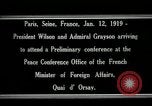
President Woodrow Wilson of United States and other dignitaries arriving at Quai d' Orsay for the Paris Peace Conference .
Arrival of United States President Woodrow Wilson and Admiral Cary T. Grayson, Physician to President Wilson. They arrive at Quai d' Orsay (37, Quai d'Orsay - 75007 Paris) - French Ministry of Foreign and European Affairs to attend a preliminary conference. President Woodrow Wilson bows his hat to greet the dignitaries. Other dignitaries arriving include Prime Minister of Italy Vittorio Emanuele Orlando, Italian Foreign Minister Baron Sonnino, Secretary of United States Robert Lansing, British Prime Minister David Lloyd George, British statesman Lord Arthur J. Balfour, American advisor of the supreme war council General Tasker H. Bliss, Prime Minister of France Georges B. Clemenceau, French Minister of Construction M. Loucher. View of Salle d' Horloge- the interior of the Quai d'Orsay where the conference was arranged. Cameramen with their camera mounted on stands seen standing. Reporters and guards can be seen. (World War I; World War 1; WWI; WW1)
CRITICALPAST.COM: About Us | Contact Us | FAQs - How to Order | License Agreement | My Account | My Lightboxes | Shopping Cart | Advanced Search | Featured Collections | Website Terms & Conditions | Privacy Policy ©2026 CriticalPast LLC.
License Agreement |
Terms & Conditions |
Privacy Policy
©2026 CriticalPast LLC.