


 Francais
 Deutsch
 Italiano

Refine Your Search
Greek-Civil-War stock footage and images
- Showing 14113 to 14118 of 27563 results more
 Hide
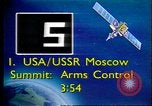
U.S.and Soviet efforts at disarmament during Reagan-Gorbachev era
Film opens with U.S.President Ronald Reagan commenting about mistrust between America and the Soviet Union. View of President Ronald Reagan and Soviet General Secretary Mikhail Gorbachev signing the arms control agreement banning the use of intermediate-range nuclear missiles, at the White House in Washington, DC on December 8, 1987. A Soviet RT-2PM Topol mobile ICBM moving on its carrier vehicle. A U.S. intermediate range missile being launched. Another view of U.S.President Reagan and Soviet General Secretary signing the Intermediate-Range Nuclear Forces Treaty (INF Treaty) on December 8, 1987, to become effective on June 1, 1988. Views of ICBMs being test launched from silos. A Soviet Tupolev Tu-95 strategic bomber in flight, seen from the side and from underneath. A U.S. Navy heavy cruiser, armed with cruise missiles. Closeup of a cruise missile rising from the ship and firing across it toward a target. Illustration of a seaborne missile fired from a warship. General Secretary Gorbachev in a group, including his wife, Raisa, visiting a Soviet Navy submarine. Major General William F. Burns, Head of the Arms Control and Disarmament Agency (in civilian clothes), is seen raising doubt about the feasibility of the Soviet suggestion to use scientific methods for checking from a distance about arms control compliance. Artist conception of satellites being shot down in space. Secretary of State, George Schultz and his wife, Helena Maria, descending steps from an airplane upon landing at Moscow, in the Soviet Union to confer with Soviet leaders in Moscow on Nov. 4, 1985, in preparations for the meeting between President Reagan and Mikhail S. Gorbachev, the Soviet leader, later in the month in Geneva, on November 19th and 20th. Negotiating teams assembling in a meeting room in Moscow. Secretary Schultz and Soviet Foreign Minister, Eduard A. Shevardnadze conversing. William F. Burns, saying, " I think we are well on the road to achieving a useful, good, and balanced treaty." Views of civilians killed by chemical weapons in the Iran-Iraq war. Soldiers in protective gear associated with chemical weapons. One soldier decontaminating a tank using a water hose. Tanks moving in Europe. U.S. troops firing an antiaircraft gun. Scenes of World War II showing conventional arms being used on tanks and from landing craft. Afghan fighters carrying a wounded comrade. Glimpse of soldiers in a trench firing a mortar and one firing a machine gun, during the Iran-Iraq war. An armored personnel carrier moving across a muddy field. More views of Reagan and Gorbachev signing the INF treaty in 1987. A U.S. spokesman noting that the USSR has not changed the offensive nature of its force structure and deployment patterns.
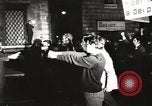
Pacifists try to storm the U.S. Embassy and fire brigade men spray a strong water jet on the protesters in Via Veneto, Rome
Italians protest against U.S. involvement in Vietnam War in Rome, Italy. The anti-war protests in Via Veneto, Rome. Anti-war protesters attempt to storm the United States Embassy (Via Vittorio Veneto, 121, 00187 Roma RM, Italy). People run while protesting. Italian Carabinieri (gendarmes) confront protesters outside the United States Embassy. The fire brigade men spray a strong water jet on the protesters. Several views of the people protesting and clapping. Some protesters are arrested.
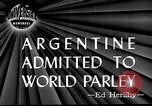
Debate about admission of Argentina to United Nations in its founding San Francisco Conference.
Debate about admission of Argentina during San Francisco Conference working toward United Nations Charter. Disabled and injured United States war veterans from World War 2 combat (mostly Navy in this image) enter the Veterans Memorial Opera House (War Memorial Opera House). View of interior of hall. Ezequiel Padilla, Secretary of Foreign Affairs, Mexico, addressing the gathering. Russian Foreign Commissar Molotov and an interpreter speaking, followed by secretary of States Edward Stettinius. Agenda of meeting is whether or not Argentina be invited for UN Security Conference. Chairman Anthony Eden calls for vote, Argentina is invited by a vote of 31 to 4. View of a parked Eastern Airlines silver liner parked at airfield in Washington DC, and new Ambassador Oscar Ibarra Garcia from Argentina emerges and is greeted by South American and United States officials. A person comes out of a U.S. aircraft and is received by authorities.
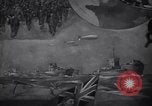
Eisenhower as the Supreme Commander of the North Atlantic Treaty Organization (NATO) and as the President of the Columbia University
Highlights the military career of U.S. General Dwight D Eisenhower from 1945 to 1952. Depicts notable World War II scenes and events starting on D-Day as Allied Forces invade France. Allied planes drop bombs on the enemy positions. Allied troops in Higgins boats land on the beaches of Normandy France. U.S. tanks move forward. Allied soldiers advance towards Saint Lo. Battle in St Lo area. General Patton Forces move forward. French troops and the soldiers of the U.S. 5th Corps march through Paris. The civilians cheer. Allied soldiers move towards the German border fighting on their way. Battle of the Bulge - when the Germans turned counter offensive. The bridge at Remagen on the river Rhine. Allied troops cross the bridge. Allied troops on the offensive, west of the Rhine. The enemy surrenders. Rubble on the streets. General Eisenhower with the troops. Military officers sign documents of German surrender on May 7 1945 in Reims at SHAEF headquarters. Eisenhower makes a speech at the end of the war. Eisenhower, in Paris, waves at the people from an open carriage. People welcome him in his homeland with a ticker tape parade in New York City. Eisenhower waves at the people gathered at the side of the streets from an open car of a motorcade. Eisenhower swears in as the 1st post war Chief of Staff of the U.S. Army. He visited troops in various parts of the world. He salutes and moves towards a car with his wife as he leaves active military life. Pictures of Eisenhower as he becomes the president of the Columbia University. He reviews the troops as he becomes the Supreme Commander of the North Atlantic Treaty Organization (NATO). Eisenhower on European soil. He enters a car. He assumes supreme command of the land, the sea and the air force. Against the threat from the USSR he prepares the European Armies. Soldiers enter into a train. He reviews troops. General Eisenhower and General Matthew Ridgway salute. He enters into a plane with his wife. Painting of Eisenhower being sworn in as President of the United States. Eisenhower Library in Abilene, Kansas, two boys leaving the Library.
President Harry S Truman presents Medal of Honor to Lieutenant Thomas J Hudner Jr. at White House in Washington DC.
Steps leading to White House garden. President Harry S Truman reads the citation and then puts the Medal of Honor on Hudner in Washington DC. President shakes hand with the Lieutenant. Civilian news and still cameramen at work as Medal of Honor is awarded to Hudner. The President posing with Hudner, the latter's parents, and Daisy Brown, the widow of Ensign Jesse Leroy Brown, whose husband was the shipmate of Lieutenant Hudner, whom Hudner was trying to save. Mrs. Brown stands. Hudner wearing medal. Lieutenant shaking hands with Mrs. Brown. Still photograph of Ensign Brown. The plane of Leroy Brown was downed by enemy Chinese fire during the Korean War. Hudner crash landed his own aircraft in an attempt to free Brown from his plane's wreckage, but he was unable to free him from the cockpit where Brown later died. Ensign Jesse Brown was the first African American pilot in the U.S. Navy, and the first U.S. Navy officer killed in the Korean War. Hudner was the first Medal of Honor recipient during the Korean War.

Women assemble and test fire rifles, machine guns and anti-aircraft guns at Aberdeen Proving Grounds, Maryland (WW2)
Opening scene shows a U.S. Army M3 Lee tank moving toward the camera, with a crew of two women, one in the top turret and the other in the lower turret (which does not show a gun). Women war production workers are seen working on various war materiel manufacturing tasks. A woman uses a sewing machine. A woman loads powder into a shell and operates a machine press to compress it. Several women install noses on shells. Some work on large shell casings. Civilian women involved in testing the newly manufactured equipment. Women examine and test small arms. One tests fires a Browning M-19. 30 caliber machine gun. as others test fire rifles. A woman is seen test firing a Browning M-1917 heavy machine gun. A battery of Anti-aircraft guns is seen raising its barrels and firing. A woman manipulates the controls of one. Women hold their ears as they test fire a 90mm anti-aircraft gun. A team of women carries a part for an artillery piece and screw it in place. Two women carry racks of artillery shells, that they load into an anti-aircraft gun. As the gun is test fired, they and a soldier with them hold their ears. Women work with pneumatic tools on the tread of an M3 Lee tank. One uses a long wrench to tighten a bolt. A woman poses in the top turret of the M-3. Two others climb aboard and close the hatch behind them. With two crew members seen in hatches, the tank drives past the camera. Final image is a woman holding two large artillery shells. (World War II period)
CRITICALPAST.COM: About Us | Contact Us | FAQs - How to Order | License Agreement | My Account | My Lightboxes | Shopping Cart | Advanced Search | Featured Collections | Website Terms & Conditions | Privacy Policy ©2026 CriticalPast LLC.
License Agreement |
Terms & Conditions |
Privacy Policy
©2026 CriticalPast LLC.