


 Francais
 Deutsch
 Italiano

Refine Your Search
Greek-Civil-War stock footage and images
- Showing 14245 to 14250 of 27563 results more
 Hide
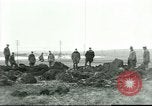
U.S. soldiers of the 18th Infantry examine huge bomb crater. U.S. occupied trenches and defenses.
Elements of the U.S. 18th Infantry in France during World War I. Soldiers gather around huge bomb or shell craters. A soldier inspects the crater. Barbed wire barriers. Troops in lattice-reinforced trenches and dugouts. A soldier stands in trench. An alarm bell seen next to him. (World War I. World War 1. WWI. WW1)

British soldiers capture Japanese soldiers in Hong Kong and United States Marines welcome by the crowd in Tianjin, China.
British in Hong Kong and U.S. Marines in Tianjin, China. A view of coastal area in Hong Kong. A landscape view of Hong Kong. British troops return to Hong Kong. British soldiers escort a Japanese prisoner of war. Japanese prisoners of war clear up the waste articles under a building. British Navy watching the prisoners cleaning buildings. Japanese prisoners pile debris and put to fire. Captured Japanese troops walk along the street after the British resumed control of Hong Kong. People gathered near a harbor in Tianjin, China. Chinese civilians gather and cheer to welcome the United States Marines. Views of U.S. Navy ships in Chinese harbor. Crowd cheers and applauds. Landing ships in the Hai River. Chinese citizens in crowd wave hands toward the United States Marines. Chinese children carry and wave American flags and cheer. United States Marines watch the crowd and smile. Marines throw cigarettes to Chinese civilians. Soldiers restrict the crowd scrambling for cigarettes and candies. (World War II period).
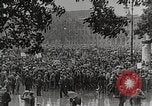
Demonstrators in front of the Altes Museum in the Lustgarten, Berlin, Germany
Demonstrations in Berlin, Germany. People gather in large numbers in front of the Altes Museum (Bodestraße 1-3, 10178 Berlin, Germany) in Lustgarten. They hold signs and banners. One sign reads, " Frankreich gieb unserer Kameraden Frei," an appeal for France to free German prisoners of war. (Note: After World War 1, France was slow to repatriate German prisoners of war, and had transported many abroad, to work in her colonies.)
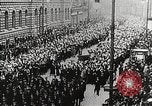
Independence Day celebrations in Prague, Czechoslovakia, 1918
Population celebrates independence of Czechoslovakia, October 28, 1918, with the fall of the Hapsburg Empire, near the end of World War 1. Streets of Prague are seen filled with marching throngs and cheering spectators. View of new national flag flying from tall building overlooking Wenceslas Square.Statue of St. Wenceslas visible below. Animated map outlines general area to encompass the new Czecho-Slovak Republic. (World War I; World War 1; WWI; WW1)

U.S. Marine Corps performing a drill and a USMC band playing on grounds of Iwo Jima Memorial
U.S. Marine Corps in the United States, performing drill maneuvers on the grounds of the US Marine Corps War Memorial (also called the Iwo Jima Memorial), in Arlington, Virginia, near Washington DC. The United States Marine Corps Silent Drill Platoon performing complex drills. Spokesperson indicates that all members of the Platoon are veterans of the Vietnam War. The Marines standing in formation and performing soloists routine. People seated on the grassy ground in a roped off area. A man recording the event with a movie camera. The Marines standing at attention. An officer standing in front of the Marines performs drill movements with several spins of rifles. The crowd watching offers applause. Audience includes men, women, and children in 1970s clothing fashions. Senior navy officers watch the drill. The officer standing in front of the Marines gives a command and the U.S. Marine Corps band starts playing and marching. A large crowd watching the Marines' performance. The USMC band marching and the Marines holding rifles marching in formation. The Marine Corps War Memorial in view at dawn or dusk.
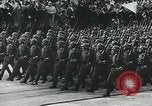
Soviet-German non-aggression pact is signed in Moscow and the Germans and the Red Army invade Poland in the European Theater.
German aggression during World War II. German troops marching in formation. A large crowd on either side of a road watches the troops. German Chancellor Adolf Hitler delivering a speech in Germany. Troops standing in formation listen to Hitler. On August 23, 1939 : People holding banners that read 'Down with War and Racism' and 'Aid the Allies'. New York Times headline reads: 'Reich and Soviet Join for Peace -- or War; No Buffer State; New Pact Warns Allies; Estonia Gives Moscow Sea and Air Bases'. Soviet politician Vyacheslav Molotov, Soviet Union leader Joseph Stalin and German Foreign Minister Friedrich Wilhelm Ribbentrop with other officers during the signing of Soviet German non-aggression pact (also called Molotov–Ribbentrop Pact) in Moscow, Russia in August, 1939. German Stuka dive bombers in action, when Germany invades Poland in a "blitzkrieg.".German Heinkel He-111 bombers in action. Buildings being totally destroyed by bombs. Red Army tanks and troops moving in snow. Victorious German troops marching in occupation. German heavy artillery batteries firing.
CRITICALPAST.COM: About Us | Contact Us | FAQs - How to Order | License Agreement | My Account | My Lightboxes | Shopping Cart | Advanced Search | Featured Collections | Website Terms & Conditions | Privacy Policy ©2026 CriticalPast LLC.
License Agreement |
Terms & Conditions |
Privacy Policy
©2026 CriticalPast LLC.