


 Francais
 Deutsch
 Italiano

Refine Your Search
Greek-Civil-War stock footage and images
- Showing 14275 to 14280 of 27563 results more
 Hide

Seventh United States Army advance through streets in Montélimar, Southern France during Operation Dragoon (WW2)
Allied Invasion of Montélimar, Southern France during Operation Dragoon of World War II. Map of Southern France shows Montélimar and Allied “Pincer” strategy to trap German forces. American soldiers fire heavy artillery and German batteries respond in kind. Retreating German troops and tanks leave much war materiel behind. Seventh United States Army tanks and trucks advance through streets. Huge black smoke cloud rises from a fire. Several German prisoners of war are captured by Allied forces. 191st tank destroyer battalion advances.
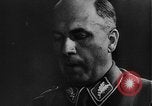
Nazi leaders speak. Faces of Allied soldiers. Nazi massacres. Victims mourned. German troops surrender. American life.
Nazi leaders in Germany giving speeches during World War 2. Soldiers from various countries like England, Poland, Greece, America and Norway. View of young boy soldiers in Germany at end of World War 2. Earlier scene of Nazi Waffen SS soldiers as they march with goosestep on parade. Victims executed in Nazi massacre in Italy shown with hands tied behind their backs. Nazi victims mourned in France. Bodies of women and children slain by the Nazi SS in Belgium. A large crowd of civilians gathered to pay homage to the dead in Lublin, Poland. Allied military vehicles and personnel trample and walk on Nazi flags and posters in Germany. A pile of Nazi flags burning in the street, as men, women and children walk past. German prisoners of war assembled in a large outdoor enclosure, and moving out in a line. German soldiers surrendering, with white flags displayed. American soldiers look at open mass graves of persons shot dead by Nazis. Emaciated boy children inmates of Buchenwald concentration camp stand behind barbed wire fence around the time of its liberation. The prior scenes are contrasted with ordinary life in the United States. A boy retrieves a ball from a pond, and throws it. Children play on see saws at a playground. A baby take first few faltering steps. A girl hangs from monkey bar. A man and two women share a newspaper article.
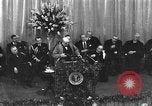
Winston Churchill's "Iron Curtain speech" regarding USSR and Eastern Bloc, at Westminster College in Fulton, Missouri
Iron Curtain speech by Winston Churchill at Westminster College in Fulton, Missouri, early in the Cold War. British Leader Winston Leonard Churchill at podium addresses the gathering in his "Sinews of Peace" speech. Officers seated on a platform in the background. Churchill speaks of the Union of Soviet Socialist Republic (USSR) and the creation of the Eastern Bloc. He places certain facts about the present position in Europe. The Opposition Leader states that Soviet Russia does not desire war but the indefinite expansion of their power and doctrines. The gathering applaud. He continues his speech by insisting on the permanent prevention of war and the establishment of conditions of freedom and democracy. He declares that a good understanding on all points with Russia under the general authority of the United Nations Organization should be made.

Madrid University students attend speeches and burn an American flag during demonstration against U.S. actions in Vietnam
Anti-American rally in Madrid, Spain during the Vietnam War. View of the Complutense University of Madrid (Universidad Complutense de Madrid Avda. de Séneca, 2 Ciudad Universitaria 28040 MADRID). Students make posters and leaflets during demonstration against U.S. action. A placard reads “NO al imperialism Yankee” (“No to Yankee imperialism”) They attend speeches. A Spanish college student speaks in front of protesters. Anti-war student activists burn an American Flag and protest on streets, against American action in the Vietnam War.
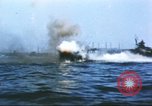
Color scenes of WWII including Pearl Harbor, D-Day, and Pacific campaign.
Montage of scenes dealing with Japanese attack on Pearl Harbor in World War 2. Bombs exploding and ships on fire; Japanese airplane diving from formation; a jeep driving past a burning airplane; hangars burning; Sailors firing anti-aircraft guns from an American ship; A New Orleans class American Cruiser firing her 8-inch guns; A South Dakota Class battleship firing her 16-inch guns; Group of American M3 Stuart light tanks in a field; U.S. Aviation Cadets marching between rows of Boeing Stearman Model 75 training biplanes; American soldiers marching in huge formations; Paratroopers in training jumps from towers; U.S. soldiers climbing down netting on side of troop transport ships to board small landing ships in the Pacific.; Marines in a landing craft carrying a large American flag; Landing craft in an amphious assault; Troops coming ashore from a Higgins boat, during training; An amphibious invasion task force at dusk; Troops wading ashore during the invasion of France in World War II, with barrage balloons aloft and support ships offshore. Staged scene of soldier on transport ship using flash light to read letter from home. Capital warships firing heavy guns and soldiers descending rope nets to enter landing craft. Soldiers landing on shore from Higgins Boats during training, and then on the shores of Normandy during the D-day invasion. American tank crew on an M26 Pershing tank. Major General George Patton with 1st Armored Division patch on his uniform sleeve. General George Marshall. General Dwight D. Eisenhower decorating an officer. Lieutenant General Henry (Hap) Arnold. Paratroopers jumping en masse from C-47 transport planes. German forces retreating in trucks along a road. Japanese General Yoshijirō Umezu, Chief of the Army General Staff, signing Surrender document aboard the USS Missouri, ending World War II, in the pacific. Glimpse of troop ship arriving in a U.S. harbor. View of U.S. military cemetery. Scene shifts to John Charles Daly, speaking in front of wall with names of Medal of Honor recipients, in the Hall of Heroes at the Pentagon, Arlington, Virginia, in 1968.
During a presidential election debate in the US, John F Kennedy and Richard Nixon comment on the necessity to defend Berlin.
The third Kennedy-Nixon Presidential Debate in the United States. Moderator Bill Shadel introduces the candidates and tells that candidates will not share the same platform. Republican candidate U.S. Vice President Richard M Nixon is in a Los Angeles studio and Democratic candidate Senator John F Kennedy is in New York. He also introduces the panel of correspondents who will question the candidates. The panel includes Frank McGee from NBC News, Charles Van Fremd from CBS News, Douglass Cater from Reporter magazine and Roscoe Drummond from New York Herald Tribune. Frank McGee asks Kennedy whether he would take military action to defend Berlin. Kennedy answers and says that the U.S. has contractual right to be in Berlin coming out of the conversations at Potsdam and of World War II. He states that the United States must meet its commitment on Berlin in order protect the security of Western Europe. He concludes by saying that the U.S. will meet its commitments to maintain the freedom and independence of West Berlin. Nixon disagrees with Kennedy's statement that the Republicans are trigger-happy and lead the nation into wars. He talks about the Democratic presidents who led the U.S. into wars. He concludes and states that he thinks there isn't any question about the necessity of defending Berlin.
CRITICALPAST.COM: About Us | Contact Us | FAQs - How to Order | License Agreement | My Account | My Lightboxes | Shopping Cart | Advanced Search | Featured Collections | Website Terms & Conditions | Privacy Policy ©2026 CriticalPast LLC.
License Agreement |
Terms & Conditions |
Privacy Policy
©2026 CriticalPast LLC.