


 Francais
 Deutsch
 Italiano

Refine Your Search
Greek-Civil-War stock footage and images
- Showing 1459 to 1464 of 27579 results more
 Hide
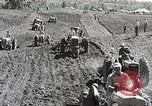
Marshall Plan aid relief to Europe after World War 2; U.S. military participation in NATO operation in Europe
American farmers on farmland with several tractors operating on the field. American men and women work to clear rocks and stones from a farm field. Group of rural neighbors in America working together to construct a barn building (raise a barn). They build the barn and wield hammers. Ships at dock with Marshall Plan food supplies from United States to Europe for post-war recovery after World War 2. Elevated view of main city square in Copenhagen, Denmark soon after World War 2. Busy roads with vehicle, pedestrian, and street car or trolley cars running on roads around the Liberty Memorial obelisk, on Vesterbrogade opposite the Grand Central Station. Crane lifting supplies for rebuilding effort beside some buildings in Copenhagen. Man in Europe cuts grass with a scythe or grass whip. American troops board ships to Europe to join NATO troops in Europe maintaining peace after World War 2. Close up view of group of American NATO forces marching in close ranks. U.S. military forces at NATO Naval headquarters in Norfolk,Virginia. Officer salute at a flag ceremony. Wide view of massive group of U.S. Navy sailors at attention during a ceremony in Norfolk. U.S. Naval fleet in Atlantic ocean. U.S. Navy jet fighter aircraft takes off from Carrier in Atlantic ocean. Camera view as planes take off from camera, and then view from rear facing camera in aircraft as plane takes off from aircraft carrier deck. View of the world's first atomic powered submarine, the U.S. Navy's USS Nautilus (SSN-571). The submarine at sea from an aerial view, and view from submarine of water breaking over its surface. American long range Boeing B-47 Stratojet aircraft parked at airfield. Personnel in control tower flashes light signals to waiting aircraft. A B-47 taxis for take off. American pilots exit personal equipment storage building of 306th Bombardment Wing at MacDill Air Force Base, Florida, and head to their aircraft for a mission. B-47 Stratojet plane taking off.

American women work in machine parts manufacturing factory during World War I
American women war production workers in machine parts manufacturing factory during World War I, supplying goods for the war production effort. Women wearing overalls, safety goggles, and caps do torch welding of metal parts (a "Rosie the Riveter" like scene, only in World War 1). Man hands over a letter of commendation or possibly a pay check to a woman welder worker.

Soldiers form a large liberty bell for a photograph during World War I
The "Human Liberty Bell" composed from 25,000 Officers and men at Fort Dix, New Jersey during World War 1, by photographers Arthur Mole and John Thomas who took them from an 80 foot tower with a large format camera. The U.S. Government contracted Mole and Thomas to create a number of such photographs as a morale booster during world war 1. (World War I; World War 1; WWI; WW1)

Burial ceremonies of United States Army soldiers at cemetery in Cheppy, France during World War I
Cemeteries of the American Expeditionary Force in France during World War 1. U.S. Army soldiers stand at a cemetery in Cheppy, France. Crosses at graves. Six soldiers bring body of an American soldier wrapped in a cloth. They place it in a grave. Soldiers stand past graves. They bring more bodies of American soldiers killed in action during World War 1, and place them in graves. A soldier digs a grave with spade. Graves dug in line. A soldier reads from a religious book to perform a religious ceremony. Other soldiers remove their hats and hold in their hands. Soldiers stand as prayer goes on during burial ceremony. (World War I; World War 1; WWI; WW1)

Large church or Cathedral, at or near La Ferte-sous-Jouarre, France, in World War I
A war-damaged cathedral at, or near La Ferte-sous-Jouarre, France, seen during World War 1. A staff car drives along the village road. Two soldiers of the American Expeditionary Forces (AEF) walk toward the camera. The shell-damaged church dominates the scene. Brief glimpse of soldiers at a communications center. (World War I; World War 1; WWI; WW1)

Russian troops maneuver to outflank Turks in the Caucasus Campaign of World War I
Slate reads: "Russian troops turning the Turkish flank," in World War 1. They are seen massed on a snowy plain in the Caucasus. Then, led by mounted officers, they march along a muddy path in the snow. Next they are seen moving in a very long single file column, through snow covered landscape. Large numbers of Turkish prisoners of war move past the camera in a town and march along a snowy path. Occasional armed Russian soldiers are seen by the prisoners. Russian troops place supplies in a sledge. They are seen transporting soldiers and supplies in bullock carts and sleds drawn by cattle. They employ Bactrian camels that are able to withstand the extreme cold. They move a herd of camels through a village and up a steep mountain road. (World War i; World War 1; WWI; WW1)
CRITICALPAST.COM: About Us | Contact Us | FAQs - How to Order | License Agreement | My Account | My Lightboxes | Shopping Cart | Advanced Search | Featured Collections | Website Terms & Conditions | Privacy Policy ©2026 CriticalPast LLC.
License Agreement |
Terms & Conditions |
Privacy Policy
©2026 CriticalPast LLC.