


 Francais
 Deutsch
 Italiano

Refine Your Search
Greek-Civil-War stock footage and images
- Showing 14641 to 14646 of 27579 results more
 Hide

Regional issues are discussed by world leaders during the Moscow Summit
Regional issues are discussed during the Moscow Summit on Soviet troops in Afghanistan, the Iran-Iraq War, Middle East Peace, and Nicaragua cease fire. Soviet Union army troops in Afghanistan. A Russian tank is stationed. A camel wearing a mask in the foreground. Soviet soldiers marching. United States President Ronald Reagan speaks on the Soviet Union's decision on the removal of the soldiers from Afghanistan. “The next few months will be no time for complacency, no time to sit back and congratulate ourselves. The Soviets have rarely before--and not at all in more than three decades--left a country, once occupied. They have often promised to leave, but rarely in their history, and then only under pressure from the West, have they actually done it.” President Reagan said. Soviet Army trucks and tanks are driven. Soviet soldiers patrolling on streets in a town in Afghanistan. A United States officer in a press conference. A Soviet aircraft in flight dropping supplies. Soviet soldiers on tanks. Scene changes to Iranian and Iraqi soldiers as they fire artillery, rockets, and from tanks during the Iran-Iraq War. Scene of United Nations meeting in progress with George Schultz representing the United States. Missile fired by United States Navy ship at Iranian target. View of firefighting operations and wreckage of Iranian oil platforms following U.S. missile attack in Operation Nimble Archer on 19 October 1987. The U.S. Secretary of State George Shultz visits places in the Middle East, working to convince Arabs and the Israelis about a peace agreement. Scenes in Nicaragua, as a cease fire with the contra rebels is signed by Nicaraguan Defense Minister Humberto Ortega, on March 23 in Sapoa. Figures seen include Nicaraguan President Daniel Ortega, Joao Baena Soares, (General Secretary of the Organization of American States), Cardinal Miguel Obando Y Bravo, and Alfredo Cesar, director of Nicaraguan Resistance.
German invasion of France,sinking of RMS Lusitania and resignation of William Jennings Bryan
Events during World War I. Sketches : workers in a German arms factory. German soldiers advance towards France. Animation of a map shows the German invasion of France through Belgium. Kaiser Wilhelm II, the German Emperor. Buildings damaged by invading Germans. U.S. president Thomas Woodrow Wilson advises Americans to stay calm. American people read papers. Cartoon depicts the President about his domestic reforms. The German atrocities in Belgium. Man holds a dead person. Sketch depicts Germany crushing everything on its way. The apprehensive people of America. Sketches of American man against a German leader. Trucks and taxi cabs on the Orne river. A gun barrel. Bombs being dropped on the German ships. Worker at a factory in America. Sketch of a man standing beside a flag having the dollar sign shows the prosperous America. Sketch shows the various resources required by the American industries. An American ship carrying war materiel. Sailors in German submarines. German submarines target allied ships. Sketches of U.S. president Wilson warning Germany. On 1st May 1915 RMS Lusitania a British luxury ship at sea as it starts from New York. Paper shows a warning by the German government. A German sailor on board a submarine as it targets a ship. The RMS Lusitania ship sinks killing many, including Americans. The U.S. secretary of State William Jennings Bryan and Thomas Woodrow Wilson with other officials. The former U.S. president Theodore Roosevelt addresses people opposing President Wilson's policy. The President prepares a note for Germany. Sketch of U.S. Democratic Presidential candidate William Jennings Bryan during his resignation. Sketch of Kaiser Wilhelm II.
U.S. President Warren Harding dies. Calvin Coolidge becomes President. Good times in America and Hyperinflation in Germany
America and Europe during post World War 1 period of 1920s Sketches: American workers in factories. The U.S. President Warren Gamaliel Harding converses with a friend. President with other officials signs a paper. President Harding dies and the Nation mourns. Pallbearers carry coffin of the President. Sketches depict the various scandals under the Harding administration, including the Tea Pot Dome scandal. Vice President John Calvin Coolidge becomes President. Several sketches of the President . Sketches of rich people in America. People in a car. Automobiles driven out of a Ford factory. Sketch of the workers building a road. Various labor saving electrical devices. Sketches depict a housewife relaxing and people becoming better off economically. Ordinary people gamble on the stock market. Various pictures of American farmers suffering, as demand for food falls in the wake of World War 1. Economic and financial crises affect Germany. Hyperinflation and riots occur in Germany. The unrest gives rise to future leaders like Adolf Hitler in Germany and Benito Mussolini, in Italy.

The Berlin Airlift. Allied aircraft transport and unload cargos for the city at Tempelhof Airdrome in Berlin, Germany.
The Berlin Airlift to sustain the city of Berlin during a Soviet blockade in the Cold War, following World War 2. Sign on airport building reads: "U.S. Air Force Station, Tempelhof, European Air Transport Service." A C-47 aircraft is seen being offloaded. A C-47 tazis past the camera. Others are seen parked. Scene shifts to a truck pulled up next to a C-54 transport plane being unloaded. A C-54 aircraft inflight overhead. German workmen unloading a C-54 into a truck. Men inside the aircraft roll sacks of coal down a slide to the men in the truck. Glimpse from inside the aircraft of coal sacks being placed on the chute and sliding to the truck bed. Some loose coal is scattered near the bottom of the chute. View of offloading operations from another C-54 aircraft. In this case, the cargo includes boxes and canvas bags. A truck backed up right against a C-47 aircraft to unload it. View of the terminal building in background. U.S. airmen unloading cargo from the doorway of a C-47. View inside where workers form a chain to pass parcels toward the door for unloading. Interior of a C-54 aircraft where a large pallet of cargo is seen on the floor. Men remove netting from the pallet. Glimpse from the rear of a British 4-engine Handley Page bomber aircraft being unloaded. A truck backing up to a parked C-47 aircraft. Cargo of Cartons and tins. One box contains a label reading: " J. & A. Kraus. Leberwurst." Other cargo includes wooden boxes. Final scene is a truck backing up to a parked British Handley Page bomber.

Atrocities against prisoners in Nazi concentration camps at different places in and near Germany.
Atrocities against prisoners in Nazi camps at different places in and occupied by Nazi Germany during World War 2. Wounded and emaciated Americans are fed and given medical care by Yank Armies of Liberation in Grasleben, Germany. Masked grave diggers open graves in Hadamar, Germany. Around 35,000 political prisoners found buried. Soldiers question Nazi German Chief physician Adolf Wahlmann at Hadamar Killing Centre. General Eisenhower, General Patton and General Bradley inspect Camp Ohrdruf (a Nazi Camp) in Germany. Heaps of human bodies and lime pits filled with corpses can be seen. 21,000 prisoners stumble around with their broken skulls in Buchenwald Concentration Camp (a Nazi camp in Germany). Corpses lie everywhere with large tattooed numbers on their stomachs. Two crematory ovens that were used. Starved people loaded into ambulances for treatment. (World War II period).
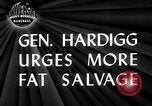
Major General Hardigg's speech on fat and oil recycling efforts; view of Halloran Army Hospital kitchen, Staten Island, New York
United States Army Major General Hardigg speaks about the need for saving waste fats and oils for recycling and reuse in the war effort during World War 2. Kitchen of Halloran Army Hospital is shown with Chefs preparing chicken and other foods, and saving fats. Homemakers and housewives shown straining fats through strainers to reserve and save fats. A housewife speaks to another woman. A girl presents a can of reserved fats to a store clerk who weighs it and gives the girl back a ration receipt.
CRITICALPAST.COM: About Us | Contact Us | FAQs - How to Order | License Agreement | My Account | My Lightboxes | Shopping Cart | Advanced Search | Featured Collections | Website Terms & Conditions | Privacy Policy ©2026 CriticalPast LLC.
License Agreement |
Terms & Conditions |
Privacy Policy
©2026 CriticalPast LLC.