


 Francais
 Deutsch
 Italiano

Refine Your Search
Greek-Civil-War stock footage and images
- Showing 14689 to 14694 of 27579 results more
 Hide
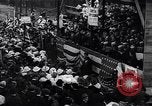
Fourth Liberty Loan Parade, Pittsburgh, Pennsylvania. American celebration and parade in London, England
Several separate scenes from World War I. Brief glimpse of 4th Liberty Loan parade in Pittsburgh, Pennsylvania, during the First World War. The Liberty Loan Committee with group of persons standing in front of their stand. Employees of Heyl & Patterson Inc. carry a banner announcing 100% subscription in the 4th Liberty Loan drive. Sign on street pole tells directions to the American Locomotive Pittsburgh works. Scene changes to London,England, where British Army drummers stand and play in front of a YMCA building. People in crowd behind them wave American flags. Americans, including YMCA workers, soldiers, sailors, nurses, and English friends celebrate in a parade,accompanied by a British Army band and escorted by London Bobbies (policemen). Revelers ride in cars bedecked with American flags. Many ride on Army trucks. U.S. officers ride in staff cars. Another change of scene shows a U.S. Navy cinematographer hand cranking his motion picture camera, while standing in an open car. The car has a sign on its side reading: "Photographic Division, U.S. Navy." Another sailor sits in driver's seat while a third keeps pedestrians clear from the camera line of sight.

A German Navy submarine arrives at a naval base in Germany.
A German Navy submarine arrives at a naval base in Germany during the World War II. The officials at the base welcome and congratulate the commander and the crew of the submarine. A flag waving on a pole shows likely targets at war, with the words 'USA Zerstorer' (perhaps referencing a U.S. Destroyer) and another flag says "USA 10000 Tanker". The commander gifts a white mice to the host officials. The submarine then heads towards the submarine yard.

Chinese Nationalist (KMT) forces engage Japanese at Teng-Chung (Tengchong) in Yunnan province (WW2)
Nationalist Chinese Kuomintang (KMT) troops of General Wei Li-huang's Chinese Expeditionary Force, operating during their Salween campaign of World War II. They attack Japanese 56th Division forces defending the city of Tengchong (Teng-Chung or Tengchung) in western Yunnan province, on the Burmese border. KMT soldiers are seen behind a tall fortification. A wooden box, at their feet, carries name of a company and a label reading, "The Largest Exporters of British Bottled Beers." The soldiers are firing recoilless weapons (bazookas). Other soldiers fire the same type weapons from a sandbagged field position. Other KMT soldiers are seen in a sandbagged trench, abutting a building. They fire rifles and hand-held machine guns. Famed war photographer, Wang Xiaoting (Wong Hai-sheng) better known as H.S. "Newsreel" Wong, is seen with a small hand-held movie camera, moving behind the KMT barricade. He films from a position next to a soldier firing a machine gun. Wong poses as he winds his camera.
History of Germany as a group of 300 medieval princely states with feudalistic rulers.
Mix of actor portrayals and actual footage: Church, homes and schools of America. Various United States soldiers. Views of German soldiers. German soldiers marching in a parade ground. Rulers and dictators of Germany: Adolf Hitler (World War II), Kaiser Wilhelm II, Otto Von Bismarck who laid identity of Germany as Nazi, Huns, and Prussians respectively. Historic overview of Germany. Princes and feudalistic rulers of the states. In contrast the US, French and British parliamentary system. King Frederick, the Great of Prussia with his cavalry and in his court. Prussian war against Austria, Russia, Sweden, France. German women wave for victorious troops. Portraits of Scharnhorst and Gneisenau. Dictums of Clausewitz, crushing of the 1848 revolt in Prussia. Germans emigrate to the U.S. Otto Von Bismarck addresses the ministry his policies of blood and iron.

President Harry Truman of United States arrives in Antwerp and moves to Brussels' airport during his Europe visit after WW II.
President Harry S. Truman of the United States visits Berlin and other places in Europe after World War II. Buildings and streets of Antwerp in Belgium. President Truman and U.S. Secretary of State James Byrnes aboard U.S. Ship Augusta. President raises his hat and waves to spectators on the dock at Antwerp. Few buildings damaged during war can be seen. Motorcade of President moving towards the Evere Airport in Brussels. Cars in cities and countryside of Belgium. At the Evere Airport, the 35th Infantry Division gives the honor guard to President. Soldiers in attention position near the Air Transport command airplanes on the airfield.
Captain Theodore J Van Kirk, navigator of B-29,'Enola Gay' interviewed at Tinian Island base, Marianas Islands in WW II
Atomic bombing mission in Japan by the United States Army Air Force, during World War II. U.S. military base in North Field, Tinian Island in Mariana Islands, South Pacific. Captain Theodore J. Van Kirk, the navigator of 'Enola Gay' (B-29 which dropped atomic bomb on Hiroshima) is asked about his experience, by Public Affairs Officer, Major John F. Moynahan (seen only from the back at very end of clip). Captain Van Kirk stands in front of Enola Gay and states his belief that the new bomb they carried would be a great help in shortening the war.
CRITICALPAST.COM: About Us | Contact Us | FAQs - How to Order | License Agreement | My Account | My Lightboxes | Shopping Cart | Advanced Search | Featured Collections | Website Terms & Conditions | Privacy Policy ©2026 CriticalPast LLC.
License Agreement |
Terms & Conditions |
Privacy Policy
©2026 CriticalPast LLC.