


 Francais
 Deutsch
 Italiano

Refine Your Search
Greek-Civil-War stock footage and images
- Showing 14695 to 14700 of 27579 results more
 Hide

President Franklin D. Roosevelt addresses the Democratic National Convention during the 1936 election campaign
President Franklin Roosevelt in his acceptance speech addresses the gathered delegates of the Democratic National Convention at Franklin Field near Philadelphia's Convention Hall. Posters of Roosevelt and his running mate John Nance Garner. Roosevelt is surrounded by guards. In the nomination acceptance speech, he speaks of the courage of the American people in withstanding problems and facing challenges. He endorses the platform of the democratic convention. He insists on protection of the family and home, sustenance of democracy, and aid to those overtaken by disaster. He talks of the war in America being waged against want and destitution, as well as a war for the survival of democracy. Crowd cheers and claps to the words of President Roosevelt. Band playing "Happy Days are Here Again" at end of clip, which was had been the campaign song of the democratic party for the prior, 1932, presidential campaign.
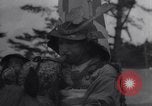
U.S. Army film showing history of Japanese militarism from the days of the Samurai to the 20th Century
Segment of U.S. film orientation film to help Allied Occupation Forces to understand background of Japanese traditions and rise of militarism prior to World War 2. Film begins showing a Japanese man dressed as a Trumpeter (kai yaku) in an army of the Feudal Period, blowing a conch shell horn. Japanese reenact Feudal period ceremonial exercises using pikes. Closeup of the way the pikes interlock as they wield them. Next young Japanese men are seen practicing Bōjutsu (the martial art of using a staff weapon called bō). A large formation of Japanese men practice in unison. A Japanese man dressed as a traditional Samurai warrior of history. Reenactment of Samurai engaged in war showing mounted Samurai warriors and foot soldiers carrying pikes. Image of the sun with Japanese sun flag gradually superimposed upon it. Slate intervenes reading: "The Sun Goddess Created the Japanese to Rule All the Other People of the Earth." Japanese people assembled near large building and tents in a park-like setting. A Japanese military officer addressing a large gathering. Japanese politicians, dressed formally, address a large gathering that includes many military officers. A crowd of Japanese people responding to a speaker by raising their arms in unison, several times. Japanese men in formation, bowing. Japanese women in formation, bowing. Large gatherings of Japanese people bowing en masse. Another politician addressing a gathering in an outdoor arena. Glimpse of Japanese school children being addressed by officials. A room full of banking officers being addressed by an official and farmers also being addressed. Young people and others marching in close order drills. A cadre of Japanese uniformed soldiers marching. A contingent of Japanese army troops marching with shouldered rifles displaying bayonets. More soldiers marching with high stepping gait. Film ends showing Japanese soldiers marching through Tori Gates at various places in Japan.
Documentary titled 'Why We Fight, The Battle of Russia' depicts history of battles fought by Russia defeating invading armies.
A documentary titled 'Why We Fight, The Battle of Russia' depicts battles fought by Russians, fighting military raids from other nations. Dramatized scenes of invasion of German knights in 1242. Town Pskov destroyed and civilians roped. In the battle of Novgorad, the Russians under emperor Alexender Nevesky defeat the Germans in a fierce battle. The Swedish attack Russia and get defeated by Russian army in battle of Poltava in 1704. French troops retreat in a frozen desert after getting defeated by Russians in 1812. German Kaiser Wilhelm II inspects World War 1 troops on Eastern front in 1917. Russian army of cavaliers and infantrymen march for battle. Map shows a part of Russia, Ukraine occupied during the battle. (World War II period).

A ship sails in the sea to examine the conditions prior to the departure of victory ship from New York to Great Britain.
Preparations for departure of victory ship from New York to Great Britain, at the end of World War II. Naval officers aboard the ship. Bow of ship cruises in the sea. A sailor watches other boats with binoculars. Other boats at the horizon seen from the ship. Meeting of Maritime Commission members and representatives of British Ministry of War Transport, at New York City. Ship ready for sail at a harbor in New York.

16 million men register themselves in United States for the WWII draft, and President Roosevelt addresses from White House.
As World War II heats up, 16,500,000 men between ages 21 to 36 register themselves throughout the United States, signing up during the first peacetime conscription in U.S. history. (This was triggered by passage of the Selective Training and Service Act of 1940, also known as the Burke-Wadsworth Act, the genesis of "Selective Service.") Opening scene shows men lining up to register for the draft before the United States entered World War 2. Views of men filing out their registration forms. At 00:22 famous prize fighter, Barney Ross, is being registered. (He jokes that the registrar shaking his hand has too strong a grip.) At 00:34 Hollywood cowboy Gene Autry is seen registering. Close up view of street signs at Chinatown intersection of Bayard Street and Mott Street in New York City. Sign below it notes "School Street. Drive Slowly. Make no unnecessary noise." Line of many registrants of Chinese-American descent waiting in line, and processing paperwork. Scene changes to another area of the city, where a line of mostly African American men wait outside a registration building. Some cheer and wave for the camera. A police officer at the entrance hustles them inside, pulling some of them along. View of the exterior of the White House in Washington DC. United States President Franklin D Roosevelt addresses the nation's men of draft age, telling them that the call up of 800,000 men for training in year one, and less than one million men in each subsequent year, is a program of defensive preparation only. Roosevelt says to the registrants that "Democracy is your cause. The cause of youth." ( Note: clip is silent except for President Roosevelt speaking at the end.)
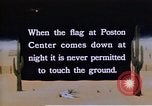
Japanese Americans lower the U.S. flag, soldiers drive in armored vehicles, and Nisei soldiers train for combat operations (WW2)
Japanese Americans lower the United States flag at Poston War Relocation Center (internment camp) in Arizona, during World War II. They fold the flag carefully. Elevated view looking down on armored vehicles and tanks during a military parade in the United States. Nisei (second generation Japanese-American) U.S. Army soldiers of the 442nd Regimental Combat Team seen in training for combat operations, at a military base in the United States. Slate notes that their slogan is "Go For Broke" and quotes a soldier as saying, "We have more to fight for than you do. Of course, we fight for our country, America, but we are also out to redeem the name of our race." Japanese- American soldiers navigate an obstacle course in Army training.
CRITICALPAST.COM: About Us | Contact Us | FAQs - How to Order | License Agreement | My Account | My Lightboxes | Shopping Cart | Advanced Search | Featured Collections | Website Terms & Conditions | Privacy Policy ©2026 CriticalPast LLC.
License Agreement |
Terms & Conditions |
Privacy Policy
©2026 CriticalPast LLC.