


 Francais
 Deutsch
 Italiano

Refine Your Search
Greek-Civil-War stock footage and images
- Showing 15367 to 15372 of 27579 results more
 Hide
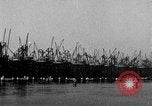
Ship building derricks and structures. Flag raising ceremony at the U.S. Shipping Board Building in Washington DC.
Mass of ship building derricks and structures, at waters edge, viewed from boat entering channel. Members of the U.S. Shipping Board and the Emergency Fleet Corporation preparing to implement orders to commandeer all U.S. shipyards and hulls, under construction therein, for the U.S. war effort. Shipping Board Chairman, Edward N. Hurley, is at corner leaning toward the man at head of table (Rear Admiral Washington L. Capps, General Manager of Emergency Fleet Corporation ?), U.S. Shipping Board flag is raised at a shipyard building, where it flutters in wind. A number of Army soldiers present in uniform. Official addresses gathering of shipyard workers and explains the takeover and has them pledge, with hands raised, to work for the success of the war effort. Other officials speak, as well. The shipyard workers wave their hats in sign of approval. Everyone leaves to get back to building ships.
Demonstrators in Trafalgar Square, London, protest British support for the United States' actions in Vietnam.
Peace Demonstration at the Trafalgar square in London, England organized by the "Campaign for Nuclear Disarmament." Large crowd of anti-war demonstrators gather at Trafalgar Square (Trafalgar Sq, London WC2N 5DN, United Kingdom). City of London Police in scuffle with protesters at Trafalgar Square. Demonstrators protest and show opposition to British support for the United States' actions in the Vietnam War. They hold banners. Military policemen control and stop the protesters from approaching Prime minister's home.

Hippies and doves gather at the Belle Isle park for a love-in; writing peace slogans on cars, dancing and promoting peace
Hippies and peace activists promoting peace in Detroit, Michigan. A large crowd of hippies and activists gather at the Belle Isle park for a love in. Man writes pacifist slogans on cars. Various peace slogans painted on cars, trucks and vans. People dance and promote peace and anti-war participants demonstrate against the war in Vietnam.
U.S. President Harry S. Truman announces the surrender of Japan and civilians celebrate victory in the United States.
Victory celebrations and VJ Day in the United States during World War II. The President of the United States Harry S. Truman addresses a gathering and announces the surrender of Japan. In Washington DC: a large crowd of civilians gathered for street parties. A newspaper headline reads 'Japan Surrenders'. In Chicago: a demonstration takes place. In San Francisco: celebrations for the end of the war include a ticker tape parade . People march through streets holding banners. In Seattle: servicemen conduct an outdoor proceeding. In New York City: a large crowd of civilians gathered at Times Square to celebrate victory over Japan.
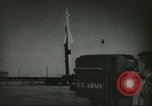
Atomic bomb scenes WWII; atomic testing at U.S. Army atomic experiment station 'Camp Desert Rock' in Nevada, United States
Episode of "The Big Picture", a U.S. Army series of news release programs. U.S. Army cameraman recording Nike missile launch. Atomic cannon fires shell creating atomic explosion and classic mushroom cloud.. Army troops spill out of Sikorsky YH-19 helicopters. U.S. Army infantry soldiers ascend hill firing their rifles. Atomic experiments at Camp Desert Rock in Nevada, United States. U.S. Army Master Sergeant Stuart Queen seated at a desk in his office. He speaks about a series of atomic experiments ("Desert Rock 6") held in barren lands of Nevada at Camp Desert Rock. Celebrating victory in Europe, during World War 2, American troops parade down the Champs Elysees in Paris, France, with the Arc de Triomphe behind them. Happy Parisians watch the parade. War scenes in Japan: footage of explosion and mushroom cloud rising after atomic bomb blast over Nagasaki on August 9, 1945. Barren land on the ground in Hiroshima after the August 6, 1945 atomic blast there . B-29 bombers in flight. Atomic bomb test detonation. Atomic artillery gun M65, also called the Atomic Cannon or Atomic Annie, fires and creates nuclear explosion on distant target.Viking missile launch. U.S. soldiers on parade. Headquarters sign at U.S. Army atomic experiment station at Camp Desert Rock, Nevada, displaying 6-pointed star with "A" in center.. Several atomic test explosions. Soldiers on hillside witness a non-nuclear explosion. Buses carry troops along a road past a sign warning of radiation hazard. Army captain, instructor, briefing troops before the start of atomic maneuvers.. Maps of planned maneuvers. Engineer surveyors lay out ground zero target. View of the ground zero area which is the target area for testing. Signal men lay communication lines to receive and transmit teletype messages. Men operate machinery and dig trenches in which troops will take cover. Other men cover them with sand. [Note: According to the U.S. Department of State, Office of the Historian, from February 18 to May 15, 1955, the United States conducted Operation Teapot, a nuclear test series at Yucca Flat and Frenchman Flat on the Nevada Test Site in the continental United States. During the test period 14 nuclear shots and 1 non-nuclear shot were detonated. Several thousand scientific, military (army, air force, navy, marines), and civilian contract personnel participated in the organization, planning, and execution of the test series. Military exercises undertaken during and following the shots took place under the name Desert Rock 6.]
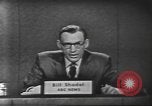
During an election debate in the US, Kennedy and Richard Nixon talk about a hypothetical invasion by the Chinese Communists.
The third Kennedy-Nixon Presidential Debate in the United States. Charles Van Fremd from CBS News asks Republican candidate U.S. Vice President Richard M. Nixon that if he were the president would he launch a war if the Chinese Communists began an invasion of Quemoy (Kinmen) and Matsu Islands and if he would authorize the use of nuclear weapons if regular conventional forces failed to halt the invasion. Nixon answers and states that it is irresponsible for a presidential candidate to indicate the course of action and the weapons he would use in the event of such an attack. He states that he would not say in advance how the U.S. would respond. He states that the Chinese Communists do not want just Quemoy and Matsu or Formosa (Republic of China or Taiwan), but the world. He concludes that defense of the free world territories and not surrender will lead to the path of peace. Democratic candidate Senator John F. Kennedy talks about a treaty to defend Formosa (Taiwan) and the Pescadores Island. He states that the U.S. would meet its commitment to Formosa. He disagrees with Nixon's suggestion that the United States should go to war if Quemoy (Kinmen) and Matsu islands are attacked as the treaty does not include these two islands. He concludes and says that the U.S. would defend if Formosa (Taiwan) or the Pescadores Island is under attack.
CRITICALPAST.COM: About Us | Contact Us | FAQs - How to Order | License Agreement | My Account | My Lightboxes | Shopping Cart | Advanced Search | Featured Collections | Website Terms & Conditions | Privacy Policy ©2026 CriticalPast LLC.
License Agreement |
Terms & Conditions |
Privacy Policy
©2026 CriticalPast LLC.