


 Francais
 Deutsch
 Italiano
Refine Your Search
Greek-Civil-War stock footage and images
- Showing 1681 to 1686 of 27579 results more
more Hide
Hide
Abyssinian Border disputes and the beginning of the Second Italo-Ethiopian War
Start of the 2nd Italo-Ethiopian War (Second Italo-Abyssinian War).Map shows Red Sea, Arabian peninsula, and Africa, and highlighting Ethiopia and its capital, Addis Ababa, along with Djibouti and the regions of Erythree (Eritrea) and Somalie Italienne (Italian Somaliland). Following border controversies, Narrator states the matter came to a head when Italian and Ethiopian elements clashed at Welwel oasis (aka Walwal, or Ual-Ual).on November 26, and again, on December 4, 1934. Views of League of Nations council reviewing the situation. (They later concluded, on October 7, 1935, that Italy violated Article 12 of the League Covenant, by its invasion on October 3rd.) Crowds are seen demonstrating in Ethiopia. Italian forces are seen embarked on a ship as part of Italy's force buildup. Italian forces, including armor and infantry, are seen in their wholesale invasion from Eritrea, into Ethiopia, on October 3, 1935. With war declared, Ethopian troops muster in areas of the Capital, Addis Ababa. Ethopian tribesmen are seen answering the call to arms
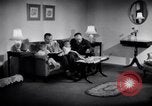
Four British labor exchange visitors return home after several weeks visiting war plants and labor organizations in America (WW2)
A British guest on labor exchange program visit spends his last day as a house guest of his counterpart American's family, in Los Angeles, California. He is seen with the father in their living room with two children, while the mother prepares dinner in the kitchen. The children are sent to bed and the men and the wife, named Ellen sits down to dinner with the two men. The British guest waves goodbye to the family at their doorstep. Scene shifts to another of the British labor exchange visitors leaving the family where he had been hosted in a different city. Next, the four British labor exchange visitors are seen seated opposite representatives of American labor organizations including the American federation of Labor (AFL), the Congress of industrial Organizations (CIO) and the Railroad Brotherhood. They had met them a few weeks ago when they first arrived in the U.S. One of the labor representatives asks them about their impressions of America. They uniformly praise the effectiveness of the U.S war effort, extolling the efficiency and productivity of her war plants. One of the commenters calls for more international unity in the labor union movement. A spokesman for the American labor representatives expresses need to support the United Nations movement. Film closes showing the four British exchange visitors boarding a U.S. Army Air Corps C-54 transport plane to fly them home to England. They are checked in by an airman who wears a leather jacket with the Air Transport Command logo on it. The aircraft is seen taking off and climbing out over hangars at the airfield. (World War II period)
U.S. troops aboard the transport ship Leviathan at Hoboken in New Jersey during World War I.
Documentary on World War I, titled 'Flashes of Action - Actualities of the World War'. Commander in chief of the American Expeditionary Forces, General John J. Pershing poses at Lucey in France during World War I. U.S. troops embark upon the U.S. Army transport ship' Leviathan' at Hoboken in New Jersey. Distant ships underway in sea. Troops dance and stage friendly boxing bouts aboard USS Wilhelmina and transport ship Tendores.
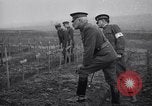
General Pershing visits cemetery; Australian, British and New Zealand troops in a wrecked French town during World War I.
Opening few seconds show American General John J. Pershing viewing a grave marker at a fresh cemetery in France during World War I. Next scene shows Australian troops dig trenches in France during World War 1. Australian troops at a destroyed railroad yard. Group of French men and women and children civilians pose for the camera, while British troops stand in background. Close up of an old French woman. The elderly French woman is talking and appears to be expressing thanks to the Allied troops and potentially grief from the devastation of the war. Soldiers on foot pass by a bomb wrecked French town with buildings reduced to piles of rubble from shelling. British troops and supplies on horse carts pass by the streets of the demolished town. British lancer cavalry regiment passes by on horseback, with lances raised. New Zealand soldiers march on railroad tracks to board a train.
Nazi war criminals tried at the Palace of Justice in Nuremberg, Germany (WW2)
Exteriors of the Palace of Justice (Fürther Str. 110, 90429 Nürnberg, Germany) in Nuremberg, Germany. American Military Police and tanks stationed outside the building. High ranking tribunals from all the major countries of the world arrive for the World War II Nuremberg Trials. Interiors of the court room. Judges, lawyers, prosecutors, and audience wear headphone to hear the translation off all the speeches in their native languages. Chief of the German Defense Council addresses the court. Shows accused German war criminals sitting in their dock. The accused includes Hermann Göring, Rudolf Hess, Joachim von Ribbentrop. Wilhelm Keitel, Karl Donitz, Erich Raeder, Baldur von Schirach and Fritz Sauckel. Hermann Göring addresses the court and says that he is not guilty. Joachim von Ribbentrop and other German accused also say that they are not guilty. Göring Stand-up to make another statement but denied doing so. U.S. Supreme Court Justice Robert H. Jackson opens the prosecution's case. He condemns the crimes done by the German war criminals against the world peace.
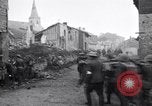
American and German wounded being carried on stretchers during World War I
Opening scene, shows a behind-the-lines medical evacuation area in a war-torn village in France,during World War 1. American soldiers, accompanied by a medical corpsman,carry, on their shoulders, a wounded comrade on a stretcher. Two American soldiers assist another wounded who walks with their help. Other medical corpsmen are seen in the area. Scene shifts to German prisoners of war carrying their wounded,under guard by American soldiers. One of the wounded German soldiers waves at the camera, from his stretcher. They proceed along a dirt road in the village until reaching a parked military ambulance, in which they place the wounded. Unharmed German prisoners are seen walking further through the village, and past a parked Renault F-17 tank, displaying a "diamond" symbol on its turret, indicating it was an American-operated tank. (The French displayed their playing card symbols elswhere their tanks.) Some of the prisoners carry rolled-up empty stretchers over their shoulders.
CRITICALPAST.COM: About Us | Contact Us | FAQs - How to Order | License Agreement | My Account | My Lightboxes | Shopping Cart | Advanced Search | Featured Collections | Website Terms & Conditions | Privacy Policy ©2026 CriticalPast LLC.
License Agreement |
Terms & Conditions |
Privacy Policy
©2026 CriticalPast LLC.