


 Francais
 Deutsch
 Italiano
Refine Your Search
Greek-Civil-War stock footage and images
- Showing 1711 to 1716 of 27579 results more
more Hide
Hide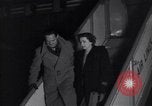
World War II RAF fighter pilot ace, Douglas Bader, is welcomed at airport in Canada.
Douglas Bader, who commanded 242 Canadian Squadron during the Battle of Britain, in World War 2, is accompanied by a woman, as he arrives at an airport in Canada. They descend steps from Trans Canada airliner. Officials at the airport welcome him. He converses with the officials before driving away in a car. (Note: Douglas Bader was Leader of an all-Canadian RAF Squadron in World War II, despite having lost both legs in a plane crash before the war. He was captured by the Germans after parachuting from his aircraft. Replacement aluminum legs were airdropped for him, with German permission, while he was in captivity.) .
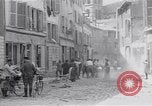
French town suffers artillery shelling by Germans during World War I
Aftermath of German artillery attack on a French town in World War 1. Rubble litters town street. Spectators watch as firefighters spray water on smoldering fire at site of a destroyed building. Men with bicycle talking, women looking at the ruins of houses. (World War I; World War 1; WWI; WW1)
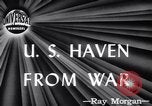
Newsreel titled 'US Haven from War' depicting European Jewish refugees brought to a camp at Fort Ontario, Oswego New York (WW2)
Newsreel titled 'US Haven from War'. Civilians greet, as a train carrying 982 European Jewish refugees arrives at Fort Ontario, in Oswego, New York. Men, women and children wave their hands, from inside the train. Old man drinks milk handed him by a woman. War Relocation Authority assist a descending woman and patient on stretcher out of the train. Refugee children at the refugee camp after escaping Europe in World War II.
United States Airmen buy goods and read news at a PX shop in Isley Field base in Saipan, Mariana Islands during World War II.
Crew members of the United States Army Air Force at their base in the Isley Field in Saipan, Mariana Islands during World War II. Men buy goods from a PX shop at the base. Jeeps and barracks near the store. Men look at war news board with newspaper sticking on the board. War map of Europe with words saying 'Allies Kaput' and a dead German soldier.
Motorcade of President Harry Truman of United States on the road to Berlin for a visit to the city, post World War II.
President Harry S. Truman of the United States visits Berlin after World War II. President's motorcade on the road to Berlin. Groups of refugees migrating from war affected area, alongside the road. Refugees carrying their things walk along the roads. The motorcade reaches outside the region of Berlin District. Signboard indicating the limits of Berlin. Damaged buildings of World War II.
General Motors guidelines for maintaining private cars during World War II, when none were manufactured in the U.S.A.
General Motors film entitled: "It's up to US," explains how to maintain private cars during World War 2, when all manufacturers switched to production of war materiel. Bugler, in U.S. Army uniform, blows reveille. Montage of American scenes, including homes and gardens; mountains; forests and lumberjacks felling a tree; an oil well gusher spewing crude oil; open pit mining operations; Niagara falls; flock of sheep grazing; workers picking cotton and it being delivered to a processing plant by horse-drawn wagon; a large timber log being cut into boards in a lumber mill; steel being manufactured for the war effort; a woman housewife or homemaker saving foods in a refrigerator in a vintage 1940s kitchen; a man cutting his lawn; a woman vacuuming her carpet; a woman taking clothes from a washing machine; a farmer plowing with a tractor; automobiles on American road and in parking lot of a defense plant. A driver with worn and dented 1938 Chevrolet Coupe car parked in front of a home is assisted by another who drives up behind him in a 1941 Oldsmobile and gives him a push. Sign at a Chevrolet service garage reading: "Official O.P.A. Tire Inspection Station." A 1942 Chevrolet 2-door fastback car drives into the garage. Mechanic greets driver and begins routine service, including: adding distilled water to battery; draining oil from car up on hydraulic lift. Scene shifts to a mechanic lubricates fittings on a 1937 Chevy on a lift at a gas station. Scene reverts to the earlier garage where mechanic drains cooling system, and refills it. The mechanic removes the carburetor and services it on a bench. He checks distributor rotor and makes compression checks. He cleans and re-gaps spark plugs, and checks tires and brakes. Cars driving on a town street. Mechanic aligning wheels on 1941 Chevrolet. Animated illustrations of tire wear from alignment problems. Servicing air in tire of 1942 2-door Chevy. More animated illustrations of tire problems. Illustrated explanation of rotation for bias tires.
CRITICALPAST.COM: About Us | Contact Us | FAQs - How to Order | License Agreement | My Account | My Lightboxes | Shopping Cart | Advanced Search | Featured Collections | Website Terms & Conditions | Privacy Policy ©2026 CriticalPast LLC.
License Agreement |
Terms & Conditions |
Privacy Policy
©2026 CriticalPast LLC.