


 Francais
 Deutsch
 Italiano
Refine Your Search
Greek-Civil-War stock footage and images
- Showing 1741 to 1746 of 27579 results more
more Hide
Hide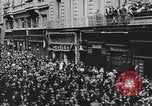
Variety of unconnected scenes from period of about 1914 through 1924, showing facets of World War I
Montage of scenes related to European mobilization and preparations for World War I, from 1914 through 1919, plus brief views of Mark VIII tank maneuvers, circa 1924. Patriotic French citizens fill a street as France mobilizes for World War 1. Italian soldiers marching to war through a town. British King George V seen with Prime Minister David Lloyd George and other British officials. British First Lord of Admiralty, Winston Churchill poses and "mugs" for camera. British troops being transported along a country road on double-decker buses and slogging through the mud in France. Two French soldiers join the line of "tommies" to be photographed, and then step out of line to watch. King George V with Field Marshal Douglas Haig, and other officers, next to their automobiles in field, during the King's visit to his troops in 1916. The King and British officers observe tests of Mark IV tank, circa 1917. Scene shifts to August 10, 1916 showing the Prince of Wales and King George V, accompanied by Field Marshal Douglas Haig, and other officers, observing the Battle of Pozières (in Battle of the Somme) from a safe distance, using a telescope. U.S. Army Mark VIII International Tanks in daytime and nighttime maneuvers (likely at Fort Meade, Maryland) circa 1924.
Newsreel "Biggest family of shipbuilders help win war"
Fifteen members of large Brockmiller family work in war production industry as ship builders at Kaiser Shipyards on the Pacific West Coast of the United States during World War 2. Wide view of war production workers busy at Kaiser Shipyards, building warships. Workers line up at pay booth to receive pay. A woman worker operating a blowtorch and then opening her protective face shield when done. The members of the family gathered at dining table eating food. Whole family including grandchildren seen together.
Scenes from Battle of Midway during World War II. U.S. Naval Academy cadets graduating June 19, 1942.
Scenes from the Naval Battle of Midway, in World War 2. A helmeted sailor, on deck of a U.S warship, silhouetted next to a propeller blade. A Fletcher-class U.S. Navy destroyer in background. View from near top of a Curtiss SOC Seagull airplane on the USS Portland (CA-33),as she fires two of her 5 inch antiaircraft guns, amidship,during the battle of Midway. Air is filled with low-altitude black flak smoke. A Japanese G4M1 model 11 ("Betty") bomber flies close by at low altitude across the line of sight. Smoke rises from the Portland's gunfire. Another Betty bomber low over the water in far background. Aerial view of a burning Japanese cruiser, far below, maneuvering to evade American attacks. View from U.S. airplane circling closer to the smoking Japanese cruiser. Closeups of panned stills showing severely damaged Japanese warships. Scene shifts to a large formation of Navy personnel in dress whites, where U.S. Admiral Chester Nimitz is decorating navy personnel who distinguished themselves in the battle. Nimitz sits, visiting a wounded sailor, at a hospital. U.S.Army Air Forces B-17 Crews, who bombed Japanese ships, are seen being interviewed on Midway Island. Scene shifts to war production workers assembling aircraft in factories in the United States. U.S. warplanes being manufactured. B-24 Liberator bomber aircraft being rolled out of a plant. Graduation ceremony at the U.S. Naval academy, in Annapolis, Maryland. Spectators watch as the cadet corps parades. View inside the historic hall of the old academy filled with spectators, cadets graduate a year early due to the war. Graduating cadets shaking hands with Academy administrators. Cadets of the class of 1943 cheer and throw their hats in the air at end of commencement ceremonies on June 19, 1942.
German Operation Barbarossa on the Eastern front in World War II.
View of the city, Pskov, on the Veilakaya river. A steel bridge is seen and city across it with smoke rising. German troops march in loose formation over a bridge in Novogorod. Views of German camouflaged tank (with shrubbery) and other armor and troops entering Soviet cities of Brest-litovsk, Minsk, Mogilev, and Vitebsk. View of German Panzer III tank heading toward the camera as it enters a narrow street in Smolensk. Animated map shows progress of these German advances and highlights German forces under German Field Marshal Gerd Von Runstedt cutting deep into the Ukraine. Headline on Chicago Daily News reads: "Nazis Claim Knock-out Victory" with subtitle line reading,"Moscow line cracks." Other newspapers reflect conviction that Soviet forces face imminent defeat by Germany. Slate shows communique issued by the German High Command, stating: "The issue in the East has already been settled. Smolensk is the last halt on the road to Moscow." More views of marching German troops. A battery of Soviet artillery firing from a snow-covered field. Animated map shows German forces moving close to Moscow. Foreign diplomats are moved from Moscow to the city of Kuibyshev. Hitler speaking on October 3, 1941, saying "This enemy is broken and will never rise again." Animated map depicts 500 thousand square miles of Soviet territory occupied by December, 1941, and compares it to the entire west central United States encompassing the states of : South Dakota, Iowa, Nebraska, Kansas, Missouri, and Oklahoma. Fires raging in agricultural area of the Soviet Union. Destroyed Soviet industrial plants, and huge numbers of Soviet citizens under German occupation. Views of destroyed Soviet armor, aircraft and artillery pieces. As season changes, German forces are seen in rain gear moving slowly through cold rainy weather. Some walk beside horses and other ride on horse-drawn caissons along with artillery pieces. Segments of film show contrast between the German military strategies. The German forces would plunge deep into enemy territory and create an area of conquest. This is illustrated by a slate bearing Adolf Hitler's statement that, "A single blow must destroy the enemy, without regard for losses, a gigantic destroying blow." An animated map illustrates the success of this approach by the Germans in Poland, France, and the Balkans. German Generals seen planning the same "Blitz" strategy against the Soviets. Film shifts to the Soviet strategy, showing their idea of building stronger defense, as they fall back, taking advantage of the great size of their territory. Views of Soviet troops on the move. View of Shells knocking out a German tanks. Panzer III tanks advancing. Panzer VI tanks completely covered by German troops catching rides. Soviet field artillery and machine guns firing in cities, forcing German soldiers to leave their vehicles. Soviet cities bombed out and burning, with debris and obstacles limiting the ability of armor to navigate in them. Montage of battle scenes cities of Rostov, Kharkov, Kiev, Kursk, Smolensk, all thwarting the Nazi blitz into the Soviet Union. Battles being waged in cities. (World War II; WW II; World War 2; World War Two)
The City of Paris, France, before and after the Nazi invasion of 1940, and America preparing for World War II
Views of Paris in the late 1930s, prior to World War II. The Arc de Triomphe de l'Étoile (Arch of Triumph). The Tuileries gardens (Jardins des Tuileries) with bed of tulips in full bloom in foreground. The Eiffel Tower (la tour Eiffel). The fountain of River Commerce and Navigation at the Place de la Concord, Paris, with the Madeleine church (L'église de la Madeleine) directly behind, the Hotel de Crillon,barely seen at left, and its twin building, the French Naval Ministry, opposite, on the Rue Royale. People strolling and shopping on the Boulevard Haussmann. Awning of Les Deux Magots café and patrons seated at tables outside, in the Saint-Germain-des-Prés area of Paris. People relaxing in the Tuileries gardens, with Arc de Triomphe du Carrousel and Musée du Louvre in background. An artist at work, seated at a bench in the foreground. The west facade of Notre Dame Cathedral. Parisians looking at posters, reading in parks, visiting bookstores. Sign directing visitors to the Congres des Ecrivains (Congress of Writers) held at Maison de la Mutualité conference center at 24 Rue Saint-Victor, 5th arrondissement of Paris, France.in June, 1935. Several writers seated at a table with others standing around. Closeup of three. Closeup of British writer, Aldous Huxley, wearing eyeglasses. Two writers conversing. Scene shifts to Paris at night. Car traffic on streets of Paris at night. Illuminated sign at Moulin Rouge cinema theatre, topped with illuminated arms of a windmill. Lighted sign of nightclub, Le Rat Mort, in Place Pigalle. Interior of a Paris nightclub with sophisticated clientele. French entertainer musician playing a guitar. An official posting an announcement called "Counseil de Revision," calling for conscription (military draft recruitment) of citizens for military service. Parisians preparing defenses in the city, in front of the Eiffel Tower. Man deep in a trench preparing a shelter. Men carrying sandbags up a ladder to protect a national monument. Copy of the New York Times newspaper annnouncing the German attack on Poland. Copy of New York Daily News announcing fall of Holland. The New York World-Telegram paper announcing capitulation of France. German Panzer II tanks and motorcycle troops entering Paris. German infantry marching through the Arch of Triumph, on the Champs-Élysées. A Frenchman wiping his eyes as he watches the occupying troops. Hermann Goering with other officers riding in an open car along a Paris street. Closeup of Arch of Triumph. Adolf Hitler, accopanied by staff, looking at the Eiffel Tower. Nazi flag flying from the tower. Closeup of Hitler looking around. The U.S. Capitol building in Washington, DC. President Franklin D. Roosevelt, in Academic garb, at the University of Virginia commencement ceremony, in Memorial Gymnasium, on June 10, 1940. (FDR's son Franklin Jr. was among the graduates assembled, from the UVA Law School). Roosevelt expresses American sympathy and support for nations invaded by the Nazis. American street scene. Women preparing gifts intended for France. A poster showing a French soldier, entitled: "Le Paquet Au Front." American draftees in training at an army post in the U.S. Smoke billowing from American industrial facilities. Workers at an American shipyard. View of warships under construction at the yard. A Huge gun barrel being moved on special rail dollies, in a U.S. arms factory. U.S. Navy F4U Corsair Production Line during World War II. M3 Lee medium tanks being manufactured in U.S. factory. Closeup of finished one being transported via transverse crane. M4 Sherman tanks moving on flat rail cars. A speeding steam locomotive pulling freight cars. Martin PBM-5 Mariner in flight over an Atlantic convoy carrying war materiel to the United Kingdom. Sailor wearing headset, standing near depth charges at stern of a ship. British Naval Ensign flying from mast of a ship.
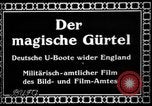
German submarine UB-35 leaves port on mission during World War I
Early slates allude to failed attempts at peaceful resolution of issues between Germany and England, in World War 1, and the Kaiser's consequent decision on February 1, 1917, to intensify German submarine warfare against Britain. Slate refers to Churchill's admitted concerns expressed in the "Sunday Pictorial," about the resulting constraint on England's control of the seas around the British Isles, referring to the U-boats creating a magic girdle (Magischen Gurtel) around England, which becomes the title for the film. In the first part, Captain, Lothar von Arnauld de la Periere of the German U-boat UB-35, stands in a skiff as he is rowed out to his submarine. He exchanges salutes with his officers, as he boards the U-35, nestled against a German ship. He gives the order to cast off the lines and proceed half power in reverse. The crew scrambles to get underway. German sailors on the nearby ship watch from her railings. Sailors use a long pole to help move the submarine away from the ship. Officers and men on the ship wave as the U-boat pulls away. Views from the submarine deck as it moves on the surface of the water heading toward the Mediterranean Sea. (World War i; World War 1; WWI; WW1)
CRITICALPAST.COM: About Us | Contact Us | FAQs - How to Order | License Agreement | My Account | My Lightboxes | Shopping Cart | Advanced Search | Featured Collections | Website Terms & Conditions | Privacy Policy ©2026 CriticalPast LLC.
License Agreement |
Terms & Conditions |
Privacy Policy
©2026 CriticalPast LLC.