


 Francais
 Deutsch
 Italiano
Refine Your Search
Greek-Civil-War stock footage and images
- Showing 1747 to 1752 of 27579 results more
more Hide
Hide
German submarine, U-35, stops and sinks the British ship, "Parkgate, "during World War I
The British armed steamer "Parkgate" is seen from the deck of the German U-35, U-Boat, under command of Captain Lothar von Arnauld de la Periereon, on April 4, 1917, during World War 1. The Parkgate has been forced to heave to in the Mediterranean Sea, between Malta and Gibraltar, following a gun battle with the U-boat. Members of the Parkgate crew come alongside the U-boat in lifeboats. An officer of the Parkgate presents the ship's papers to the U-35 Captain, on the conning tower of the U-boat. Next, the Captain of the Parkgate is seen being taken captive, and an explosives team from the U-boat rows to the Parkgate to set demolition charges that will help sink her. the U-boat crew fires their deck gun to strike the Parkgate low at the waterline. She begins to take on water and list. Her 7.6 cm gun can be seen on the stern of the Parkgate. In final stages, the Parkgate's bow tilts upwards and she sinks, with a large detonation as her boilers explode. (World War i; World War 1; WWI; WW1)
British ship Patagonia is sunk by the German U-Boat, UB-7, during World War I
Opening slates indicate how seriously Britain views the German U-Boat campaign against Allied shipping in World War 1. Captain Wilhelm Werner of German U-Boat, UB7, is seen on deck with his officers consulting navigation charts. Their navigator sights the sun with a sextant to determine their latitude. Slate tells of their sinking of the British Steamer, "Patagonia." View of the Patagonia, stopped, in the Atlantic, and then listing and sinking. (This occurred on September 15, 1915, in the Atlantic ocean, off the coast of France.) Change of scene shows a crewmember of the UB-7 next to the conning tower, putting on his boots as a wave washes over his feet. Another slate about the seriousness of the U-Boat operations. (World War i; World War 1; WWI; WW1)
A German U- Boat sinks a three-masted schooner at sea during World War I
A three-masted schooner stopped at sea by a German U-Boat during World War 1. It is being watched by officers in the conning tower of the U-Boat. The submarine moves abeam the ship to which it sends crew members in a dinghy to attach explosives at her waterline. The Schooner, still under full sail, is seen settling slowly into the water, and finally sinks from sight. (World War I; World War 1; WWI; WW1)
Assorted scenes of World War I, as America enters in 1917
An Allied ship in final stage of sinking by German U-Boat during World War 1. The ship's boilers explode as she goes under. U.S. President Woodrow Wilson looking out a window in his office in the White House. Officers and crew crowd conning tower of German submarine U-35 as it approaches a steamer it has stopped in Mediterranean Sea. View of shells from the U-Boat's deck gun, striking at the ship's waterline. View from the U-Boat U-35 deck as the attacked ship is sinking. She disappears, bow-first, beneath the water. Black smoke issues from her stack. President Wilson signing papers at his desk. American flag flying in front of the nation's capitol. President Wilson addressing the Congress and obtaining a declaration of war against Germany, on April 6, 1917. A banner reading: "War is declared." New recruits marching into an Army Post, in civilian clothes, carrying personal baggage. Regular U.S. soldiers beginning the basic training of recruits. Recruits learning the manual of arms, with wooden substitute weapons. Recruits engaged in Calisthenics outdoors at an army base. Contingents of uniformed and trained American soldiers marching along a road. Soldiers practicing live fire with machine guns, and engaged in bayonet training. Troops in formation double-time marching. American troops marching to trains at a railroad station, as spectators cheer them from the train station platforms. They board railway train and wave as it pulls out of the station.
American Expeditionary Forces (AEF) enter a village in France during World War I.
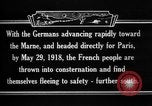
The United States enters World War I. French refugees flee from their homes to safer places. People move along a road. Horse drawn carts carry their belongings. People carry their belongings as they move along a rail road track. American soldiers enter a village as people look on. (World War I; World War 1; WWI; WW1)
United States 103rd regiment of the 26th Division advance for an offensive in France during World War I.
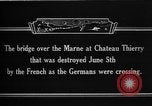
The United States enters World War 1. A damaged bridge over Marne at Chateau Thierry. U.S. General John J. Pershing and a French General confer as they plan a Franco-American offensive. Soldiers of United States 103rd Division advance across a field on July 18th , 1918. (World War I; World War 1; WWI; WW1)
CRITICALPAST.COM: About Us | Contact Us | FAQs - How to Order | License Agreement | My Account | My Lightboxes | Shopping Cart | Advanced Search | Featured Collections | Website Terms & Conditions | Privacy Policy ©2026 CriticalPast LLC.
License Agreement |
Terms & Conditions |
Privacy Policy
©2026 CriticalPast LLC.