


 Francais
 Deutsch
 Italiano

Refine Your Search
Greek-Civil-War stock footage and images
- Showing 18319 to 18324 of 27588 results more
 Hide
Color Sound

Crowded corpses at doorway and piled inside a barrack building at Wöbbelin Nazi concentration camp in Ludwigslust, Germany (WW2)
Wobbelin (Wöbbelin) Nazi concentration camp in Ludwigslust, Germany after Allied liberation in World War II. A barrack building marked “60” inside the concentration camp. Inmates and officers look at crowded corpses at the doorway of the barrack building and piled inside. Inspection party and some inmates walk ahead and find dead body of starved inmates lying on ground outside a hospital building.
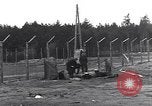
Living inmates cook food around open fire near barb wired fence Wöbbelin concentration camp in Ludwigslust, Germany.
Footage from three days after liberation of the Wobbelin Nazi concentration camp (Wöbbelin) in Ludwigslust, Germany. Inmates who survived are seen cooking food around an open fire near barb wired fence at the concentration camp. Man wearing uniforms among the inmates. An inmate lies on the ground. Inmates draw water and fill buckets from a hand pump. (World War II period).

American newspapermen sprayed with delousing powder prior to inspection of the Nazi concentration camp in Dachau, Germany.
American newspapermen inspect the Nazi concentration camp in Dachau, Germany. Group of newspapermen sprayed with delousing powder by Allied soldiers as others watch. The fence of Dachau concentration camp. Group of newspapermen stand together and talk. (World War II period).
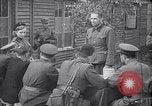
Russian officers interrogate camp guards, dig mass graves and inspect gas chambers of Majdanek concentration camp near Lublin, Poland.
The Nazi concentration camp in Majdanek, Poland (also known as Maidanek) soon after its liberation in World War II. Russian officer interrogates German guards and officials of the camp. Men dig up mass graves for evidence of atrocities and pull out dead bodies. Women weep as bodies uncovered. Decomposed and deformed bodies and pile of skull uncovered. Soviet Russian officers stand and view a mass grave. Barbed wire fencing and wooden sticks used for beating inmates. Zyklon B (or Cyclone B) chemical can that was used for gas in the gas chamber. Soviet officials tour the gas chambers. Guards and officials of camp interrogated with the help of a Russian woman interpreter. Various prisoners tell the story of atrocities at the Lublin Concentration Camp, KL Lublin. Clip is part of Nuremberg Trials prosecution exhibits 228, 229.
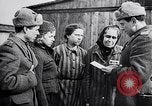
Russian soldiers rescue women and children prisoners and recover dead bodies at the Auschwitz Concentration camp in Poland.
Auschwitz Concentration camp of the Nazi Germans in Auschwitz, Poland during World War II. Russian soldiers note details of survivor women inmates from Yugoslavia. Inmates walk along with soldiers along barbed wire fencing. Male inmates carry a stretcher with dead body of a young woman. Pile of dead bodies taken out from a chamber. Horse carts draw lumps of dead bodies out of the camp. Young children released from experiment laboratories of the concentration camp, walk along paths guarded by barbed wire fencing. Clip is part of Nuremberg Trials prosecution exhibits 228, 229.
A British Royal Artillery officer, in charge of Belsen concentration camp at Lower Saxony, Germany speaks after liberation.
An officer of the British Royal Artillery, in charge of the Bergen-Belsen concentration camp operated by Nazi Germany at Lower Saxony, Germany. The officer speaks after liberation about the conditions at the camp when Allied forces reached there. Seventeen thousand prisoners buried by them. The prisoners had no food for six days and they ate turnips. The officer informs about the cook house since organized at the camp. Clip is part of Nuremberg Trials prosecution exhibit 230. (World War II period).
CRITICALPAST.COM: About Us | Contact Us | FAQs - How to Order | License Agreement | My Account | My Lightboxes | Shopping Cart | Advanced Search | Featured Collections | Website Terms & Conditions | Privacy Policy ©2026 CriticalPast LLC.
License Agreement |
Terms & Conditions |
Privacy Policy
©2026 CriticalPast LLC.