


 Francais
 Deutsch
 Italiano

Refine Your Search
Greek-Civil-War stock footage and images
- Showing 18889 to 18894 of 27581 results more
 Hide
Color Sound
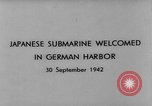
Japanese submarine being welcomed at a German port, by German Naval High Command
Japanese submarine being welcomed in a German harbor, 30 September 1942 during World War II. German Naval vessels escort the Japanese submarine into the harbor. Officers and sailors stand on the deck of the Japanese submarine.German Admirals board the submarine and greet a Japanese admiral. A German womanpresents flowers to the Japanese Admiral. The Japanese Admiral converses with head of German U-Boat Command, Admiral Karl Doenitz, who is later seen aboard the submarine greeting its officers. On shore, the Japanese Admiral and staff are greeted by German Grand Admiral Erich Raeder, Commander in Chief of the German Navy.

Adolf Hitler's German commandos liberate Italian Prime Minister Benito Mussolini from imprisonment in Italy
Arrival of Mussolini in Germany after his liberation by German commandos, from imprisonment by King Emanuele in Italy during World War II. Ju 52 transport aircraft arrives at German airfield. Italian Prime Minister Benito Mussolini steps from the aircraft. He is greeted by German Chancellor Adolf Hitler and embraced by his son, Vittorio Mussolini. He and Hitler get in a car displaying both Italian and Swastika symbols. Mussolini is greeted by German foreign Minister Joachim Von Ribbentrop, as he enters a building. They both talk. Inside, Hermann Goering chats with Mussolini. Hitler and Mussolini leave the building and enter a car. They arrive at an airfield. Hitler shakes hand with Mussolini, who says farewell to German military officers in attendance. They wave to him, as he climbs aboard a Ju 52 transport plane for his return to Italy.
Germans raise the Nazi flag and put flags on the buildings to celebrate Hitler's 55th Birthday in Germany.
55th Birthday of Hitler on 20 April 1944. The Nazi flag being raised. A monument topped by German Eagle with motto engraved on its side reading (in German): Our walls are broken but not our hearts. A small celebratory parade along Unter den Linden in Berlin passes under the Brandenburg Gate. A band plays music. A woman puts the Nazi flag on a wall. Berliners place small swastika flags all about in the city, including some in the rubble of Allied bombing. A flag on a damaged building. A woman holds a banner with the slogan: Our walls are broken but not our hearts. People read newspaper. German Chancellor Adolf Hitler in a motorcade stops on a road and he is greeted by Hermann Goering. They chat in the road in front of his car. Hitler walks with Goering to Greet members of the German military high command, including: General Wilhelm Keitel; Grand Admiral Karl Doenitz; and other flag officers. Hitler then walks with the officers to review an honor guard. (World War II period).

Accused conspirators being tried in Peoples Court in Germany after the 20th July bomb plot against Hitler.
People's Court Trial Concerning Plot of 20th July, 1944, to assassinate Hitler and overthrow the government. Judge Roland Freisler presides. People seated in a court room. A man in civilian clothes is brought before the judge who harangues him rather than listening to any testimony. A second man, Ulrich Wilhelm Graf Schwerin von Schwanenfeld, is also harangued by Judge Freisler, but manages to get a few words into the record. (World War II period).

German Army Major Otto Remer, Commander of the Berlin Guard Regiment, addresses his regiment after the plot on Hitler's life
Major Otto Remer,Commander of the Berlin Guard Regiment. He is known for his role in thwarting overthrow of Hitler's regime, following the 20th July, 1944 bomb Plot, when Hitler ordered him to take charge of all troops in Berlin and to apprehend conspirators. Major Remer addresses his Regiment, drawn up in formation, and emphasizes the Unity of the Nazi party and the German Army. His Regiment then parades while he reviews them. (World War II period).
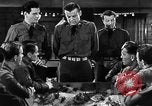
A Rifle Squad officer briefs the Sergeants about the Squad Column, Skirmish Line and Open Squad Formation in U.S. (WW2)
The advantages of the battle formations during World War II. The U.S. Army Sergeants seated at a desk and discuss the model. A Rifle Squad officer talks about the Battle Formations made by the smallest unit the Rifle Squad. He holds a stick in his hand. The model shows the two basic formations first the Squad Column and second the Skirmish Line. The officer also talks about Squad Wedge formation. He speaks about the usage of different formations. The officer explains the details of the formations that is how and when they are used. He first talks about the Squad Column which is the basic and easiest way of formation to control the fire. The troops hold each other's belt during the squad formation. He also speaks that always use Squad Column at night. Next is the Open Squad Column which is useful in crossing the open terrain where there is no cover. The Rifle platoon during the Open Squad Column formation. The officer asks the Sergeant about the questions regarding the Squad Column. The Squad Wedge which can form a Skirmish Line and is faster then the Squad Column. The Sergeant listen to him as he talks about the responsibility of Squad Leader during the formation. A model depicts the formations of Wedge. A Sergeant asks question related to the difference between the Open Squad Column and Wedge and the officer answers. Last formation the Skirmish Line. A model depicts the Skirmish Line formation by the Rifle Squad and usage of it to start the attack. The model shows the troops advancing for attack. The officer sums up in short three of the formations. He also speaks about the other formation and gives example.
CRITICALPAST.COM: About Us | Contact Us | FAQs - How to Order | License Agreement | My Account | My Lightboxes | Shopping Cart | Advanced Search | Featured Collections | Website Terms & Conditions | Privacy Policy ©2026 CriticalPast LLC.
License Agreement |
Terms & Conditions |
Privacy Policy
©2026 CriticalPast LLC.