


 Francais
 Deutsch
 Italiano
Refine Your Search
Greek-Civil-War stock footage and images
- Showing 1885 to 1890 of 27579 results more
more Hide
Hide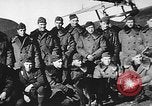
Some of the first American flying squadrons in World War I. The 1st and 103rd Aero Squadrons and their members
During World War 1, in 1918, American Expeditionary Force's 1st Aero Squadron members, including a mascot dog, pose on airfield. Airplanes in the background. Crewman pastes paper iron cross over enemy bullet hole in tail of airplane. Colonel Billy Mitchell decorating a flyer. General Benjamin Foulois in cockpit of a DH-4. United States officers shake hands with Colonel Thomas D. Milling. Colonel Frank Laub talks with a French officer. Members of the Lafayette Escadrille converted to the American 103rd Aero Squadron. July 1918 - Major William Thaw, steps forward and salutes, followed by Lieutenant Gordon D. Larner, Lieutenant Charles I. Merrick, and Lieutenant Edgar G. Tobin. Ace Captain Field Kindley, stands by a Sopwith Camel, supporting a small dog perched on its propeller. Ace Major Raoul Lufbery, smoking a cigarette, poses in front of a Nieuport 28c.1. Ace Captain Elliot Springs, also smoking a cigarette, poses in front of another airplane. Ace of Aces, Captain Eddie Rickenbacker, poses by SPAD S.XIII, number 5 ( its number not seen in this image) with "Hat in Ring" insignia painted on fuselage. (WWI,WW1, World War One, First World War)
As the United States enters World War II, U.S. military forces are seen, deployed in various places throughout the world.
American troops are seen in arctic gear moving on skis through blustery snowy weather in Iceland, during World War 2. They were sent in 1941 to relieve British troops occupying Iceland since 1940, during World War II. A guard post at the American camp, with Quonset Hut in background. Closeup of U.S. sentry in arctic gear holding rifle with bayonet affixed. View from above, of numerous tents partially covered with snow in the American camp. Change of scene shows U.S. troops disembarking from transport ships at the British Isles. They march with their combat gear onto a square where Army trucks wait to transport them inland. Another scene shows the American troops, viewed from behind, parading in London. Other scenes show them marching in various areas of London. Saint Paul’s cathedral is seen in the background of one scene. A large number of American M3 Stuart Light tanks move on a railroad train in Britain. Scene shifts to the Middle East, where railroad cars and various military supplies for Russia are be offloaded from American ships. A Russian officer is seen signing receipts for war materiel, from a U.S. Army Technical Sergeant. A row of American Army trucks are lined up behind them. The Russian and American exchange salutes, and shake hands. Next, a troop ship carrying American troops is seen arriving at a port in India, where they disembark with their gear. An American Army Sergeant in a pith helmet pays attention to a little Indian girl. Scene shifts to China, in 1942, where Brigadier General Claire Lee Chennault, Commander of the China Air Task Force, of the Tenth Air Force, that replaced the American Volunteer Group (Flying Tigers), is seen with Brigadier General Caleb V. Haynes, Commander of the India Air Task Force. A colonel joins their discussions. A Consolidated B-24 Liberator bomber is parked behind them. View of Curtiss P-40 Warhawk fighter planes, with Flying Tiger markings, parked on a flight line. A B-24 bomber landing on a runway, between hills, deep in China. Closeup of Nationalist China Generalissimo Chiang Kai-Shek, saluting. Huge numbers of Chinese troops assembling in a formation. Next, an expeditionary force of American troops is seen arriving on a troop ship in Australia. They line the ship’s deck and wave. General Douglas MacArthur arriving in Australia to assume the office of Supreme Commander, South West Pacific Area (SWPA). .Glimpses of U.S. Navy activities in Australia: setting up defenses of islands; unpacking a Kingfisher float plane and making it ready for use on a desert island. The final segments of the film show American forces in August ,1942 sailing to Adak in the Aleutian Islands, to strengthen American defenses there. Troops seen descending by rope ladder from the American transport ship USS J Franklin Bell (PA-34), into her landing craft for deployment on Adak Island. Scenes of landing craft reaching the beach and offloading troops, vehicles, and supplies. View of beach filled with supplies. One landing craft is clearly marked with ""P34" showing that it belongs to the USS J Franklin Bell ( later reclassified as APA-16).
Battle of Papua New Guinea in World War II
Animated map shows New Guinea and Papau. Areas occupied by American and Australian Forces , seeking to dislodge Japanese Forces, at Buna and Gona, are shown. General Douglas MacArthur, arrives at Papua. He strolls through an American/Australian milltary camp in the jungle. He is dressed in a perfectly pressed uniform, smoking a cigar. (Narrator states he arrived to take personal charge of the offensive.) Closeup of MacArthur. American troops flown in from Australia, advance toward the Japanese positions at Buna. Another scene shows Australian troops making their way through jungles as they advance over the Owen-Stanley mountain range toward Gona. Australian troops fire mortars and one seen firing a Bren light machine gun. An American soldier firing an M1919 Browning machine gun. More views of Allied soldiers firing rifles and machine guns, including a water-cooled Browning M1917 gun. A bomb or shell explodes at a Japanese position. Scene shifts to Allied Military Headquarters in New Guinea, where staff plot information on large status maps about Japanese reinforcements arriving in the Bismark Sea, to bolster the enemy’s defenses. An Australian pilot runs to his Spitfire airplane, and American pilots rush to their B-25 Mitchell bomber, named “Dirty Dora.” An Australian Douglas A-26 invader airplane taking off. The B-25, Mitchell bomber (Dirty Dora) taking off. A USAAF B-17 Flying Fortress bomber taking off. More Allied aircraft taking off and in flight, including a formation of Australian A-26 invader airplanes. An Australian Airspeed Oxford training aircraft is seen diving . View from cockpit of an A-26 Invader airplane firing machine guns at Japanese ship. View of Allied warplane dropping bombto skip a Japanese ship. Bombs explode. Aircraft strafing Japanese ship. Various views of smoke rising from struck many Japanese ships. (World War II; WW II; World War 2; World War Two)

U.S. Captain Carl Zimmerman speaks about U.S. Forces consolidating below 38th Parallel during Korean War.
Focuses on Korean War. Antiaircraft guns fire in combat with enemy. Refugees walk up on hill. Troops march on field. Tanks advance on battlefield. Captain Carl Zimmerman speaks at desk about the causes of events which took place during Korean campaign, picture of refugees walking up hill in the background. Captain recalls day 10th August in 1950 and summarizes the United Nations consolidation below the 38th Parallel. Map shows Pusan, Masan, Changnyong, Pohang and other places. Close view of map highlighting Chinju, Masan, South West region of Taegu, Uisong, Pohang, and Yongdok. Map of Korea depicts the ground support given by marines, navy and air force planes. U.S. forces counterattack. U.S. troops march on road near Pohang 30 August 1950. Tanks advance on street. Soldiers on tanks. Troops in combat with enemy. Troops fire guns. Troops take cover behind woods. Captain Carl speaks with Lieutenant Tom, Platoon Leader of 24th Division. He shares experience of his platoon moving North of Korea during war. He further speaks about air support and artillery used in war. He talks about captured communists and weaponry used by North Koreans and his platoon. Marines march across field. Marines climb up mountain. Enemy opens fire. Wounded marine runs back for aid. Marines rush to attack. Marines fire machine guns and rifles. American aircraft overhead drop bombs. Explosions on ground. Map of Korea marks date 10/8/1950 and depicts areas captured by U.S. forces below 38th parallel. Captain Carl speaks at desk.
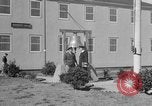
Officers collected from ground, Naval and Air Force work collectively at the National War College, Washington DC.
The Joint Operations Staff College at Norfolk, Virginia. Seminars conducted at the National War College and the Industrial College of the Armed Forces. Officers collected from ground, Naval and Air Force work collectively. Officers examine globe, read books and attend medical service classes. Officers enter into building. Officers play pool (billiards). Door Sign reads 'Student Committee Room'. Officers seated in a round table conference. Officers attend the War College in Washington DC. Civilian and Army officers meet each other at school. Officers attend classes at the Industrial College of Armed Forces. Officers examine a chart in room. Officers in a aircraft factory examine aircraft being assembled. Officers observe workers assembling a truck. Officers confer in a library with books on nearby shelves. Officers eat together in dining facilities and play handball. Military caps of different services on a hat rack. Massive columns of US Army soldiers and military vehicles, artillery, tanks, and tank destroyers parade on a street (possibly New York City) possibly at end of World War 2 or near that time. Military bomber aircraft in flight in formation overhead. The United States and British flags fluttering side by side in a breeze.

Radio reporter John Charles Daly reports on U.S. Navy in Pacific Front War under command of Admiral Nimitz (WW2)
(Audio only). Radio reporter John Charles Daly reports on U.S. Navy operations in Pacific Front War under command of Admiral Chester W Nimitz in World War II. News about bombardment of Okinawa and attack on Japan by U.S. troops. New York weather report and news about Easter celebrations. News about war in Italy.
CRITICALPAST.COM: About Us | Contact Us | FAQs - How to Order | License Agreement | My Account | My Lightboxes | Shopping Cart | Advanced Search | Featured Collections | Website Terms & Conditions | Privacy Policy ©2026 CriticalPast LLC.
License Agreement |
Terms & Conditions |
Privacy Policy
©2026 CriticalPast LLC.