


 Francais
 Deutsch
 Italiano
Refine Your Search
Greek-Civil-War stock footage and images
- Showing 2119 to 2124 of 27482 results more
more Hide
Hide
General Yamashita on trial for war crimes during the Battle of Manila in Manila, Philippines (WW2)
General Tomoyuki Yamashita stands for trial in Manila, Philippines. Former Japanese Commander General Yamashita charged for several war crimes in World War II. Filipino spectators are searched before entering the court. General Yamashita in the court. American and Japanese flag on stage. Dignitaries on stage. Major General Russel Burton Reynolds opens the session. A Filipino woman swears an oath as a witness. Army prosecutor brings witnesses. A 10-year-old Filipina girl testifies that she was bayoneted in the arm and the back. Filipino businessman Francisco Lopez talks about the crimes done by the Japanese forces during the Battle of Manila.
German and Italian prisoners play volleyball and soccer at a camp in the United States during World War II.
German and Italian Prisoners of War during World War 2 in the United States at a U.S. operated POW camp. The prisoners play games in the camp. Prisoners play volley ball. Other prisoners play soccer. Prisoners seated on bench watch them play.
Comyns Carr questions Mrs. Yasuko Konoye and General T. Taylor reads his summation during War Crimes Trials in Tokyo.
War Crimes Trials in Tokyo, Japan, for Japanese defendants after World War 2. Other officials and judges in the courtroom. Mrs. Yasuko Konoye, a new witness is sworn in. British prosecutor Comyns Carr asks Mrs. Konoye to identify herself and reads her statement. As Mr. Carr stops reading his statement, Mr. Brooks and Mr. Logan make objections to the document being presented. General Telford Taylor reads his summation.
Amphibious landings of the Allied troops in Normandy on D Day during World War II.
The role and contribution of the U.S. Army Signal Corps in combat and war. Allied troops including Signal Corps soldiers advance inland after the Normandy landings on D Day during World War II. Soldeirs rest after establishing the Normandy beachhead. A bridge across the channel. Trucks pass over it. Ships anchored off shore. Soldiers keep a watch. A harbor destroyed due to a winter storm. Landing chips and crafts anchored along the shoreline. A barrage in flight overhead. Supplies and reinforcements on the beachhead. Damage caused due to the storm. Allied soldiers around crafts and equipment on the shore.
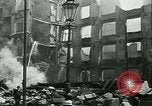
British response to Nazi air raids in Battle of Britain, and use of American radar in the European Theater during World War II.
The role and contribution of the U.S. Army Signal Corps in combat and war. Opening scenes show bomb damage due to German Luftwaffe blitzkrieg air raids (The Blitz) in Southern Counties of London earlier during Battle of Britain in World War 2. Firemen and rescue workers try to extinguish the fires with water hoses. The rescue workers conduct operations amidst bomb damaged buildings and rubble. Severely damaged buildings. Rubble strewn all over the streets in England. A Food Flying Squad van makes its way on the streets. Food distributed from the van. A British man walks amidst the rubble. Relief work in progress. Buckets of food and water lying at camps. Displaced civilian people eat and drink. London civilian residents evacuate numerous areas. Evacuees walk across a bridge. Big Ben seen in the background. Allied bombers in flight. Royal Air Force de Havilland Mosquito aircraft track and shoot down enemy aircraft. The dogfights result in mid air explosions. Two soldiers operate a U.S. radar designed to direct antiaircraft fire in combat area. The radar tracks a target moving up to 600 miles an hour. The soldiers track down aerial targets, the gun directors make adjustments and the antiaircraft guns are fired at buzz bombs. Enemy V-1 Flying bombs are hit and downed before they can reach the coastline. German V-1 rockets are tracked over England by radar and shot down. An V-1 is hit. It descends to the ground and explodes. France: A downed V-1 flying bomb is examined. The wreckage of a V-1 in a field. Soldiers and civilians near the wrecked V-1 Flying Bomb
The U.S. Army Signal Corps Signal Intelligence work during World War II.
The role and contribution of the U.S. Army Signal Corps in combat during World War 2. Soldiers on guard duty in a field. A soldiers talks over a radio receiver at the door of a cabin. An antenna on the cabin roof. Signal Officers intercept enemy transmission by the mean of radio and other electric equipment. Electrical equipment, radios, deciphering equipment, laboratory equipment and parts seen at work in Signal Corps facilities where intercepted enemy communications are analyzed and codes and ciphers are deciphered. Officers skilled in encryption and decryption work to decode enemy codes and messages. They use a microscope to read and write messages in microscopic writing on grains of rice. Signal Intelligence work in North Africa during World War 2. U.S. soldiers on tanks advance over rough terrain. A formation of U.S. B-17 bomber aircraft in flight. Tanks advance with the ground forces. The radio intercept picked up messages from a certain German Division headquarters. A soldier sets radio direction finders on the particular location. Officers receive the information and locate the headquarters on a map. The Allied troops attack the enemy. They hit them with tracers. Artillery and guns are fired. Smoke from fire due to explosions. Soldiers advance in prone positions. They lie low during the night assaults. German soldiers load and fire a mortar. Explosions in a field due to mortar attack. Dead U.S. soldiers and injured U.S. soldiers in foxholes and on the battlefield following mortar attacks. U.S. soldiers help a fellow wounded soldier in a jungle setting.
CRITICALPAST.COM: About Us | Contact Us | FAQs - How to Order | License Agreement | My Account | My Lightboxes | Shopping Cart | Advanced Search | Featured Collections | Website Terms & Conditions | Privacy Policy ©2026 CriticalPast LLC.
License Agreement |
Terms & Conditions |
Privacy Policy
©2026 CriticalPast LLC.