


 Francais
 Deutsch
 Italiano
Refine Your Search
Greek-Civil-War stock footage and images
- Showing 2125 to 2130 of 27482 results more
more Hide
Hide
Army Signal Corps receive and send messages via various methods in World War II; Pentagon signal center operations.
The role and contribution of the U.S. Army Signal Corps in combat during World War 2. Submarine cables laid down by the Signal Corps. Soldiers operate field army communication equipment for communication within and between units. Soldiers talk over the radio in a military jeep. American soldiers employ communication equipment seated at a table in a camp. A U.S. Army Signal Officer goes through documents. An officer receives a message in Washington DC. The message is relayed from the State Department to the Signal Center in the Pentagon building. Exterior views of the Pentagon building circa 1943 or 1944. Inside the Army Communications Signal Center in the Pentagon, technicians work using various communication equipment. They receive messages punched on tape as the tapes emerge from machines. Workers encoding and decoding secret and confidential messages that run the war. Workers at the 'Traffic Control, Army Command and Administrative System'. Paper messages seen gliding across a track near the ceiling above a signboard. A man inserts and removes cables from switchboard slots. The plans are then passed on in code through a maze of antennas all over the world. An animated map depicts the sending of these messages by radio multi-channels, radio teletypes, and manual radios to the front lines. A vast network of Army communication system from Washington DC to the rest of the world to carry a message around the world in three and a half minutes.
British officials meet in England as Adolf Hitler prepares his troops in Germany during World War II.
The first phase of German assault on France and the Low Countries during World War II. Animated maps illustrate Czechoslovakia and Poland defenses against Germany, and the East Prussian Corridor. Civilians including children flee war violence. German troops and tanks parade. England: UK Prime Minister Neville Chamberlain addresses a gathering. Britain's Foreign Secretary Lord Halifax (Edward Fredrick Lindley Wood, 1st Earl of Halifax), Winston Churchill, Leon Blum, and other officials. Germany: Hitler arrives at the Reichstag in Berlin. He addresses the Nazi officers and officials. A sign for the custom border district at Kreis. Bullet ridden walls and bomb damaged buildings. German troops load and fire artillery. German Panzer tank units invade Poland in 1939. Hitler looks through an artillery periscope. Black smoke rises due to numerous explosions.
The Battle of Netherlands and the invasion of Belgium by the Germans during World War II.
The first phase of German assault on France and the Low Countries during World War II. An animated map depicts the German campaign to capture Liege (Luttich) and Fort Eben-Emael in Belgium. German troops invade Holland. Soldiers in trucks. Germans cross the Meuse (Maas) in boats. A collapsed bridge over the river. Armed German soldiers on bicycles cycle through a village. Soldiers drag a boat on the road. The Germans capture Fort Eben-Emael using flamethrowers. Soldiers fire guns during street fights. A soldier wades through shallow water while others cross a field amidst explosions. Bomb explosions and bomb damaged buildings. Soldiers take cover in a field. German troops cross the Albert Canal in Belgium. Troops in boats make their way across. They advance with tanks. Soldiers dig fox holes and eat. Soldiers man tanks and fire artillery. German aircraft bomb Allied positions. Massive explosion at Werk 4 fortification bunker of Fort Eben-Emael. Bomb damaged buildings and ruins. Black smoke arises due to explosions. German soldiers march Belgian and Dutch prisoners of war on a street.
German invasion of Holland and Belgium, and the formal Dutch surrender during World War II.
The German assault on the Netherlands and Belgium during World War II. An animated map depicts the German campaign to capture Liege (Luttich) in Belgium, and Holland. German invasion of Holland and the Dutch surrender. Soldiers in prone position fire guns as they advance in a field. They run across a road, cross the Meuse (Maas) and the Albert Canal in boats. Soldiers come ashore and take cover. Smoke due to explosions. Tanks in a field. Bomb damaged buildings and bridges. Troops advance on tanks. A map of Holland depicts Rotterdam. A bridge in the city. Shops on the streets. Soldiers fire guns. German officers. Troops advance in vehicles over a bridge. Tanks on the streets. German soldiers march Belgian and Dutch prisoners of war. The Church of Saint-Pierre de Jandrain in Orp-Jauche, Wallonia, Belgium. Deserted streets in the city. German officers in cars. An officer greets the soldiers. German officers discuss a map and strategize during a meeting. Soldiers march with their belongings.
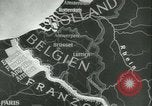
German paratroopers land in Rotterdam and advance during the Battle of Rotterdam in World War II.
The German assault on the Netherlands during the first phase of German assault on France and the Low Countries in World War II. Germany commences Operation Fall Gelb on May 10, 1940. An animated map depicts the movement of the English and French Armies across France towards the Ruhr Area in Germany in response to the German aggression. German Fuhrer Adolf Hitler plans with his Generals and senior officers. An animated map depicts the position and advance of German Army Groups A, B and C towards the French border. German officers discuss over a map. A series of shots of German communication equipment as orders are received, typed, and transmitted by radio operators via morse code, typewriter, switchboard. A soldier leaves with a message on a motorbike. Military vehicles advance towards their positions. German Luftwaffe General Kurt Student accompanied by a Nazi officer greets troops and leaves in a car. German aircraft in flight during the Battle of Rotterdam. The pilot and gunner aboard. German officers and paratroopers seated in the transport aircraft. The paratroopers jump from the aircraft and descend towards the target area of Rotterdam. A map depicts the target area of Rotterdam in Holland. German troops advance on ground. Soldiers on motorbikes and tanks. They uproot barricades, fences and obstructions as they advance. German trucks haul artillery. German troops cross the Rhine in rubber boats and over pontoon bridges. German soldiers stuff grenades into their belts, lay wire, and horses are pushed into water. Street fighting on deserted streets. Medics attend to the wounded. German tank guns fired resulting in explosions. German Junkers Ju 87 or Stuka dive bombers in flight drop bombs over Rotterdam. Tanks are hit. Wounded soldiers helped onto motorbikes. A sign for a field hospital. German Corpsmen care for the wounded. German officers and soldiers during a discussion in the field. Dead French soldiers and wrecked French tanks. French prisoners of war (POW) transferred. Military trucks, antiaircraft guns and jeeps advance.
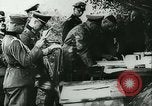
French POWs taken by Germans forces as they close in on Dunkirk during the Battle of France in World War II.
The German assault on France during the Battle of France in World War II. An animated map depicts the German attacks on the Maginot Line and city of Paris. An animated map depicts the positioning and movement of the English and French Armies on one side and the Germans on the other side of the Maginot Line (defensive line) on the French border towards Germany. Germans forces fight through a city as they close in on Dunkirk. German troops load and fire artillery. Black smoke arises due to explosions in the battlefield. A gun barrel as the gun is fired. A German officer gives orders to fire. Soldiers cover their ears with their hands as the guns are fired. French soldiers seen firing artillery at night, in defense. Blazing ruins of city at night, consumed in fire and flames. German tanks advance. Soldiers fight at night. Officers give orders to load and fire artillery. Smoke due to the explosions. Machine guns fired. Burning buildings and wrecked vehicles. German soldiers search French POWs (Prisoners of War). The prisoners seated behind a barbed wire fence at the prison camp. Captured French General Henri Giraud exits a German aircraft. He is met by German officers.
CRITICALPAST.COM: About Us | Contact Us | FAQs - How to Order | License Agreement | My Account | My Lightboxes | Shopping Cart | Advanced Search | Featured Collections | Website Terms & Conditions | Privacy Policy ©2026 CriticalPast LLC.
License Agreement |
Terms & Conditions |
Privacy Policy
©2026 CriticalPast LLC.