


 Francais
 Deutsch
 Italiano

Refine Your Search
Greek-Civil-War stock footage and images
- Showing 2611 to 2616 of 27581 results more
 Hide
Color Sound
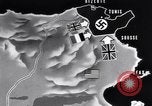
Allied Forces defeat Axis forces in Tunisia during World War II
The final battle of Tunisia, North Africa during World War 2. An animated map shows Allied Forces moving on all sides pressing forward against German forces still remaining in Northern Tunisia. in World War 2. Map outlines battles of Hill 609, Longstop Hill, Goubellat Plain, and Dejebel Mansour, and Takrouna. U.S. forces move 200 miles from the south to confront German forces in the north. Views of U.S. soldiers in trucks and M3 half-tracks, and towing heavy artillery with a tractor. Views of hills where Germans are positioned, west of Tunis and Bizerte. Allied guns firing. French forces sweeping for mines and digging some up with bayonets. French General Alphonse Juin confers with his staff as they review a large map laid out on a jeep. Brief view of French infantry in the field and gunners firing artillery. German Panzer IV tanks moving to counter British attacks. German tanks and artillery firing barrages against the British. Camera pans over destroyed German armor. British 78th Division attacks Longstop Hill. A long line of British infantry moving single file up a hillside. British soldiers firing Vickers machine guns from protected positions and infantry moving uphill, carrying small arms and Bren light machine guns. British troops scaling steep hills, using ropes, as shells burst close to them. One throws a hand grenade that explodes on the hilltop. After reaching the hilltop, the infantry scamper down the other side and continue moving forward, firing their weapons. Several dead German soldiers are seen as the British troops overrun the German positions. British engineers and pioneers working with caterpillar tractors and shovels to build roads. Later, trucks are seen using a new road. In the meantime U.S. troops are seen arriving to commence their assault on Hill 609. It begins with long range artillery firing from camouflaged positions and shells exploding all over on Hill 609. It continues into the night. View of soldiers in artillery headquarters, under a tent illuminated by lanterns. Long sequence of nighttime artillery fire. Medical Corps doctors treating wounded as the nighttime artillery barrages continue. U.S. infantry digging in after taking Hill 609. View of American soldiers walking up Hill 609. View of British Field Marshal Bernard Montgomery consulting with staff officers in the field. British 8th Army commander, Lieutenant General Sir Oliver William Hargreaves Leese, looking through binoculars as he stands with staff members at the front. Scene shifts to U.S. airmen arming machine guns on a parked P-38 fighter plane. Others roughly handling bombs to be placed into U.S. bombers. Bomber with nose art of devil riding a bomb and name "Hell a Poppin." Air crews arrive by jeeps at their B-25 Mitchell bombers and others arrive at their B-17 bombers. View of B-25 number 41-13202 named "Idaho Lassie" of the 321st BG, 445th BS, 12th Air Force. Engines running on bombers and on a British spitfire fighter plane. Formations of Allied aircraft, including B-24 liberator bombers, Martin B-26 Marauder bombers, British spitfire fighters, and B-17 Flying fortress bombers. British and American armor moving forward firing guns. French artillery firing and French infantry advancing. French machine gunners in white hats. U.S. B-24 Liberator aircraft dropping bombs. German fighter planes attacking allied bomber formations. Gunners in the bombers firing at them. Gun camera view of German fighter being shot down. More views of Allied aircraft bombing and strafing. Map shows American forces reaching Bizerte, the British capturing Tunis and German forces split and defeated.

Activities of American troops on the Italian Front during World War II.
The U.S. Fifth Army in Italy during World War 2. Heavy rains slow advance of American forces. Soldier rides on hood of a jeep as Army vehicles make their way along flooded roads in Italy. A truck pulls a jeep back onto the road after it slid into a gully. Views of rivers that have become roaring torrrents. A pontoon bridge being destroyed by heavy currents. American troops assisting one who was injured in the floods. Infantrymen digging mud without much success until they get help from a construction caterpillar tractor with a large blade. A Red Cross worker struggles through the mud to carry a box filled with donuts for the troops. A carries the box, for her as she struggles to continue slogging through the muddy field. Lieutenant General Mark Clark, Commander of the Fifth Army, is seen eating one of the donuts, while standing in front of a tent, as the Red Cross worker also hands one to a Captain standing nearby. Red Cross worker passes donuts to other soldiers. Glimpse of a Roman Catholic mass being conducted by an Army Chaplain. Nearby, a camouflaged 155mm long tom gun fires at German positions on Mount Camino. American soldiers loading the gun. Other American soldiers watching the gun firing, from a somewhat sheltered position. Explosion is seen in distance from direct hit atop Mount Camino. American forces moving about during their own artillery barrages and firing mortars and bazookas. American wounded being brought on stretchers to a field hospital set up near the battle front. Doctors and medical corpsmen attend to patients in tent treatment areas. One carries supplies of blood plasma. A patient being given a transfusion. Women drawing water from a well in sight of the hospital. American infantry advancing through a gulley. A Truck carries American troops cautiously into an Italian village. German prisoners of war, under guard by American soldiers, wade through a stream on their way to the rear. Ambulances and jeeps gather near a medical reception area in a village, where wounded soldiers are brought on litters. Glimpse of local Italian civilians mingling with American soldiers.

Churchill addresses people and expresses the need to prevent any further wars at Westminster College in Fulton, Missouri.
Winston Churchill, the Prime Minister of United Kingdom, delivers a speech at the Westminster College in Fulton, Missouri. In these speech excerpts, Churchill talks about the situation in Europe and delivers his famed Iron Curtain reference. He talks about the two world wars and the need to prevent any further wars. U.S. President Harry S. Truman and other dignitaries sit behind him on the stage. The audience applauds.
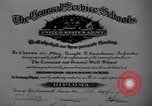
The military career of General Dwight D Eisenhower from 1926 to World War II
Film starts showing Dwight D. Eisenhower's diploma as honor graduate of the Army Command and Staff School, in 1926. Image of Major Eisenhower (in civilian clothes) Narrator says he was assigned to France, to prepare a guide book on American battlefields in Europe. Image of Eisenhower as a member of General Douglas MacArthur's staff in the Philippines, where MacArthur was Commander-in-Chief of the Philippine army. Glimpse of headquarters building there. MacArthur in his office helping the Commonwealth of Philippines work out a plan for its military defense. Image of Lieutenant Colonel Eisenhower in 1939, serving as Executive Officer of the 15th Regiment, at Fort Lewis, Washington, View of the Regiment's Headquarters building. Scene shifts to 1940, showing German forces invading Holland and Belgium. German tanks are seen in action. German Junkers 87 Stuka dive bombers and Heinkel 111 bombers drop bombs. After passing of the Selective Service draft act, President Franklin D. Roosevelt is seen at a public ceremony on October 29, 1940, where Secretary of War Henry L. Stimson drew from a bowl the capsule containing the first draft number of World War 2. Views of Lt. Col. Eisenhower as Chief of Staff of the Army 3rd Division and later as Chief of Staff of the Ninth Corps. Next, he is seen as Chief of Staff to General Walter Kreuger, who in 1941 led the Third Army in the most realistic maneuvers held by American troops (The Louisiana maneuvers). Views of American troops engaged in those maneuvers. Image of Eisenhower as a Brigadier General. Views of the Pearl Harbor bombing during Japanese attack on December 7, 1941.

World War II scenes involving U.S. General George S. Patton, Jr.
World War Two scenes involving U.S. General George S Patton,Jr. The conquest of Sicily in World War 2. Soldiers of the 7th U.S. Army fire artillery. Explosions in the distance. General Patton with a group of soldiers. American troops in the streets of Sicily. The civilians cheer. Patton waves as a military vehicle passes by. Military vehicles and jeeps pass on the streets. Patton with other officers. American soldiers walk past rubble in the street of Sicily. Troops march. Patton with other soldiers behind a donkey cart. General Eisenhower salutes as he reviews the troops. Patton with General Eisenhower. Patton addresses new troops in Great Britain. Patton with soldiers. Soldiers practice fighting. (Narrated by actor Ronald Reagan.)

Royal Air Force (RAF) Boston bombers fly towards Nazi German war plants in occupied Europe and drop bombs (WW2)
Royal Air Force (R.A.F) Boston bombers over occupied Europe during World War II. The bombers strike Nazi German war plants in occupied Europe during low level attacks. Aerial view of explosions on the ground.
CRITICALPAST.COM: About Us | Contact Us | FAQs - How to Order | License Agreement | My Account | My Lightboxes | Shopping Cart | Advanced Search | Featured Collections | Website Terms & Conditions | Privacy Policy ©2026 CriticalPast LLC.
License Agreement |
Terms & Conditions |
Privacy Policy
©2026 CriticalPast LLC.