


 Francais
 Deutsch
 Italiano
Refine Your Search
Greek-Civil-War stock footage and images
- Showing 27055 to 27060 of 27481 results more
more Hide
Hide
United States Artillery officers fire at German positions in Anzio, Italy (WWII)
United States soldiers fire at Nazi positions in Anzio, Italy during the Battle of Anzio (World War II). Artillery officers use binocular to view German positions before a battle. Soldiers stand behind trenches. Another soldier uses the telephone while viewing enemy positions in the battlefield. A Howitzer raises its barrel. Man turns the wheel of a Howitzer. Artillery officers with headphones speaking. The observation officer orders on phone to change the range of firing. Soldiers fire artillery under a canopy. Partially conceal Long Toms and Howitzers continuously fire.
United States troops create a Shanty town made of glider crates in the United Kingdom (WW2)
Bomber towing a glider over an air base in the United Kingdom during World War II. Aerial view of a glider assembly field. Glider crates in assembly field. A soldier stands on the balcony of a “shanty” house made from glider crates. Sign reads “Shanty Town”. Soldiers open a glider crate. Men remove the glider carefully from the crate. Two men take a metal bed frame to the crate. A man stands by the door of a shanty house. “Vine and Hollywood” is written beside the door. Soldiers relaxing inside Shanty houses. Soldier sitting on bunk bed polishes his shoes while another writes letters. A soldier with headset listens to his homemade crystal set radio and reads a magazine. Specially constructed blinds of glider crate tiny house open. Troops lined outside a glider crate barber shop. A sign detailing the rates for a haircut. A barber shop made from scrap. A barber cuts the hair of a soldier inside makeshift barber shop.
United States troops test new aerial and land military weapons (WWII)
The United States Army tests new weapons during World War II. United States Army Air Force bombers drop 100-pound bombs in a huge concentrated salvo over a field. Shells explode simultaneously. A medium bomber drops an aerial torpedo. Anti-personnel bombs burst in the air shortly after being dropped from a flying bomber. Fighter planes diving and dropping auxiliary gasoline tanks used as incendiaries. This is a WW2 example of napalm use. Gasoline tanks explode and burst into flames upon hitting the ground. Artillery officers fire phosphorus shells from mortars. Explosion from phosphorus shells. Soldiers testing flamethrowers on a tank. A group of soldiers use flamethrowers simultaneously, covering the screen with thick smoke and flames.
General Eisenhower inspects a Ninth Air Force Base in England; Allied bombers attack German infrastructure in France (WWII)
Supreme Allied Commander in Europe General Dwight D. Eisenhower inspects a Ninth Air Force Base in England during World War II. General Eisenhower salutes to men. United States soldiers look outside from a window to watch General Eisenhower’s arrival. Brick layers stop working on a wall to salute to General Eisenhower. General Eisenhower speaks with the M-26 Marauder crewmen. General Eisenhower laughing. General Eisenhower sits on in the cockpit of a fighter plane and fires its machine guns. Crowds of crewmen watch Eisenhower inspecting aircraft. An the airfield control tower, General Eisenhower and other officials watch the take-off of B-26 Marauders for a combat mission. B-26 Marauder bombers take off from the airfield. B-26 Marauder bombers form a formation in flight. B-26 Marauder bombers dodge anti-aircraft fire. Bomber with broken windshield window due to anti-aircraft fire damage. Bombs are dropped above a Nazi aerodrome in France. Aerial view of the Nazi aerodrome, railway switch yard bombings in Normandy. B-26 Marauder bombers heading back to England after bombing important military infrastructure in Normandy. A B-26 bomber lands on the runway. British Royal Air Force (RAF) Avro Lancaster bombers take-off from the Ninth Air Force Base at night. Lancaster bombersdrop bombs over German ammunitions dump and stores depot in France at night. Nighttime view of explosions on the ground.
Men unload large incendiary bombs, arming sky markers before storage in bomb dumps (WWII)
Incendiary bomb storage in Allied bomb dumps during World War II. Incendiary bombs are neatly stacked in a bomb dump. A truck backing on the right of the pile. Men unload wooden crates and large incendiary bombs from trucks. Man unloads crates containing 100-pound M47A2 bombs. Men unpack bomb from its wooden protective crate. 500-pound PT-1 Pyrogel-filled AN-M76 bomb is rolled off from the truck. The AN-M76 is also called "Blockburner" or "Goop". Technicians remove the shipping bands off the AN-M76. Truck crane carries an AN-M76 bomb. Stacks of AN-M76 bombs are stacked in the bomb dump. Men carefully place the bomb in the stack. Men flip the crate containing an M17 Aimable Cluster bomb. Men unpacking the M17 500lb Aimable Incendiary Cluster Bomb. Technicians remove the tape and cuts the wires securing the incendiary bomb. A man removes the protective frame of a bomb. The men roll an M17 Aimable Cluster bomb to a stack. Two men stand in front of a shed with a door sign “Bursters”. Man opens a crate, inspects bursters. A Chemical Warfare officer shows a sky marker (made from a converted M47 bomb casing filled with FM smoke producing solution) while other soldiers look on. The Chemical Warfare officer demonstrates the method of arming the sky marker with a modified US 101 fuse. A sky marker is sealed with a rubber washer and a plastic disc. A threaded aluminum fuse adapter and another fuze are inserted. A flange is bolted down. Men marking sky markers prior to storage in bomb dumps. Wooden sign reads “DANGER ACID”.
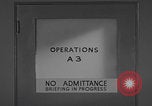
United States Eighth Air Force command headquarters WW2.
United States Eighth Air Force officials deliberate and issue field orders to drop bombs during World War II. Writing on the frosted glass door reads “Operations A3”. A sign in door reads “No Admittance Briefing in Progress”. Daily operations conference headquarters of the Eighth Air Force. The commanding general shares his plan of action. Map of the United Kingdom and Ireland is seen behind the general. The assistant of the commanding general uses a long stick to point to a wall map. Eighth Air Force officials review a map on the desk. An official shows the commanding general a place on the map. The general makes a decision. An officer from the general’s officer makes a call. Men and women using teletype to write field orders and messages. Operational staff of air division headquarters discuss important details regarding the new field order. Operational staff member points to a large wall map. Other officers listen during a meeting. The chemical officer puts down his phone after a call.
CRITICALPAST.COM: About Us | Contact Us | FAQs - How to Order | License Agreement | My Account | My Lightboxes | Shopping Cart | Advanced Search | Featured Collections | Website Terms & Conditions | Privacy Policy ©2026 CriticalPast LLC.
License Agreement |
Terms & Conditions |
Privacy Policy
©2026 CriticalPast LLC.