


 Francais
 Deutsch
 Italiano
Refine Your Search
Greek-Civil-War stock footage and images
- Showing 3205 to 3210 of 27482 results more
more Hide
Hide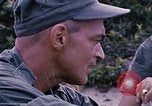
A chaplain approaches the U.S. Marine and speaks to them about their operations in Vietnam during the Vietnam War.
A film report depicts the role of U.S. Navy chaplains during the war in Vietnam. Navy Chaplain, Lieutenant Vincent R. Capodanno, USNR(ChC) is seen sitting on the sand with several U.S. Marines. He smokes a cigarette and talks with one of them about a member of their unit who was severely wounded by a grenade during an enemy ambush. Elsewhere, Chaplain Capodanno is seen talking with other Marines about the war and about their homes and loved ones. He approaches a marine seated on sand bags, who shares news from his personal letter. U.S. Marines in combat gear are seen on a patrol in a Vietnamese village. The chaplain talks to a marine about the operation and his particular assignment. The marine answers his question. A close up of chaplain Capodanno.
Cars carrying litter patients drive towards C-97 Stratofreighter and released Korean War prisoners are taken aboard
Operation Little Switch repatriation effort (first phase of Operation Big Switch), in which released prisoners of war (POW) from the Korean War are taken from Panmunjom, Korea to Japan, and then to the U.S. Cars carrying released sick and injured prisoners in litters drive towards U.S. Air Force Boeing C-97 Stratofreighter parked at Haneda Army Airbase at Haneda Airport in Tokyo, Japan. Ambulance car backs up towards the aircraft. The U.S. soldiers in stretchers are taken aboard C-97 aircraft by U.S. military medical staff. Men stand in the background and under a wing of the aircraft. An Army General stands by.
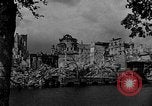
People in the U.S. listen as President Truman speaks during the United States flag raising ceremony in Berlin at end of World War 2
Filmed shortly before the Potsdam Conference in Berlin, Germany. A view of the devastated city of Berlin shortly after the end of World War 2 in Europe. Aerial views of bomb damaged Berlin and point of view shots from a moving car passing destruction, rubble, and skeletons of buildings from bomb damage. U.S. President Harry Truman surveying the damage from an open car, and view of his car approaching the Brandenburg Gate and driving on the Unter den Linden. Three flag towers each decorated at the base with an image of Truman, Stalin, and Churchill. U.S. President Harry S. Truman is riding through Berlin with General Secretary of the Communist Party of the Soviet Union Joseph Stalin and Soviet Foreign Minister Vyacheslav Mikhailovich Molotov. Flashback shows German Fuhrer Adolf Hitler parading in Berlin. People crowd on either side of a street to cheer. Close up back and side profile view of Hitler as he stands in a moving car waving to the crowd. Hitler speaking at a Nazi Rally, forcefully and animated, about Germany wiping out inferior races, and decrying America's society of mixed people, saying that it has a ridiculous notion of equality and freedom that cannot stand up against Germany. The German people in the hall applaud. Truman speaks into a microphone in Germany after the war. U.S. delegates stand in the background. A radio tower. A U.S. military serviceman operating controls for the radio broadcast. People in the U.S. listen to President Truman speaking from a Berlin Radio Station. A hand on a typewriter. People of the United States in groups listening to radio: Men gathered at a city store listening to the radio speech; a woman typist listening to the radio beside her typewriter; men in a rural general store gathered around a radio near a wood stove; farmers listening to a radio; office workers gathered around a radio; a family in a living room listens to the radio; group of U.S. Army soldiers gathered to listen to the radio . Truman speaking on the grounds of the United States Group Control Council Headquarters in Berlin. He is in a courtyard that had been the home of the German Air Defense for Berlin. An honor guard from Company 'E' of the 41st Infantry is present, along with Secretary Stimpson, Assistant Secretary McCloy, and Generals Eisenhower, Patton, Clay, and Bradley. Soldiers stand in formation in the background. He speaks about peace in the world during the ceremony raising the United States flag over the U.S. controlled area of Berlin. His words included the statement, "Let's not forget that we are fighting for peace and for the welfare of mankind. We're not fighting for conquest."
Hideki Tojo in hospital after attempting suicide; war damaged Tokyo, Japanese people reads news bulletins after defeat
Japanese Premier Hideki Tojo attempts suicide in Japan. People walk outside a hospital. A sign board reads' U.S. 98th Evacuation Hospital'. Sergeant John Archinal donates blood to save Hideki Tojo. The doctors perform blood transfusion. A close view of Sergeant John Archinal. The gun from which Tojo shot himself. The troops look out from a window. The doctors treat Tojo in the hospital. A close up view of Tojo. Tojo on a bed in the 98th Field Evacuation Hospital. 1st Lt. Rebecca Schmidt, Hideki Tojo’s nurse, stands by his bedside. A view of the damaged buildings. U.S. Army troops in Tokyo look at the damaged Imperial Diet building 1 Chome-7-1 Nagatachō, Chiyoda City, Tokyo 100-0014, Japan). Flashback scene shows Japanese Emperor Hirohito visiting the damaged city before the surrender in World War II. The emperor looks at a chart on a table. Subordinates and Japanese officials stand in the background. U.S. soldiers read a sign which reads "No Trespassing - The Emperors palace" outside the Imperial Palace. Japanese boys bowing in front of the Imperial Palace. Dismayed Japanese people read news bulletins. A woman distributes a one page newspaper on the street in Tokyo. People crowd outside a movie theater. Japanese people buy movie tickets from a box office booth. A Japanese elderly man walking. Japanese people wait for a tram or trolley or streetcar. They get in the tram. American troops riding inside the tram or streetcar. Admiral William “Bull” Halsey rides a white horse. Admiral Halsey stands beside the horse and smokes. He sits on horseback and rides the horse, having promised that he would ride a horse through the streets of Tokyo after the Japanese defeat in World War 2.
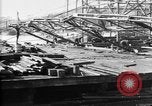
U.S. Army 106th Engineers constructing a warehouse at waterfront in Brest, France during World War I.
U.S. Army 106th Engineers in the Port de Commerce (commercial harbour) of Brest, France during World War 1. This site is adjacent to L'arsenal de Brest (Arsenal of Brest) military and naval installations on the river Penfeld. U.S. Army 106th Engineers are constructing a warehouse in the area of Basin 5. View of Engineers raising a completed section of trusswork for the warehouse, by means of cables. Engineer using power drill on sections of new trusswork being assembled on the ground. German prisoners of war using two-man saw and hammers as they cut and install wooden joists in the construction. The working prisoners are monitored by U.S Army officer. German prisoners excavating at entrance of the building. Wider view of construction site, showing rail cars nearby and construction material everywhere. A barge plying waters of River Penfeld in background, and a variety of vessels tied up in the harbor. A bridge in the backgound. Engineers tending a large steam-driven machine sheltered in a shed.
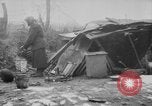
Deplorable living conditions of Russian people and children under Communist rule in the Soviet Union during World War 2
A Nazi German propaganda film shows deplorable living conditions under Communist rule in the Soviet Union during World War II. Half starving Russian men and women in crude huts. Exteriors of a building. Interiors of the building shows barefoot and ragged Russian children smoking cigarettes. A church being converted into an electric powerhouse. A cobbler and a baker at work. Russian prisoners of war march and victorious German troops advance.
CRITICALPAST.COM: About Us | Contact Us | FAQs - How to Order | License Agreement | My Account | My Lightboxes | Shopping Cart | Advanced Search | Featured Collections | Website Terms & Conditions | Privacy Policy ©2026 CriticalPast LLC.
License Agreement |
Terms & Conditions |
Privacy Policy
©2026 CriticalPast LLC.